Botanical species
Oenothera biennis
L.
Common Evening-primrose
Description
Morphological description
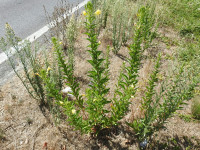
Biennial herbaceous plant, with an erect habit that can reach a height between 30 cm and 2 meters. The stem is generally simple or sparsely branched, sometimes robust, with a swollen and fusiform base; the surface is covered by variable pubescence, consisting of short appressed hairs and longer, curved or spreading hairs, often associated with red-colored papillae.
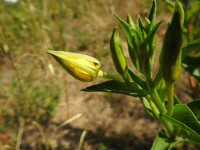
The basal leaves form a basal rosette with an oblong-lanceolate blade, often sinuately pinnatifid or denticulate, with dimensions varying between 8 and 30 cm in length and 1-6 cm in width, with a fairly long petiole. The cauline leaves are lanceolate, from ovate-lanceolate to narrowly lanceolate, subsessile or with very short petioles, with strongly dentate or subentire margins, often lobed at the base; the surface can be glabrous or slightly rough. The leaves are generally green or pale green, with evident venation and the main vein sometimes reddish in adult specimens.
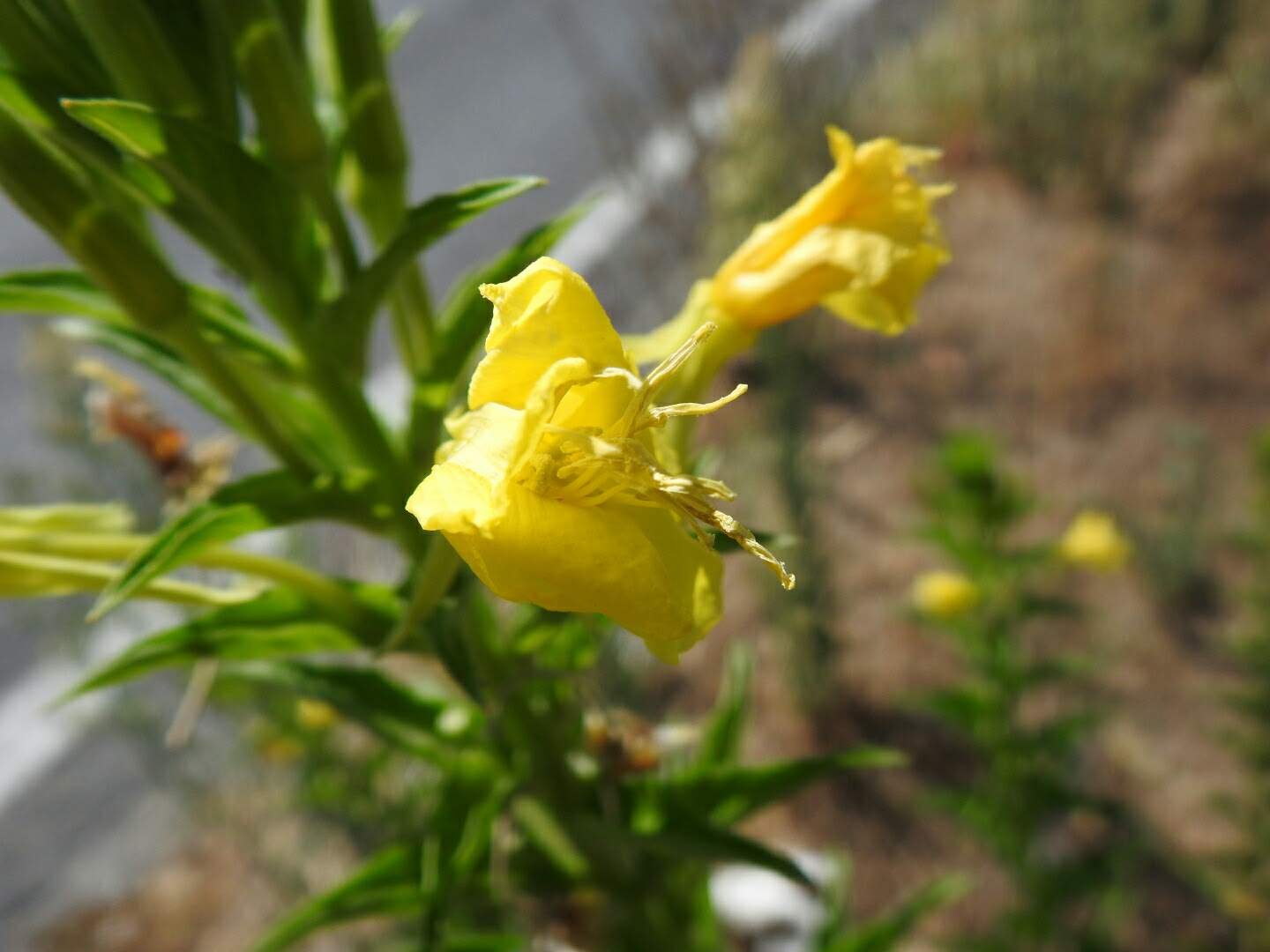
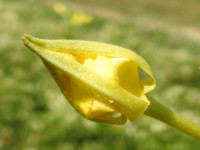
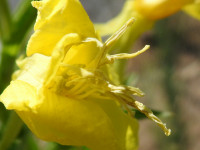
The flowers are arranged in a leafy terminal raceme, usually unbranched, shaped like a dense spike. They are relatively large, with a diameter of 2.4-5 cm, characterized by yellow petals, heart-shaped inverted, which open towards sunset. The petals exceed the stamens, are on average 1.2-3 cm long and bright yellow in color, which can tend to orange with age. The calyx is green, with a tube about 2.5-4 cm long and erect sepals 1.2-2.8 cm long, with free tips from 1.5 to 4 mm. The androecium consists of 8 stamens (4+4), and the gynoecium is composed of an inferior ovary with 4 carpels.
The fruit is a cylindrical capsule, 1.4 to 4 cm long, sessile or nearly so, erect and sometimes velvety or pubescent, containing seeds arranged in two rows per locule. The seeds are dark brown or black, about 1.1-2 mm long, with an irregularly dotted surface.
The root system, typical of biennial species, consists of an elongated and fleshy main root, traditionally used as food in some cultures.
Habitat and distribution
Native to North America, this species is now naturalized in much of Europe, including Italy, and in the Mediterranean area, where it is found in anthropized and open environments. It prefers disturbed habitats such as uncultivated lands, sandy areas, roadsides, and waste grounds, often with well-drained and moderately fertile soils. It grows from the plains up to modest hill and mountain elevations, generally up to about 1,000 meters above sea level.
In Italy it is widespread throughout almost the entire territory, more frequently in the central-northern regions and in the more temperate Mediterranean areas. The species tolerates sunny exposures and open environments well, showing a preference for sandy or gravelly soils.
Flowering period
Flowering mainly extends from June to September, with some geographic variations that can slightly anticipate or delay flower appearance depending on local climatic conditions. The flowers open at sunset, a characteristic that favors particular nocturnal or crepuscular pollinating insects.
Ecology and pollination
The species exploits a reproductive strategy well adapted to its open and disturbed habitats. The evening opening of the flowers and their bright yellow color are a strategy to attract pollinating insects active at dusk or during the night, such as moths and other nocturnal pollinators. Pollination is therefore insect-mediated, with reproductive efficiency also supported by autogamy, as the plant is self-compatible.
Seed dispersal mainly occurs by falling near the mother plant, but seeds can also be transported by animals or abiotic agents, contributing to the spread of the species in disturbed and open environments.
Curiosities and traditional uses
This plant was introduced to Europe around the 17th century, probably from Virginia, and cultivated since 1612 at the Botanical Garden of Padua. Its Italian common name, Common Evening-primrose, is less widespread compared to onagra, a term more frequently used for species of the genus.
The Common Evening-primrose has an interesting ethnobotanical value: the roots and leaves are edible and have been used in some traditional cultures both as food and for medicinal properties. The fleshy roots, in particular, can be consumed raw or cooked and have been employed as a popular remedy for digestive or inflammatory disorders. Young leaves can also be used in salads or as a vegetable.
In folklore, some traditions attribute beneficial properties to the plant related to skin health and the nervous system, although such uses are not universally recognized or supported by modern science.
Etymology
The scientific name derives from Greek: "Oenothera" probably from "oinos" (wine) and "ther" (hunter), although the exact origin is uncertain and subject to interpretations. The Italian name "enagra" probably derives from medieval Latin or from ancient popular denominations linked to the plant and its uses, while "onagra" is a more common term for plants of the genus, often also used in scientific language.
Sources
- Prof. S. Pignatti, Flora d'Italia
- Tela Botanica / H. Coste, Flore descriptive et illustrée de la France
- World Flora Online (WFO)
Characteristics
Scheda botanica
| Famiglia | Onagraceae |
|---|---|
| Fioritura | maggio – settembre |
| Forma biologica | Biennials |
| Habitat | with yellow flowers |
Domande frequenti
- Quando fiorisce Common Evening-primrose?
- Common Evening-primrose fiorisce maggio – settembre.
- Che tipo di pianta è Common Evening-primrose?
- Common Evening-primrose è una Hemicryptophytes (Biennials) secondo la classificazione di Raunkiaer.
- A quale famiglia appartiene Common Evening-primrose?
- Common Evening-primrose appartiene alla famiglia botanica Onagraceae.
Where I found it (17 sightings)
Classification
- Kingdom
- Plantae
- Family
- Onagraceae
- Full name
- Oenothera biennis L.
- Synonyms
- Brunyera biennis (L.) Bubani; Onagra biennis (L.) Scop.
- Life form
- Hemicryptophytes biennials
Similar species
Search for species with similar characteristicsNoticed an error in the identification? Write to me
Other species of the same family
Onagraceae
Explore
Other species of Onagraceae