Botanical species
Chamaenerion dodonaei
(Vill.) Schur ex Fuss
Rosemary-leaved Willowherb
Description
Morphological description
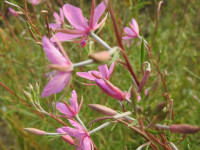
Perennial herbaceous plant belonging to the Onagraceae family, it has an erect and branched habit that can reach a height of up to 150 cm. The stem is cylindrical, ascending-branched, densely leafy and characterized by a hirsute, tomentose and hairy surface, giving the plant a rather woolly appearance.
The leaves are alternate, sessile and linear in shape, about 4 cm long. They have an entire margin, sometimes slightly dentate, with margins slightly turned upwards. The texture is herbaceous, rigid and the leaves appear green on both sides, without evident lateral veins. The shape and arrangement of the leaves somewhat resemble those of rosemary, from which one of the species' synonyms derives.
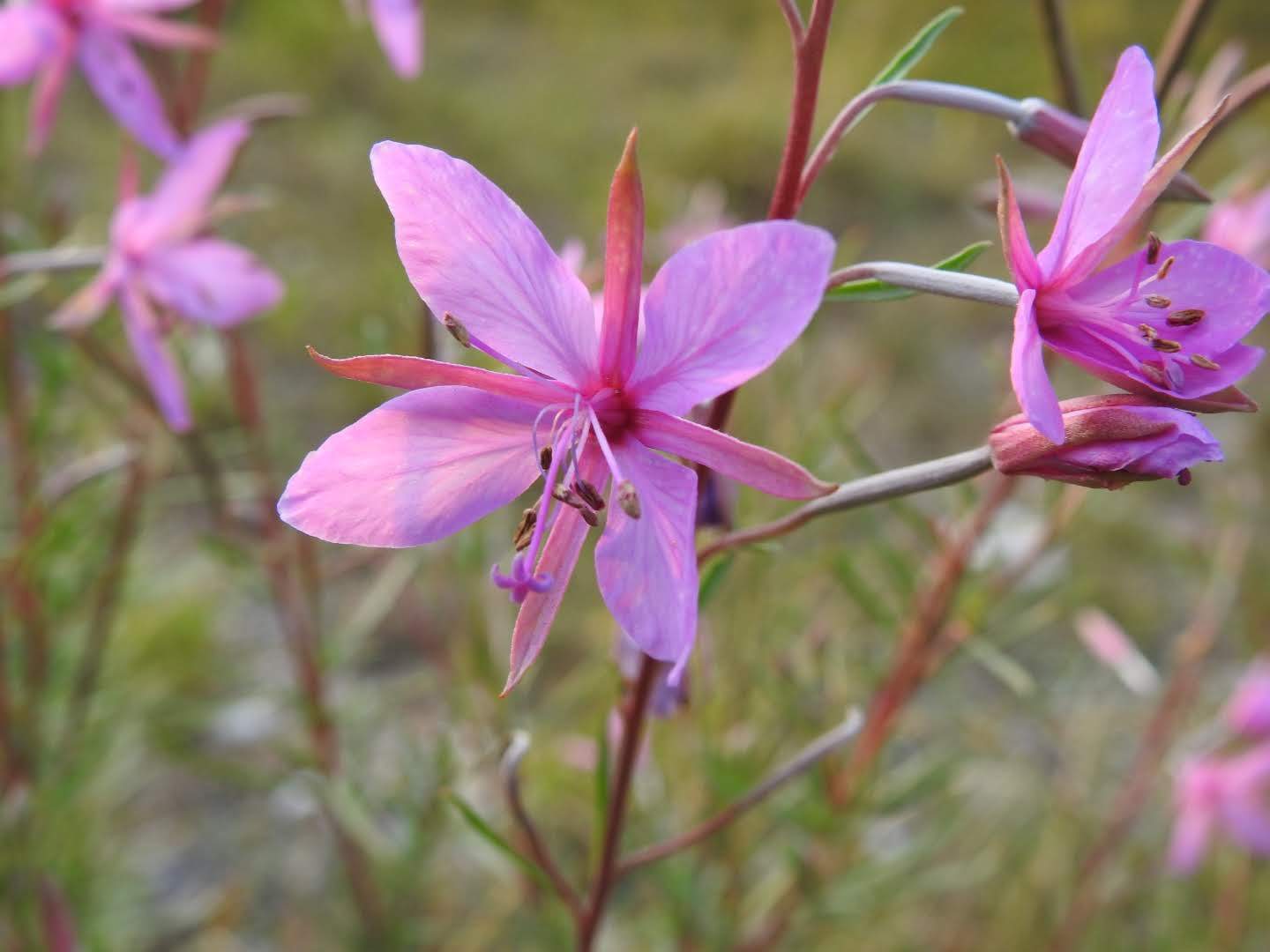
The flowers, pink in color, are grouped in long, erect racemose inflorescences located at the apex of the stems. Each raceme can host 5 to 10 flowers, each relatively large, with a diameter of 2-3 cm. The petals are four, spreading, obovate and of unequal size. The calyx is wine-red in color, without a tube, with four spreading sepals. There are four stigmas and eight stamens, while the style is pendulous and velvety in the lower half, about as long as the stamens. The flowers are borne on long peduncles alternating among the leaves.
The fruit is a long and narrow loculicidal capsule, containing numerous seeds provided with a tuft of hairs at the apex that facilitates anemochorous dispersal (transport by wind).
The root system is not described in detail in the sources, but as a mountain and perennial plant, it is presumed to have robust roots well anchored to the substrate.
Habitat and distribution
This species has a predominantly orophilous distribution in Southern Europe, extending from the mountain ranges of the Iberian Peninsula, through the Alps and up to the Balkans, with probable presence also in Anatolia and the Caucasus. In Italy, it typically grows in mountainous environments, on loose soils, slopes, gravel, riverbeds and open calcareous areas.
Its growth altitude can reach up to about 1700 meters above sea level. It prefers sunny exposures and well-drained soils, often in ruderal or subalpine environments.
Flowering period
Flowering extends from May to September, with possible variation related to altitude and latitude. In colder climates or high mountains, flowering may be concentrated in the central summer months, while in lower or milder areas it can start as early as May and continue until early autumn.
Ecology and pollination
The species relies on pollinating insects, including probably bees, bumblebees and other typical pollinators of mountain environments. The flower structure, with spreading petals and well-exposed stamens, facilitates access for pollinating insects.
Seed dispersal is favored by the capsule which, once mature, opens releasing seeds equipped with a tuft of hairs, an adaptation useful for aerial transport, allowing colonization of new loose or gravelly environments typical of its habitat.
Curiosities and traditional uses
No specific information is available on ethnobotanical, medicinal or food uses for this species in the consulted sources. However, the common name “Rosemary-leaved Willowherb” and the botanical tradition linked to this genus suggest a historical interest in the plant, at least for taxonomic and naturalistic purposes.
Etymology
The genus name derives from Greek: "khamái" means “on the ground” or “low”, while "Nerium" indicates oleander, from which the name intends to indicate a plant “similar to a small oleander”. The specific epithet dodonaei is a tribute to Rembert Dodoens (1517-1585), a famous Dutch botanist and professor at Leiden, author of an important illustrated flora.
The Italian common name “Garofanino di Dodonaeus” precisely recalls this link with Dodoens and the resemblance of the flowers to those of the carnation, although the plant is not closely related to carnations.
Sources
- Acta Plantarum - Flora delle regioni italiane (scheda di Giuliano Salvai)
Characteristics
Scheda botanica
| Famiglia | Onagraceae |
|---|---|
| Fioritura | maggio – settembre |
| Forma biologica | Fruticose |
| Habitat | with pink flowers, Perennial plant |
Domande frequenti
- Quando fiorisce Rosemary-leaved Willowherb?
- Rosemary-leaved Willowherb fiorisce maggio – settembre.
- Che tipo di pianta è Rosemary-leaved Willowherb?
- Rosemary-leaved Willowherb è una Chamaephyte (Fruticose) secondo la classificazione di Raunkiaer.
- A quale famiglia appartiene Rosemary-leaved Willowherb?
- Rosemary-leaved Willowherb appartiene alla famiglia botanica Onagraceae.
Where I found it (7 sightings)
Classification
- Kingdom
- Plantae
- Family
- Onagraceae
- Full name
- Chamaenerion dodonaei (Vill.) Schur ex Fuss
- Synonyms
- Chamaenerion rosmarinifolium (Haenke) Moench; Chamaerion dodonaei (Vill.) Holub; Epilobium dodonaei Vill.; Epilobium rosmarinifolium Haenke
- Life form
- Chamaephyte fruticose
Similar species
Search for species with similar characteristicsNoticed an error in the identification? Write to me
Other species of the same family
Onagraceae
Explore
Other species of Onagraceae