Botanical species
Epilobium hirsutum
L.
Great Willowherb
Description
Morphological description
Perennial herbaceous plant, Epilobium hirsutum is characterized by an erect habit, with height varying from 50 cm up to 2.5 meters. The stem is robust, often branched in the upper part, and has a typically quadrangular cross-section at the base, while becoming more rounded at the top. The surface of the stem is densely covered with long, spreading hairs, sometimes mixed with smaller glandular hairs, giving it a hairy and velvety appearance.
The leaves are arranged mostly oppositely on the lower parts of the stem, while above they alternate and assume a semi-clasping position, partially embracing the stem. They are lanceolate or ovate-lanceolate, measuring between 1.5-2 cm in width and 4-12 cm in length, with an irregularly serrated margin and an acute apex directed forward. The leaf surface is slightly velvety, covered with simple and glandular hairs, with well-visible secondary veins.
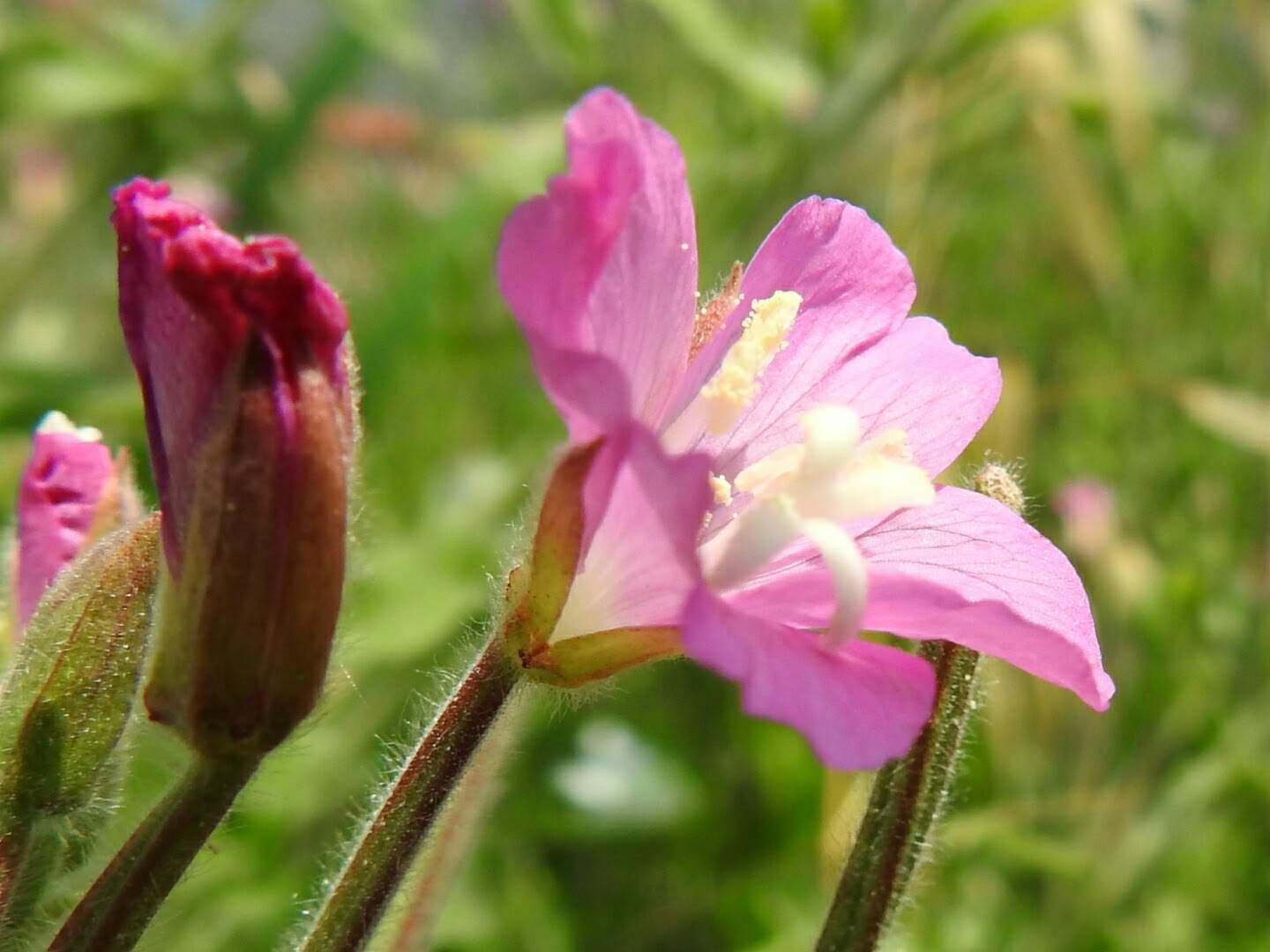
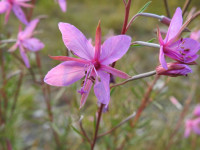
The inflorescence consists of wide and loose clusters, composed of 8-20 hermaphroditic, erect, and pedunculated flowers. The flowers are relatively large, with bilobed petals measuring from 6 to 20 mm long and 6-15 mm wide, of intense purplish pink color, often described as fuchsia. The sepals, green and mucronate, measure about 6-10 mm in length. The stamens are eight, erect, while the stigma is deeply divided into four lobes arranged in a cross, initially erect and later curved.
The fruit is a linear and pubescent capsule, which can reach lengths between 5 and 10 cm. The seeds are small (about 1 mm), oblong-obovoid, with a papillose surface and equipped with a tuft of woolly hairs (coma) 5-7 mm long, which facilitates anemochorous dispersal. The root system includes a stoloniferous rhizome, often superficial, allowing the plant to expand horizontally and survive adverse conditions.
Habitat and distribution
Epilobium hirsutum is a common and widely distributed species throughout the Italian territory and the Mediterranean basin. It prefers humid and cool environments, such as ditch edges, marshes, reed beds, riverbanks, ponds, and generally wet places. It develops on soils of various types, provided they are sufficiently moist, and can grow from the plains up to about 1700 meters of altitude.
In Italy it is present in all regions, from plains to hilly and mountainous areas, showing good adaptability. In the Mediterranean and much of Europe, it is mainly found in riparian and wet habitats, but is also present in other areas with similar conditions. The plant prefers sunny or partially shaded exposures, where soil moisture is constant.
Flowering period
Flowering generally extends from July to September, with some local variation related to climate and altitude. In more temperate and humid climates, flowering can begin as early as June, while at altitude or in cooler conditions it extends until September. The flowers are fragrant and last several days, favoring the attraction of pollinating insects.
Ecology and pollination
The species is an important melliferous resource for various insects, including bees and butterflies, which visit the flowers to collect nectar and pollen. The flower structure, with erect stamens and protruding stigma, facilitates entomophilous pollination. The plant reproduces both sexually, through seeds dispersed by the woolly coma and wind, and vegetatively through the stoloniferous rhizome.
Adaptation to wet habitats and the rhizomatous root system allow it to rapidly colonize marginal areas of water bodies and river courses, contributing to soil stabilization and the ecological balance of aquatic and marsh plant communities.
Curiosities and traditional uses
Epilobium hirsutum is known in popular tradition for its medicinal properties. Historically it has been used as an astringent and emmenagogue, and more recently preliminary studies have highlighted potential uses for prostate problems and in the prevention of certain viral infections. For external use, the plant has been employed to treat dermatitis, mouth inflammations, pharyngitis, and superficial wounds.
The hairy tufts of the seeds, although not having succeeded in replacing cotton, have been used to make wicks for lanterns, exploiting their slow combustion capacity. It is also a valuable melliferous plant, contributing to the production of quality honey.
It is important to emphasize that traditional medicinal uses are for informational purposes only and do not replace official medical treatments.
Etymology
The scientific name derives from Greek: "epi" means "above" and "lobos" indicates "lobe", referring to the position of the petals above the ovary. The specific epithet "hirsutum" recalls the plant's hairy characteristic, particularly evident on the stem and leaves.
The Italian common name "epilobio maggiore" highlights the relatively large size of the flowers compared to other species of the genus, while "garofanino d’acqua" refers to the flower color similarity with that of the carnation and its typically aquatic habitat.
Sources
- Prof. S. Pignatti, "Flora d'Italia"
- Acta Plantarum - Flora delle regioni italiane (scheda di Giuliano Salvai)
- Tela Botanica / H. Coste, "Flore descriptive et illustrée de la France"
- World Flora Online (WFO)
Characteristics
Where I found it (4 sightings)
Classification
- Kingdom
- Plantae
- Family
- Onagraceae
- Full name
- Epilobium hirsutum L.
- Life form
- Emicriptofite scapose
Similar species
Search for species with similar characteristicsFurther reading
Noticed an error in the identification? Write to me
Other species of the same family
Onagraceae
Explore
Other species of Onagraceae