Botanical family
Onagraceae
Description
Botanical characteristics
The plants belonging to the family Onagraceae are predominantly herbaceous, with some rare shrubs and occasionally tree species. They are typical of humid environments and often have stolons that allow rapid vegetative spread. The leaves are generally opposite, but in some species they can be spiral; they are simple and lanceolate in shape, without stipules.
The flowers are hermaphroditic and generally actinomorphic, sometimes weakly zygomorphic. They have a pentacyclic structure, but typically are 4-merous, with 4 sepals and 4 distinct petals. The stamens are eight, arranged in two whorls. The ovary is inferior, formed by four carpels, a distinctive characteristic of this family. The flowers are pollinated by insects, mainly diptera and hymenoptera, with evolved entomogamous mechanisms.
The fruits vary depending on the genus, but often appear as capsules or berries. The seeds are small and in some genera, such as Epilobium, are equipped with fine hairs that favor anemochorous dispersal (transport by wind).
Distribution and diversity
The family Onagraceae has a cosmopolitan distribution, present on all continents except the Antarctic regions. It includes about 660 species divided into 21 genera, ranging from herbaceous plants to shrubs and occasionally trees, adapted to various habitats but with a preference for humid environments.
Main genera and representative species
Among the best known and most important genera of Onagraceae are:
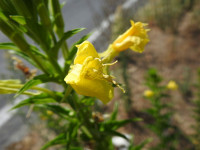
- Oenothera: central genus of the family, includes herbaceous species with often yellow or pink flowers, known for their decorative effect and some medicinal properties. In Italy, several species of Oenothera are present as spontaneous or naturalized plants.
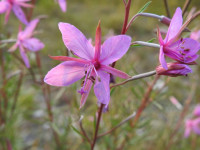
- Epilobium: a widespread genus easily recognizable by small flowers and winged seeds with silky hairs. Species such as Epilobium angustifolium are common in many temperate areas.
- Fuchsia: genus of shrubs native to South America, known for its very decorative pendulous flowers, mainly used as ornamental plants.
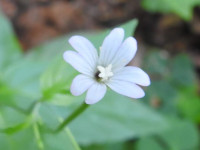
- Circaea: genus of small herbaceous plants with less showy flowers, typical of temperate understories.
- Ludwigia: includes aquatic or marsh species, important for their ecological role in wet environments.
- Other relevant genera include Camissonia, Clarkia, and Gayophytum, especially in America.
In Italy, species of Oenothera and Epilobium are more common, found both in natural environments and disturbed areas.
Etymology
The family name derives from the genus Onagra, now included in the genus Oenothera. The term "Onagra" was introduced in 1754 by the Scottish botanist Philip Miller. The etymology of the name is ancient and probably refers to the traditional use of some species of Oenothera as medicinal plants or for other purposes.
Curiosities and uses
The Onagraceae play an important ecological role, especially in wet areas where some species contribute to soil stabilization and provide habitat for pollinating insects. Some species of Oenothera are used in phytotherapy, while Fuchsia is widely cultivated as an ornamental plant thanks to its showy flowers.
Sources
- Wikipedia
Species of the family
4 species catalogued
Explore
Other botanical families