Botanical species
Hypericum richeri
Vill.
Alpine St John's-wort
Description
Morphological description
Perennial herbaceous plant, glabrous and robust, with erect or ascending stems reaching a height between 20 and 60 cm. The base of the stem is woody, while the upper part, which supports the inflorescence, is undivided and unbranched. The stem has a cylindrical section and sometimes presents two pronounced ribs in the upper part.
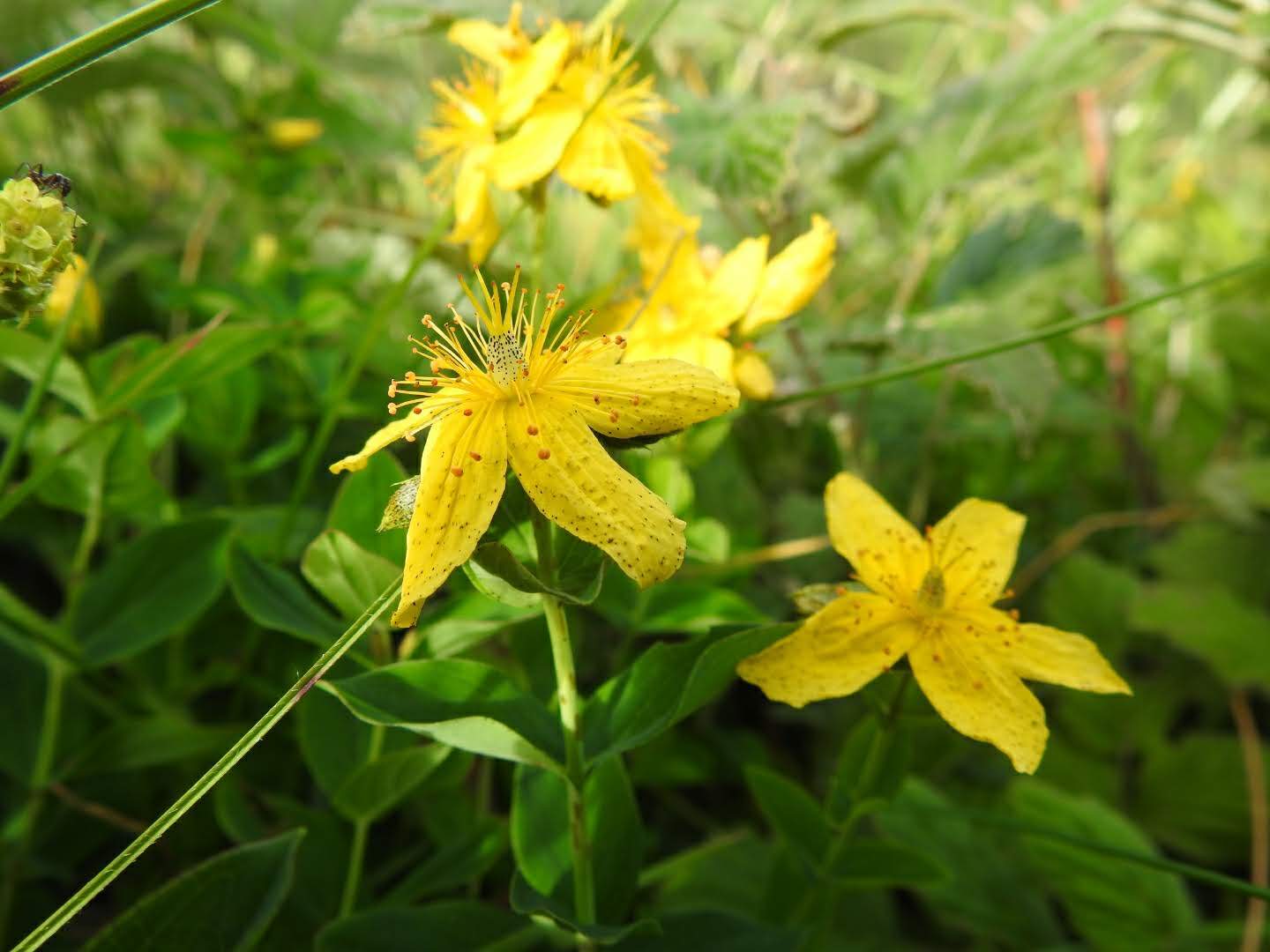
The leaves are opposite, sessile, lanceolate to ovate-lanceolate in shape, with sizes varying between 2 and 4 cm in length and 1-1.5 cm in width. They are characterized by entire margins and bordered by small black oil glands, visible to the naked eye. The lower surface shows prominent veins and a well-marked reticulate network. The leaves are generally longer than the internodal interval of the stem, almost completely wrapping it, a distinctive feature compared to similar species such as Hypericum montanum.
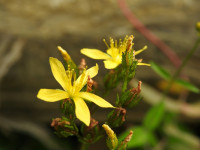
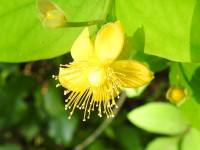
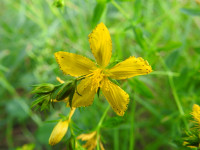
The inflorescence consists of dense cymes located at the apex of the floral scape, formed by few to numerous showy flowers. The flowers are hermaphroditic, with five elliptical petals of bright yellow color, 2.5 to 3 cm long, dotted with black oil glands. The sepals are lanceolate, acuminate, 6-8 mm long and bordered by thin fringes up to 1.5 mm long, also equipped with black glands. The petals are 2-3 times longer than the calyx. Numerous stamens are grouped in bundles and the ovary is superior.
The fruit is a conical or broadly ovoid septicidal capsule, 6-12 mm long, also dotted with black glands. The seeds are cylindrical, slightly curved, equipped with a small apical membranous wing and present a longitudinally grooved surface, with dimensions of about 0.6 x 1-1.5 mm.
The root system, not described in detail in the sources, is presumably composed of secondary roots developed from a woody base.
Habitat and distribution
This species is typical of mountainous and subalpine environments of southeastern and central Europe, mainly present in the mountain ranges of Southern Europe, from the Iberian Peninsula to the Alps and the Balkans, with a possible extension towards the Caucasus and Anatolia. In Italy it is reported in the Alps and in the northern and eastern mountainous areas, although it is not very frequent.
It prefers habitats such as mountain pastures, meadows, heathlands and areas with megaforb vegetation, on calcareous or rocky soils, often on slopes and in sunny or semi-shaded exposed areas. The altitudinal range generally extends from 1000 to 2350 meters above sea level.
Flowering period
Flowering occurs between June and August, with a peak around the summer solstice, when the plant reaches the maximum development of the flowering tops. Seasonal variations are mainly related to altitude and latitude, with earlier or prolonged flowering in more southern areas or at lower altitudes.
Ecology and pollination
The species is a scapose hemicryptophyte, with buds at ground level from which leafless floral scapes develop. The showy yellow flowers, with petals dotted with black glands, attract various pollinating insects, particularly bees and other hymenopteran pollinators, which facilitate entomogamous pollination.
The septicidal capsule containing seeds equipped with a membranous wing suggests a primary anemochorous dispersal, i.e. wind-facilitated, which can contribute to effective seed distribution in pastures and open mountain environments.
Curiosities and traditional uses
The Italian common name, "Alpine St John's-wort", recalls the flowering period around June 24th, St John's feast, traditionally associated with plants with medicinal and ritual properties. The species name honors Dominique Richer de Belleval, French botanist and founder of the Montpellier Botanical Garden.
This species is recognized as medicinal and the flowering tops are harvested at peak flowering to extract active principles. It contains essential oil (caryophyllene), flavonoids and hypericin, a molecule known for its antidepressant and antiviral properties. Traditionally, St John's wort oil (also called "red oil" or "St John's oil") has been used externally as a healing and soothing agent for burns, wounds and ulcers, and orally for gastric disorders such as gastritis and ulcers.
These uses fit into a broader herbal tradition linked to the genus Hypericum, highly valued in European folk medicine. It is important to note that therapeutic indications should be considered for informational purposes only and do not replace medical advice.
Etymology
The genus name, Hypericum, derives from the Greek "hyper" (above) and "eikon" (image or figure), probably referring to the ancient custom of decorating sacred images with these flowers during the Walpurgisnacht festival, later replaced in popular tradition by St John's feast.
The specific name "richeri" was dedicated to Dominique Richer de Belleval (1564-1632), French botanist who founded the Montpellier botanical garden and contributed important botanical engravings.
The Italian common name recalls the tradition linked to St John's feast and the dedication to Richer de Belleval, underlining the historical and cultural importance of the species.
Sources
- Prof. S. Pignatti, "Flora d'Italia"
- Acta Plantarum - Flora delle regioni italiane (sheet by Mirna Medri)
- Tela Botanica / H. Coste, "Flore descriptive et illustrée de la France"
- World Flora Online (WFO)
Characteristics
Scheda botanica
| Famiglia | Hypericaceae |
|---|---|
| Fioritura | giugno – agosto |
| Forma biologica | Scapose |
| Habitat | with yellow flowers, Perennial plant |
| Uso officinale | Pianta officinale |
Domande frequenti
- Quando fiorisce Alpine St John's-wort?
- Alpine St John's-wort fiorisce giugno – agosto.
- Che tipo di pianta è Alpine St John's-wort?
- Alpine St John's-wort è una Hemicryptophytes (Scapose) secondo la classificazione di Raunkiaer.
- A quale famiglia appartiene Alpine St John's-wort?
- Alpine St John's-wort appartiene alla famiglia botanica Hypericaceae.
Where I found it (4 sightings)
Classification
- Kingdom
- Plantae
- Family
- Hypericaceae
- Full name
- Hypericum richeri Vill.
- Life form
- Hemicryptophytes scapose
Similar species
Search for species with similar characteristicsFurther reading
Noticed an error in the identification? Write to me
Other species of the same family
Hypericaceae
Explore
Other species of Hypericaceae