Botanical species
Hypericum montanum
L.
Pale St John's-wort
Description
Morphological description
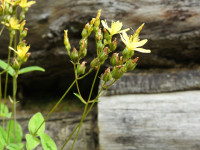
Perennial plant generally 30 to 80 cm tall, Pale St John's-wort has an erect and bushy habit, with robust and glabrous stems, sparsely branched only in the inflorescence area. The stems are round and lack sharp edges, giving the plant a slender but solid appearance. The root system is typical of tufted ericaceous plants, with roots that provide good anchorage to the soil, although sources do not provide a detailed description.
The leaves are arranged oppositely along the stem and have a lanceolate shape, with sizes roughly between 1.5-3 cm in width and 4-6 cm in length. The underside of the leaves is glaucously covered by a slight pubescence or may be rough, sometimes more or less pubescent. They are characterized by smooth margins and an abundant presence of black glands along the edges; the upper leaves may also have translucent glands. The internodes are long, often 2-4 times the length of the corresponding leaf, giving the stem an elongated and airy appearance.
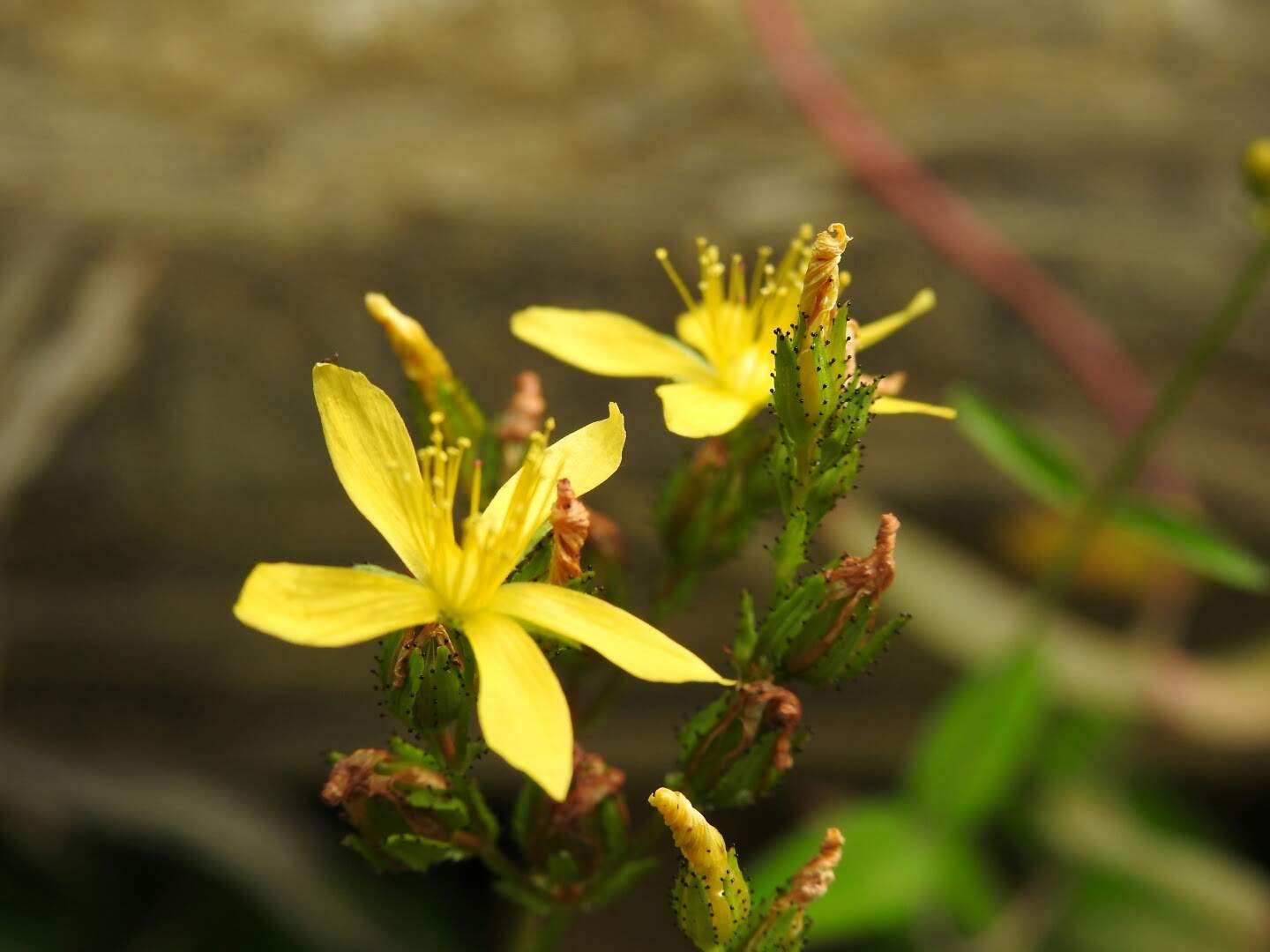
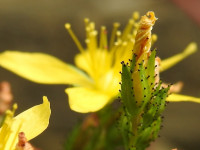
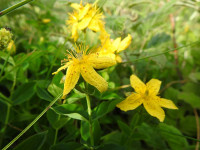
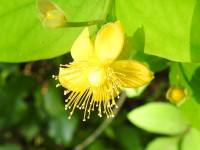
The inflorescence consists of dense and almost glomerulate corymbs, supported by long peduncles, giving a compact but well-defined appearance. The flowers are yellow, with five petals about 9-10 mm wide, lacking black glands. The sepals are five, lanceolate, 1.5-4.5 mm long, with subdentate margins due to cilia about 0.5 mm long, which bear distinctive black glands. The calyx is characterized by 6-8 black subsessile or shortly pedunculate glands along the edge. The flower is medium-sized relative to the plant and has petals about twice as long as the calyx.
The fruit is an ovoid septicidal capsule 6-8 mm long, with evident longitudinal vittae. The seeds are numerous, cylindrical in shape, brown in color, and measure between 0.7 and 0.9 mm. The capsule allows effective seed dispersal, although specific details on the dispersal mechanism are not elaborated in the sources.
Habitat and distribution
This species is mainly distributed in European regions and the Caucasus, with a significant presence in peninsular Italy and Mediterranean mountainous and hilly areas. In Italy it grows mainly in oak and beech woods, preferring forest environments, especially in stages of degradation or secondary succession.
Pale St John's-wort is found from lowlands up to 1800 meters altitude, preferring well-drained soils and exposures ranging from semi-shaded areas to those with greater illumination, typical of forest edges and clearings. It frequents mixed woods and is often found in transitional habitats between closed and open environments.
Flowering period
The flowering period extends through June and July (6-7), corresponding to the temperate summer. No significant variations in phenological calendar related to geographic distribution are reported, although at higher altitudes flowering may shift to later periods due to harsher climatic conditions.
Ecology and pollination
The yellow flowers of Pale St John's-wort are particularly attractive to numerous pollinating insects, including bees, bumblebees, and other hymenopterans, which play a fundamental role in pollination. The flower structure, with broad petals and sepals bearing glands, facilitates access and collection of nectar and pollen.
The plant is a tufted hemicryptophyte, meaning it lives perennially thanks to buds located at ground level, forming dense tufts that facilitate survival in forest environments subject to seasonal variations. Seed dispersal occurs via the septicidal capsule that opens at maturity, releasing numerous light and cylindrical seeds, potentially transported by wind or small animals, although there is no specific information on dispersal agents.
Curiosities and traditional uses
The common name "Pale St John's-wort" recalls popular tradition linked to the period of St John (June 24), historically associated with this plant for its medicinal properties and use in herbal medicine. In general, plants of the genus Hypericum are known for their anti-inflammatory, antiseptic, and antidepressant properties, although Hypericum montanum is less studied compared to the better-known species Hypericum perforatum.
In Mediterranean herbal tradition, related species have been used to prepare infusions and ointments to treat wounds, burns, and nervous disorders. However, for this specific species no documented food uses or particular references in local folklore are recorded.
Etymology
The generic name "Hypericum" derives from the Greek "hyper" (above) and "eikon" (image or figure), with a traditional meaning referring to the use of the plant to ward off images or evil spirits, particularly during the period of St John. Linnaeus proposed an alternative interpretation, associating the name with the presence of image-like spots on the petals.
The specific name "montanum" indicates the ecological preference of the species for mountainous or hilly environments. The Italian common name directly recalls this environmental characteristic and the connection with the feast of St John, which marks the peak flowering period of the plant.
Sources
- Prof. S. Pignatti, "Flora d'Italia"
- Acta Plantarum - Flora delle regioni italiane (scheda di Gianluca Nicolella)
- World Flora Online (WFO)
Characteristics
Scheda botanica
| Famiglia | Hypericaceae |
|---|---|
| Fioritura | giugno – luglio |
| Forma biologica | Tufted |
| Habitat | with yellow flowers, plant with a spreading bushy habit |
Domande frequenti
- Quando fiorisce Pale St John's-wort?
- Pale St John's-wort fiorisce giugno – luglio.
- Che tipo di pianta è Pale St John's-wort?
- Pale St John's-wort è una Hemicryptophytes (Tufted) secondo la classificazione di Raunkiaer.
- A quale famiglia appartiene Pale St John's-wort?
- Pale St John's-wort appartiene alla famiglia botanica Hypericaceae.
Where I found it (3 sightings)
Classification
- Kingdom
- Plantae
- Family
- Hypericaceae
- Full name
- Hypericum montanum L.
- Life form
- Hemicryptophytes tufted
Similar species
Search for species with similar characteristicsNoticed an error in the identification? Write to me
Other species of the same family
Hypericaceae
Explore
Other species of Hypericaceae