Botanical family
Hypericaceae
Description
Botanical characteristics
The plants of the family Hypericaceae are angiosperms belonging to the order Malpighiales. They are mainly shrubs, small trees, or perennial herbs, characterized by a habit ranging from erect to spreading. The leaves are generally simple, opposite or sometimes arranged alternately, and often have translucent glands which, depending on the genus, may be visible and give a dotted or spotted appearance.
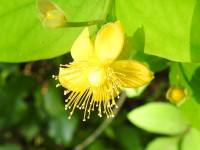
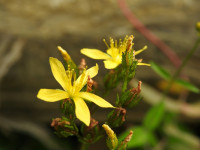
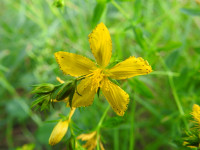
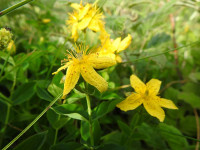
The flowers are generally hermaphroditic, radial, with a calyx made up of free or slightly fused sepals and a corolla composed of five petals, often yellow or golden, sometimes with numerous dark spots or dots. The stamens are numerous and arranged in several whorls, often very showy and an integral part of the ornamental aspect of the flowers. The nectar and pollen from these flowers attract various pollinating insects.
The typical fruit is a capsule that opens to release numerous small seeds, but in some species it may also appear as a drupe or berry. Among the distinctive characters of the family, besides the foliar glands, is the presence of specific chemical compounds, such as hypericins (for example hypericin), known for their pharmacological properties.
Distribution and diversity
The family Hypericaceae has a cosmopolitan distribution, with a prevalence in tropical and subtropical regions worldwide. Some genera also extend into temperate areas, including the Mediterranean region, where the genus Hypericum is present.
Overall, the family includes about 6 main genera and several hundred species. Among the best known and studied genera are Hypericum, Cratoxylum, Harungana, Psorospermum, Vismia, and Eliea. Most species are concentrated in tropical zones, with some species adapted to cooler and temperate climates.
Main genera and representative species
The most important and widely distributed genus is Hypericum, which includes well-known herbaceous and shrubby species, some of which occur spontaneously in the Italian territory and other Mediterranean regions. Among these, some species are particularly famous for their medicinal properties and for their presence in Mediterranean meadows and scrublands.
Other genera such as Cratoxylum and Harungana are more typical of tropical African and Asian areas and less represented in Europe. The genus Vismia is also prevalent in tropical forests, particularly in America.
In Italy, the genus Hypericum is represented by several spontaneous species, some of which are traditionally used in herbal medicine.
Etymology
The name of the family derives from the type genus Hypericum, a name with ancient origins deriving from the Greek “hyper” (above) and “eikon” (image), probably referring to the traditional use of hanging these plants above sacred images for protection, or to the arrangement of the leaves or flowers. The family was formally described with the name Hypericaceae by Jussieu in 1789.
Sources
- Wikipedia
Species of the family
4 species catalogued
Explore
Other botanical families