Botanical species
Hypericum androsaemum
L.
Tutsan
Description
Morphological description
It is a small-sized evergreen shrub, reaching a height between 50 and 100 cm. The stem is lignified at the base, erect or ascending, reddish in color and characterized by the presence of two well-defined longitudinal ridges. The stem surfaces are glabrous and free of black glands.
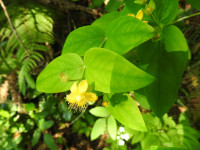
The leaves are opposite, sessile or slightly semi-amplexicaul, ovate in shape and varying in size between 2-5 cm in width and 5-10 cm in length. They have an entire margin, are glabrous on the upper surface and glaucous on the lower one. In the mesophyll, small depressions can be observed due to the presence of translucent glands, not visible to the naked eye. The leaves are persistent, giving the plant an evergreen appearance.
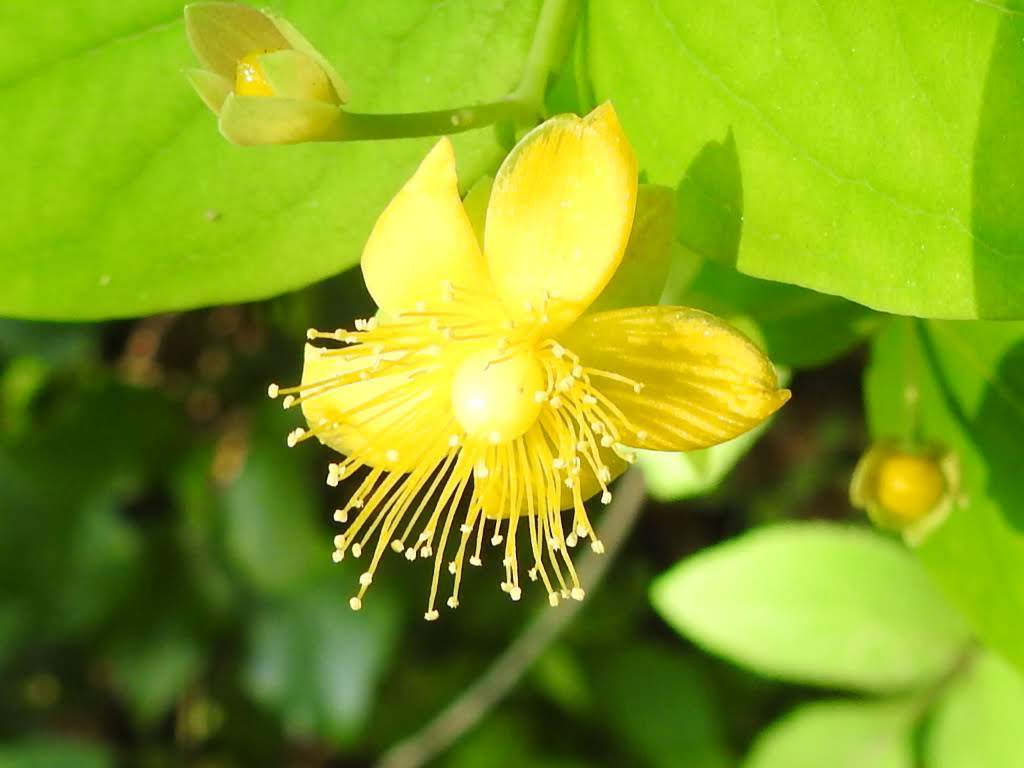
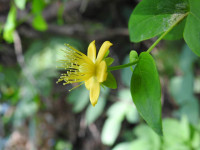
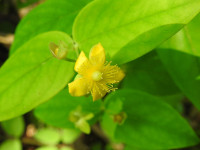
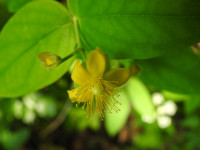
The inflorescence is a corymbose cyme, generally few-flowered, located at the apex of the branches. The flowers have five golden-yellow petals, 6 to 12 mm long, slightly longer than the sepals. The sepals are oval, unequal, 5 to 15 mm long, green in color, persistent even during fruiting and reflexed. The stamens are numerous, grouped in five free bundles connected at the base, protruding beyond the petals. The styles are three, curved outward but shorter than the superior ovary.
The fruit is a fleshy, indehiscent, sub-spherical drupe, surrounded by persistent sepals that expand and become larger up to 8 x 15 mm during maturation. The drupe changes color during development: green-yellow, then reddish and finally black-bluish, measuring about 4-5 x 11-14 mm. Inside are ellipsoid, alveolate and verrucose seeds, brown-black in color, about 1-1.3 mm long.
The root system, typical of Mediterranean shrubby plants, is well developed to anchor the plant and tolerate variable soil conditions, although it prefers moist substrates.
Habitat and distribution
This species is widespread throughout much of the Italian territory, with a greater presence on the islands and the peninsula up to the northern limits of Emilia and Liguria. North of these areas, it appears more frequently as a naturalized plant, often escaped from cultivation. It is also present in the western Euro-Mediterranean and subatlantic range.
It prefers mesophilous and thermophilous woodland environments, with shaded or semi-shaded exposure, often in moist places such as riverbanks or cool areas within forests. It grows on well-drained soils but with sufficient moisture, at altitudes ranging from 0 up to about 1400 meters above sea level.
Flowering period
Flowering extends from May to July, with possible local variations due to different altitude and climatic conditions. In milder climates or lowland areas, it can start as early as May, while in mountainous or northern areas it tends to shift towards June-July.
Ecology and pollination
The flowers, with their showy golden-yellow corolla and prominent stamens, are adapted to attract pollinating insects, particularly bees and other hymenopterans, which facilitate cross-fertilization. The stamen bundles contribute to efficient pollen deposition.
Seed dispersal occurs through the fleshy drupes, which, maturing from red to black-bluish and containing a characteristic reddish juice, attract birds and other frugivorous animals. These contribute to seed dissemination through their feeding and subsequent defecation, promoting colonization of new habitats.
Curiosities and traditional uses
This species, also known by common names such as Tutsan, Shrubby St. John's Wort, or All-heal, has a long tradition in popular and medicinal use. Although it does not have the fame of perforate St. John's Wort, it contains active principles such as hypericin, essential oils, tannins, and vitamin C.
Traditionally, it has been used as a vulnerary and diuretic remedy, as well as to relieve digestive disorders and headaches. In popular phytotherapy, infusions of the plant are used to treat renal colics and migraines. The name "all-heal" derives precisely from its supposed beneficial health properties.
In cosmetics, it is appreciated as a protector of the skin from ultraviolet rays. Furthermore, some research indicates a possible use as a nematotoxic insecticide.
The plant is often cultivated in gardens, where it is valued for its evergreen habit and bright flowers; from here it has spread into the wild especially in northern Italy. Dried leaves are sometimes used as bookmarks, thanks to their mild vanilla scent.
In folklore and biblical tradition, St. John's Wort has sometimes been identified with the "Rose of Sharon," a symbol of love and beauty mentioned in the Song of Songs.
Etymology
The scientific name "Hypericum" probably derives from the Greek "Hypèreikon," a term that could mean "under the heather" or "under the herb" ("ypo" = under, "èreike" = heather), referring to the custom of placing the leaves under food as protection against evil spirits.
The specific epithet "androsaemum" derives from the Greek "androsaimon," meaning "human blood," evoking the bright red color of the juice of the ripe berries.
The Italian common name "Erba di San Giovanni" refers to the traditional harvesting of the plant around June 24th, the feast of St. John, a period when the plant reaches full flowering and was believed to possess particular magical and medicinal virtues.
Sources
- Prof. S. Pignatti, "Flora d'Italia"
- Acta Plantarum - Flora delle regioni italiane (scheda di Nino Messina)
- World Flora Online (WFO)
Characteristics
Scheda botanica
| Famiglia | Hypericaceae |
|---|---|
| Fioritura | maggio – luglio |
| Forma biologica | Nano-Phanerophytes |
| Habitat | with yellow flowers |
| Uso officinale | Pianta officinale |
Domande frequenti
- Quando fiorisce Tutsan?
- Tutsan fiorisce maggio – luglio.
- Che tipo di pianta è Tutsan?
- Tutsan è una Phanerophytes (Nano-Phanerophytes) secondo la classificazione di Raunkiaer.
- A quale famiglia appartiene Tutsan?
- Tutsan appartiene alla famiglia botanica Hypericaceae.
Classification
- Kingdom
- Plantae
- Family
- Hypericaceae
- Full name
- Hypericum androsaemum L.
- Life form
- Phanerophytes nano-phanerophytes
Similar species
Search for species with similar characteristicsNoticed an error in the identification? Write to me
Other species of the same family
Hypericaceae
Explore
Other species of Hypericaceae