Botanical species
Hypericum perforatum
L.
Common St. Johnswort
Description
Morphological description
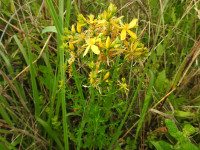
Perennial herbaceous plant, rhizomatous, with glabrous stems that can reach a height of about one meter. The roots develop from a woody rhizome, which allows the plant to overwinter. The stems at the base are prostrate and lignified, with leafless horizontal branches, often slightly reddish in color; the flowering branches are erect and branched, characterized by two longitudinal ridges that give the stem a slightly flattened appearance.
The leaves are arranged oppositely, almost sessile or with short petioles, ovate-lanceolate or sometimes elliptic-oblong in shape, with an obtuse or mucronate apex and a wedge-shaped to rounded base. The leaf surface is dotted with numerous translucent glands, visible in backlight as small holes, and has dark glands on the margin. The margin is entire, the blade is flat and free of significant irregularities.
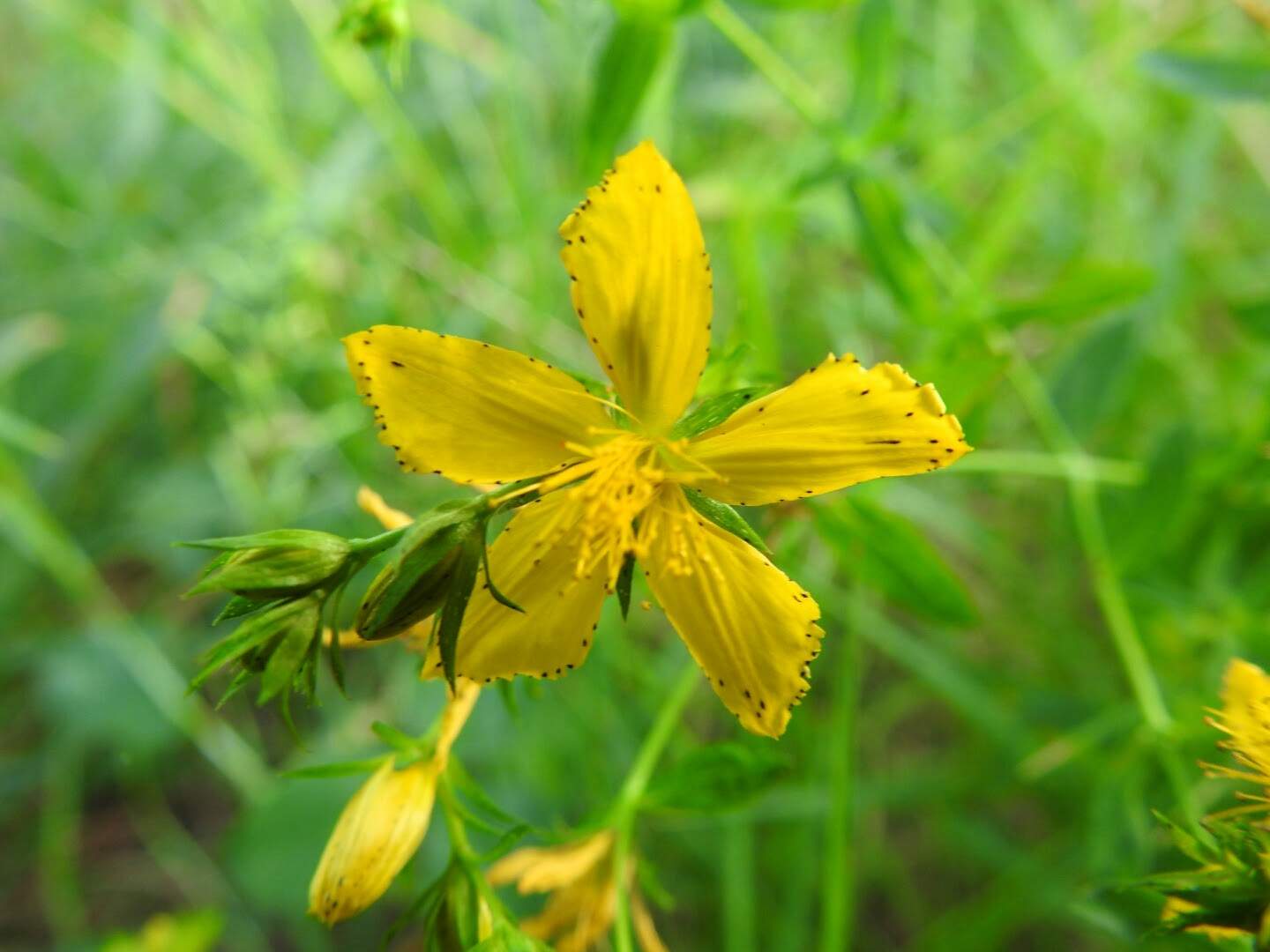
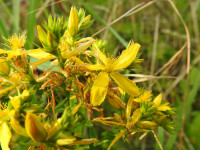
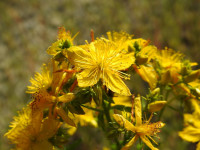
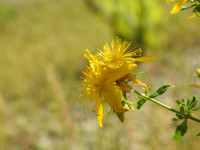
The flowers, of intense golden yellow color, are gathered in terminal corymbose or broadly pyramidal inflorescences, composed of numerous flowers. The diameter of the flowers generally varies between 1.5 and 2.5 cm. Each flower has five lanceolate-acute sepals, entire, with margins dotted with black glands, without cilia. The petals are also five, ovate or oblanceolate in shape, asymmetric and denticulate at the margins, with dark glands scattered along the edge and sometimes glandular lines on the blade (this latter characteristic not present in some populations). The stamens are arranged in three bundles (two pairs plus one single), shorter than the petals.
The fruit is a trilocular capsule, from ovoid to subconical, 5 to 9 mm long, with two longitudinal lines on each valve, decorated with oblong reddish glands arranged obliquely on the sides. The seeds, cylindrical or elliptic-curved, measure about 0.8-1.2 mm, have a reticulated surface and coloration ranging from red to reddish-black.
Habitat and distribution
This species is widely distributed throughout the Italian territory and the Mediterranean, present in all regions and over a wide altitudinal range from sea level up to about 1600 meters altitude. It preferably grows in open and sunny environments such as dry meadows, roadside margins, grassy and uncultivated places, loose and often nutrient-poor soils. It is a species adaptable to different soil types, preferring well-lit exposures and conditions of moderate dryness.
At the European and Mediterranean level, its distribution includes much of Europe, Western Asia, and North Africa, where it is found in similar habitats.
Flowering period
The flowering generally extends from May to September, with variations related to altitude and latitude: in warmer and lowland areas flowering can begin as early as May while in mountainous zones it lasts until the end of summer or early autumn.
Ecology and pollination
Common St. Johnswort is mainly pollinated by pollinating insects, including bees, bumblebees, and other hymenopterans, which are attracted by the very visible golden-yellow flowers rich in nectar. The arrangement of the flowers in corymbs facilitates access for pollinating insects. The plant adopts a reproductive strategy that combines the production of numerous seeds with overwintering through rhizomes, thus ensuring good colonization capacity and persistence over time.
Seed dispersal occurs mainly by falling near the mother plant, but can also be favored by external agents such as wind or animals, although no particularly specialized dispersal modes are known.
Curiosities and traditional uses
Common St. Johnswort, also known as Common St. Johnswort, is one of the most well-known and used medicinal plants since ancient times. Its common name derives from the tradition of harvesting it around the feast of St. John (June 24), a time when the plant was believed to reach its maximum efficacy.
Historically it has been used for its therapeutic properties, particularly as a natural antidepressant, sedative, anxiolytic, astringent, and anti-inflammatory. The oil obtained from the flowers is used in cosmetics to tone the skin and in traditional medicine to massage painful parts or treat wounds. The infusion of Common St. Johnswort is also used to treat couperose and skin redness.
Besides medicinal use, Common St. Johnswort has been employed in the preparation of liqueurs for its aromatic and digestive properties, and the dried stem could be used as a tea substitute.
In European folklore, the plant was considered protective against demons and evil spirits, so much so that bunches of Common St. Johnswort were hung on doors or a small bouquet was placed under the pillow on St. John's night to obtain protection for the following year.
It should be noted, however, that the intake of preparations based on Common St. Johnswort can interfere with various drugs, due to the induction of liver enzymes (cytochrome P450), and therefore it is always advisable to consult a doctor before using it as a remedy.
Etymology
The genus name Hypericum derives from Greek: "yper" means "above" and "eikon" "image", with the ancient belief that the plant drove away shadows and evil spirits. Linnaeus proposed a different interpretation, linking "yper" to "above" and "eicos" to "resemblance", referring to the presence on the petals of spots that look like images or figures. The suffix "-icum" derives from the Greek verb "eiko", which means "to seem" or "to appear similar".
The specific name perforatum refers to the numerous translucent glands present on the leaves, visible in backlight as small holes or perforations.
The Italian common name "erba di San Giovanni" is linked to popular and religious tradition related to the harvesting of the plant near the feast of St. John the Baptist, associated with rituals of protection and healing.
Sources
- Acta Plantarum - Flora delle regioni italiane (actaplantarum.org)
- Acta Plantarum - Scheda di Marinella Zepigi
- Tela Botanica / H. Coste, Flore descriptive et illustrée de la France
- World Flora Online (WFO)
Characteristics
Scheda botanica
| Famiglia | Hypericaceae |
|---|---|
| Fioritura | aprile – settembre |
| Forma biologica | Scapose |
| Habitat | with yellow flowers |
| Uso officinale | Pianta officinale |
Domande frequenti
- Quando fiorisce Common St. Johnswort?
- Common St. Johnswort fiorisce aprile – settembre.
- Che tipo di pianta è Common St. Johnswort?
- Common St. Johnswort è una Hemicryptophytes (Scapose) secondo la classificazione di Raunkiaer.
- A quale famiglia appartiene Common St. Johnswort?
- Common St. Johnswort appartiene alla famiglia botanica Hypericaceae.
Where I found it (9 sightings)
Classification
- Kingdom
- Plantae
- Family
- Hypericaceae
- Full name
- Hypericum perforatum L.
- Life form
- Hemicryptophytes scapose
Similar species
Search for species with similar characteristicsFurther reading
Noticed an error in the identification? Write to me
Other species of the same family
Hypericaceae
Explore
Other species of Hypericaceae