Botanical species
Erythronium dens-canis
L.
Dog's-Tooth-Violet
Description
Morphological description
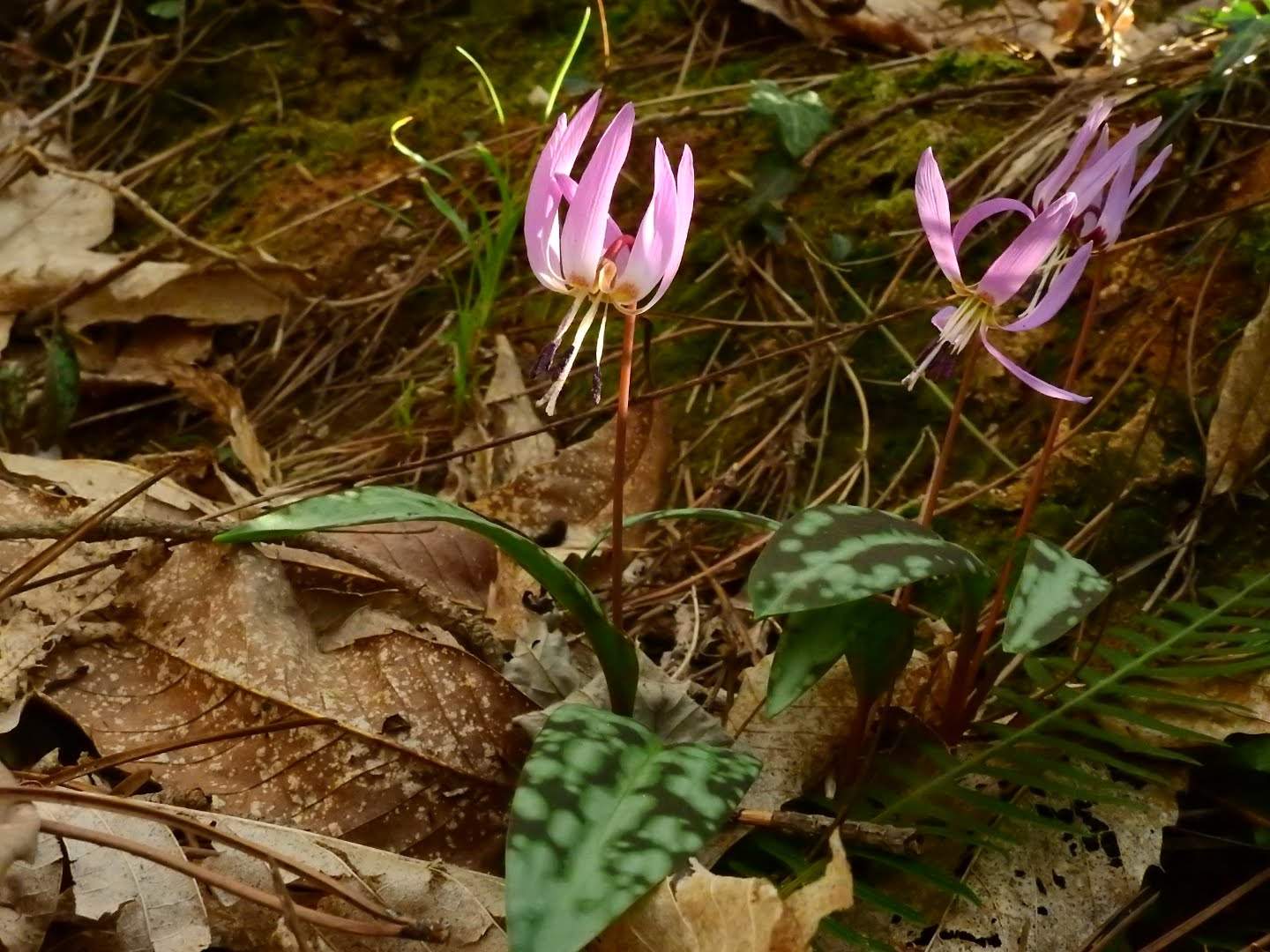
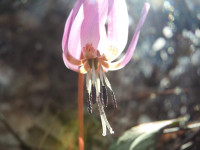
Perennial herbaceous plant equipped with an oblong bulb, shaped like a tooth, covered by a whitish tunic. The floral scape, 10 to 30 cm tall, is slender, reddish in the upper part, and ends with a single pendulous flower, a distinctive characteristic of the species. The plant generally bears two opposite leaves, which are glaucous green with light and wine-colored spots, having a lanceolate-ovate shape with an entire margin. Leaf dimensions range from 4 to 7 cm in length (exceptionally up to 15 cm) and 3 to 4 cm in width; they are petiolate and characterized by spots that tend to lighten with maturity. In sterile plants, only one leaf may be present, more oval and with spots tending to brown.
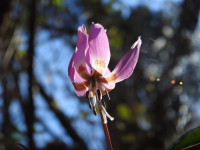
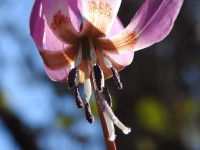
The flower is solitary, borne on a naked and slender stem up to 10 cm long, and has 6 tepals connivent at the base into a tube, which fold strongly backward (reflexed). The corolla varies in color from pink to reddish-violet to white, with the inner part hosting 2 to 4 nectariferous callosities. The anthers are linear, bluish in color, and about 7 mm long; the style is white and of similar height to the stamens (6 in total). The stigma is single and trifid.
The fruit is a trigonal capsule, more or less spherical or ovoid in shape, about 15-20 mm long, enclosing numerous oblong-pyriform seeds, initially smooth and whitish, which become irregularly warty and brownish upon maturation. The seeds are equipped with an elaiosome, a widened and curved structure that facilitates dispersal.
The root system is bulbous, without stolons, with bulbs 20-35 mm long and 7-10 mm wide.
Habitat and distribution
The species is widespread in southern Europe, with a Eurasian range extending from Europe to Japan, also including the arid belt of southern Siberia. In Italy, it mainly grows in central-southern regions and in mountainous environments up to 1300 meters altitude.
It prefers humid broadleaf woodland environments, particularly in understories and along path edges, with moderately acidic soils. It is often found in clearings and glades, where light is sufficient but not direct for long periods, and humidity is constant. The intensity of leaf spots varies depending on exposure: in the understory, spots are more intense and dark, while outdoors they tend to lighten quickly.
Flowering period
Flowering mainly occurs between February and April, with some variations related to altitude and latitude. In warmer and lower areas, flower appearance can be anticipated, while in mountainous zones flowering extends until late spring.
Ecology and pollination
The pendulous flower favors pollination by pollinating insects, probably hymenopterans and dipterans, attracted by the nectar produced by the internal callosities of the flower. The reflexed structure of the tepals facilitates insect access to the reproductive organs.
Seed dispersal is favored by the presence of the elaiosome, which attracts ants and other insects that carry the seeds away from the mother plant, thus contributing to the colonization of new environments.
Leaf spots are probably an ecological adaptation for camouflage, reducing the risk of browsing by herbivores. This characteristic has been the subject of studies analyzing its evolution and variability depending on the habitat.
Curiosities and traditional uses
The plant's bulb, resembling a dog's tooth, is edible and used in some cultures for food purposes. In Japan, for example, the bulbs are used to produce starch employed in the preparation of food pastes; in Mongolia, the leaves are consumed as a vegetable and the bulbs are cooked with reindeer milk.
The genus Erythronium includes numerous species, many of which are appreciated in gardening for their showy flowers, especially those native to North America such as E. americanum and E. californicum.
Despite the food uses, it is important to emphasize that pharmaceutical or medicinal applications are not adequately documented and should be considered with caution.
Etymology
The scientific name derives from the Greek "Erthros", meaning "red", referring to the pink-violet color of the corolla. The specific epithet "dens-canis" indicates the shape of the bulb, which resembles a dog's tooth, from which also derives the common Italian name "Dog's-Tooth-Violet".
Sources
- Acta Plantarum - Flora delle regioni italiane (actaplantarum.org)
- Acta Plantarum - Flora delle regioni italiane (scheda di Nino Messina)
- World Flora Online (WFO)
Characteristics
Where I found it (10 sightings)
Classification
- Kingdom
- Plantae
- Family
- Liliaceae
- Full name
- Erythronium dens-canis L.
- Synonyms
- Erythronium dens-canis L. var. niveum Baumg.; Erythronium niveum (Baumg.) Pînzaru
- Life form
- Geofite bulbose
Similar species
Search for species with similar characteristicsFurther reading
Noticed an error in the identification? Write to me
Other species of the same family
Liliaceae
Explore
Other species of Liliaceae