Botanical species
Lilium bulbiferum
L.
Orange lily
Description
Morphological description
Perennial herbaceous plant belonging to the family Liliaceae, it has a variable height between 40 and 100 cm. The root system consists of a trigonal-shaped bulb, equipped with white and pointed scales, which acts as a perennial organ from which the stem, leaves, and flowers develop each year.
The stem is erect, angular and grooved, with a triangular section, with a puberulous surface and purple spots in the basal part. It is generally leafy and can bear small bulbils at the axil of the upper leaves, a characteristic from which the specific name derives.
The leaves, with herbaceous texture, are arranged alternately along the stem. The basal leaves are ovate-lanceolate, slightly petiolate, while the upper ones become progressively narrower and lanceolate-linear. They have from 5 to 7 parallel veins, with a basal surface that is glabrous or slightly velvety.
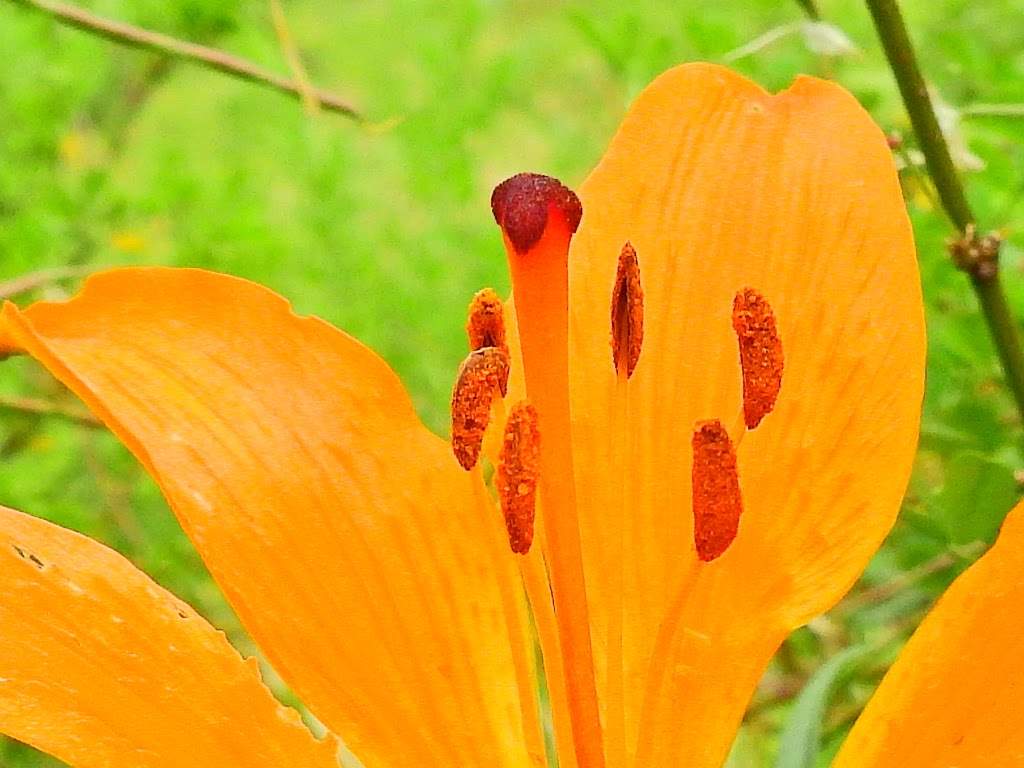
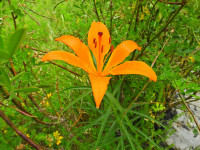
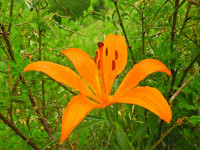
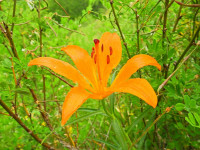
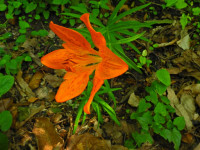
The inflorescence consists of simple few-flowered racemes, bearing from one to five erect flowers, supported by velvety pedicels. The flowers are large, with a campanulate perianth measuring between 8 and 10 cm. The tepals, arranged in two series of three, are bright orange, sometimes tending to yellow or orange-red, frequently spotted with dark brown spots. The outer tepals are elliptic and acuminate, while the inner ones are wider and subspatulate, slightly curved outward forming a wide trichome.
The six stamens are erect, with red-orange filaments and reddish-brown anthers that protrude outside the flower. The ovary is cylindrical, with an orange style slightly longer than the stamens and a violet trilobed stigma.
The fruit is an ovoid capsule with three locules, containing numerous seeds. Maturation occurs between August and September.
Habitat and distribution
The species is typical of the mountainous and submontane regions of south-central Europe, with a distribution that includes the Alps, Jura, Carpathians and, sometimes, more southern mountain ranges. In Italy it is mainly present along the alpine and pre-alpine reliefs, but also at hill altitudes, up to about 2,000 meters above sea level. It can also be found in plain areas, such as in the upper Friulian plain.
It prefers environments with sunny exposure and calcareous soils. It grows along moist and well-lit grassy slopes, in tall herbaceous vegetation, sparse shrublands and open woods. It grows on well-drained soils, often rocky or stony, and can tolerate slightly xerophilous conditions, especially in the presence of rocks or debris.
Flowering period
Flowering mainly occurs in the months of May, June, and July, with local variations related to altitude and climate. In general, in warmer areas flowering can start as early as May, while in the mountains it extends until July.
Ecology and pollination
The flower, with its bright color and open trichome shape, is particularly visible and attractive to pollinating insects. Pollination occurs mainly through insects, which are attracted by the bright orange color and the dark internal spots, which act as visual guides towards the nectar.
The presence of bulbils at the axil of the upper leaves allows a mode of vegetative propagation, while seed dispersal occurs through release from the dehiscent capsule, which opens at maturity to release numerous light seeds, facilitating their dispersal by wind or other agents.
Curiosities and traditional uses
This species, also known as "Orange lily" or "bulbilliferous lily," owes its common name to the flowering that occurs near the feast of St. John (June 24). It is appreciated for its beauty and bright color, but it is vulnerable to excessive collection, so it is protected in many areas.
Traditional food or medicinal uses are not commonly documented; however, like many plants of the family Liliaceae, it is considered inedible and potentially toxic if ingested.
Etymology
The genus name, Lilium, derives from Latin and generally indicates the lily. The specific name bulbiferum means "bearing bulbs" and refers to the bulbils that develop at the axil of the upper leaves or, more generally, to the underground bulb from which the plant regenerates each year.
The Italian common name "Orange lily" recalls both the color of the flower, which tends to orange-red, and the flowering period around the feast of St. John.
Sources
- Acta Plantarum - Flora delle regioni italiane (scheda di Giuliano Salvai)
- World Flora Online (WFO)
Characteristics
Scheda botanica
| Famiglia | Liliaceae |
|---|---|
| Fioritura | maggio – luglio |
| Forma biologica | Bulbous |
| Habitat | with orange-colored flowers, with fragrant flowers |
Domande frequenti
- Quando fiorisce Orange lily?
- Orange lily fiorisce maggio – luglio.
- Che tipo di pianta è Orange lily?
- Orange lily è una Geophytes (Bulbous) secondo la classificazione di Raunkiaer.
- A quale famiglia appartiene Orange lily?
- Orange lily appartiene alla famiglia botanica Liliaceae.
Classification
- Kingdom
- Plantae
- Family
- Liliaceae
- Full name
- Lilium bulbiferum L.
- Synonyms
- Lilium aurantiacum Weston; Lilium bulbiferum L. var. croceum (Chaix) Pers.; Lilium croceum Chaix
- Life form
- Geophytes bulbous
Similar species
Search for species with similar characteristicsNoticed an error in the identification? Write to me
Other species of the same family
Liliaceae
Explore
Other species of Liliaceae