Description
Botanical characteristics
The plants belonging to this family are mainly perennial herbs with a typical habit often bulbous or rhizomatous. The leaves are simple, alternate, and linear in shape with parallel veins, frequently gathered in basal rosettes; in some species, cauline leaves with sheathing attachment are also present.
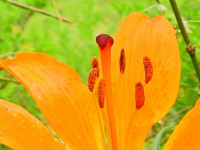
The flowers are generally actinomorphic (radially symmetrical) and hermaphroditic, with a showy and often very conspicuous structure. They appear singly or grouped in inflorescences, borne on solitary or clustered peduncles. Each flower consists of six petaloid tepals arranged in two biseriate rows, separated at the base (dialipetalous). In some genera, such as Scoliopus, the tepals are only three. At the base of the tepals are nectaries, which contribute to attracting pollinators.
The androecium includes six free stamens, while the gynoecium is formed by three fused carpels constituting a superior ovary. The floral formula is indicated as ✶ P3+3 A3+3 G(3). The fruit is typically a capsule; however, in the subfamily Medeoloideae the fruit is a berry.
Pollination occurs mainly through insects (lepidoptera, hymenoptera, diptera), while some tropical species are pollinated by hummingbirds.
Distribution and diversity
The family is widely distributed in the temperate regions of the northern hemisphere, with some occurrences also in tropical areas. It is a relatively ancient group, with an evolution that began about 52 million years ago between the Late Cretaceous and the Paleocene.
The family currently includes, according to modern classification, about forty genera grouped into four subfamilies: Streptopoideae, Calochortoideae, Medeoloideae, and Lilioideae. The total number of species is high, including many ornamental taxa of great importance. However, it should be noted that in the past the family Liliaceae was much broader and included numerous genera now reclassified into other families.
Main genera and representative species
Among the best-known genera of the family are:
- Lilium (lilies), with typical species such as Lilium martagon present in the temperate regions of Europe and Asia;
- Tulipa (tulips), famous for their brightly colored flowers and widely cultivated;
- Fritillaria, recognized for the characteristic bell-shaped flowers, with some wild species in Italy;
- Gagea, a genus of small herbaceous plants often yellow, also widespread in Italy;
- Erythronium, known as wild tulip or trout lily, with elegant flowers and spotted leaves;
- Calochortus and Clintonia, more common in North America but representative of the group's diversity.
In Italy, some species of the genera Lilium, Fritillaria, and Gagea are present, contributing to the spontaneous flora of meadows and temperate woods.
Etymology
The family name derives from the Latin Lilium, a term that in turn comes from the ancient Greek λέιριον (leírion), which indicated the lily. This reflects the importance and recognizability of the species belonging to this group, particularly appreciated for their beauty.
Curiosities and uses
Many species of this family are widely cultivated as ornamental plants thanks to their showy and fragrant flowers, much used both in gardens and in the trade of cut flowers and bulbs. Among these, lilies, tulips, and lily of the valley are among the most known and appreciated worldwide.
Entomogamous pollination carried out by butterflies, bees, and other insects is fundamental for the reproduction of many species, also contributing to the biodiversity of temperate ecosystems.
Sources
- Wikipedia
Species of the family
2 species catalogued

Explore
Other botanical families