Botanical species
Scabiosa columbaria
L.
Small Scabious
Description
Morphological description
Perennial herbaceous plant, scapose, with height varying between 30 and 80 cm, sometimes up to 1.5 m. The stem is erect, cylindrical, branched in the upper part, generally glabrous or with sparse hairs, never velvety. The root system consists of a hardened taproot rhizome, which allows the plant's perenniality.
The leaves show strong heterophylly. The basal leaves, arranged oppositely, are dull, gray-green in color, generally undivided with crenate or dentate margins, but often deeply incised or lyrate. They are covered with short and sparse hairs, denser on the veins and petiole. The cauline leaves are progressively pinnatisect, with lanceolate or linear lobes, tending to be subsessile towards the top of the stem; the lateral segments are narrow, 8 to 16 times longer than wide, with the terminal segment not much wider than these, at most 1.5 times.
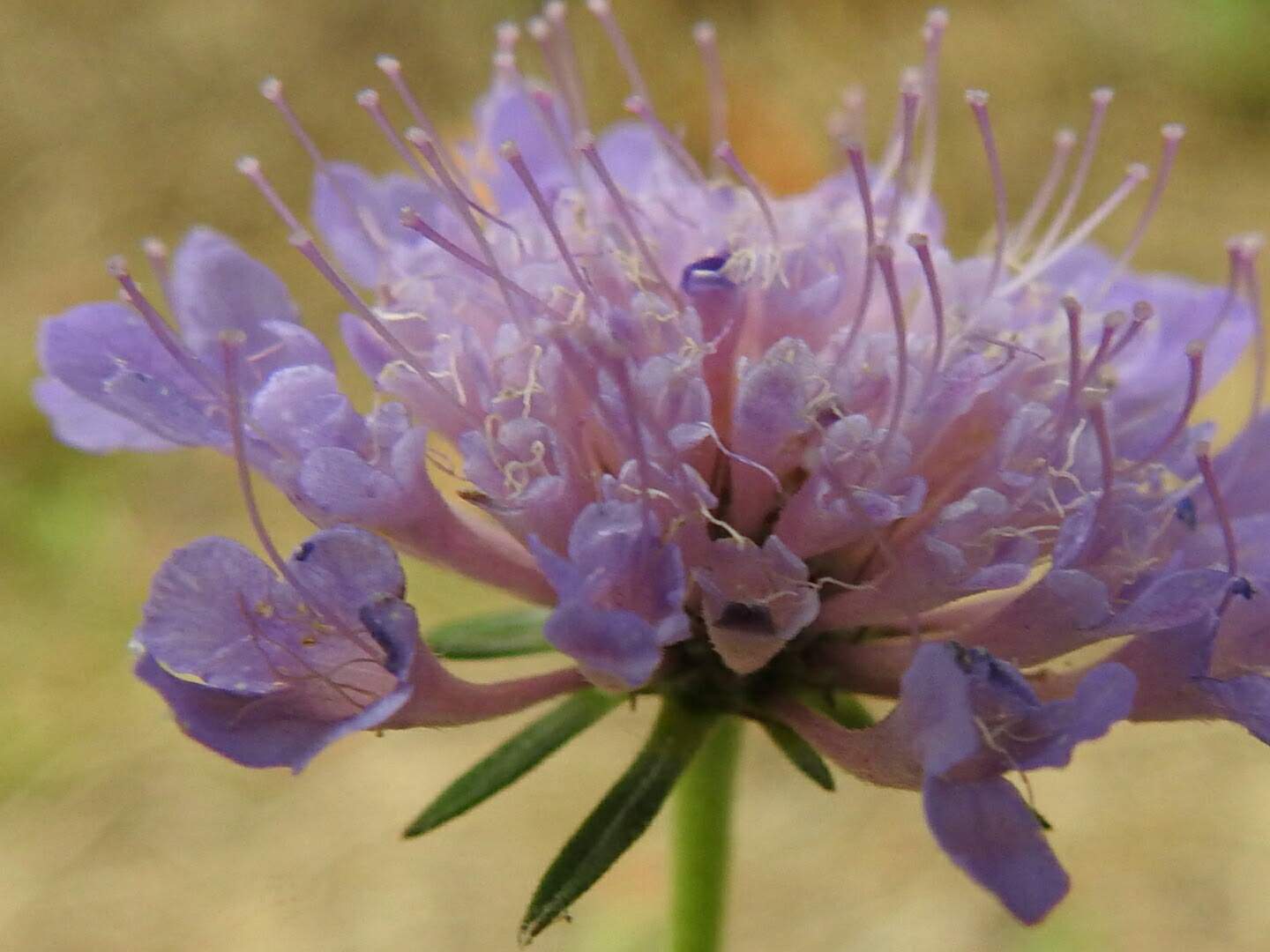
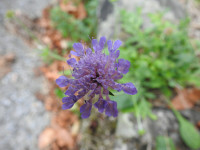
The flowers are gathered in numerous hemispherical or subglobose capitula, with a diameter between 2 and 3.5 cm, placed at the apex of each branch on short peduncles. Each capitulum is composed of numerous hermaphroditic tubular flowers, surrounded by an involucre formed by linear-lanceolate bracts, shorter or equal to the marginal flowers, with pubescent surfaces. The corolla is pink-violet or lilac in color, with five unequal lobes (two upper and three lower); the peripheral, zygomorphic ones are larger and of a more intense shade than the central ones. The androecium includes four stamens inserted in the corolla tube with free anthers. The ovary is bicarpellate, inferior. The calyx is hairy, cup-shaped, with five bristles 1 to 8 mm long, which exceed the membranous crown, which is glabrous and shows a prominent venation.
The fruits are achenes about 2-4 mm, ovoid, deeply longitudinally grooved with eight ciliate-membranous ribs, wrapped by the persistent involucre that presents numerous teeth facilitating anemochorous dispersal (wind transport).
Habitat and distribution
Typically Eurasian species, found from Europe to Japan, also present in North Africa and Western Asia. In Italy it is widely distributed, preferring mountainous and hilly environments up to about 1,500 m altitude. It grows mainly in poor meadows, dry and rocky pastures, steppe areas, along hedges and at forest edges. It favors calcareous, well-drained substrates and sunny or semi-shaded environments, generally facing south or west.
Flowering period
Flowering extends from June to September, with slight geographical variations. In more northern or mountainous regions it can last until October, while in Mediterranean areas it tends to end earlier, coinciding with the arrival of drier summer climates.
Ecology and pollination
The species is a scapose hemicryptophyte, with buds at ground level allowing it to survive unfavorable periods. The flowers are entomophilous, i.e., pollinated by pollinating insects, mainly bees and butterflies attracted by the colorful corolla and the arrangement of flowers in capitula. The flower morphology is adapted to favor entomogamous pollination, with anthers freely inserted in the corolla tube and zygomorphic corolla.
Seed dispersal occurs mainly by wind (anemochory), thanks to the presence of achenes equipped with a membranous crown and bristles that facilitate transport even over moderate distances.
Curiosities and traditional uses
Small Scabious has historically been used in officinal contexts for the properties contained in the rhizome, which includes saponins, starch, and a glucoside called scabiosin. These compounds confer broncho-sedative properties, fluidifying respiratory secretions and sialagogue effects (stimulating saliva production). The decoction prepared with the plant was used for lavages, irrigations, and gargles.
In some areas of northern Italy, such as Biellese, Small Scabious has also been used as an ingredient in spring soups, confirming a traditional alimurgical use.
From an ornamental point of view, the plant is appreciated for its lilac-violet flowers and represents a significant melliferous resource, providing nectar and pollen to various pollinating insect species. Moreover, a blue dye can be obtained from its flowers.
Etymology
The genus name derives from the Latin scabies, meaning “scabies” or “mange,” referring to the traditional officinal properties attributed to the plant for treating skin diseases. The specific epithet columbaria probably refers to the resemblance of the finely divided leaves to bird’s feet (columba = dove) or to the dove-gray color of the flowers.
The Italian common name “vedovina selvatica” probably recalls the delicacy and slender habit of the plant, as well as its presence in mountainous and arid environments, often associated with solitary and silent landscapes.
Sources
- Prof. S. Pignatti, Flora d'Italia
- Acta Plantarum – Flora delle regioni italiane (scheda di Giovanni Buccomino)
- Tela Botanica / H. Coste, Flore descriptive et illustrée de la France
- World Flora Online (WFO)
Characteristics
Scheda botanica
| Famiglia | Dipsacaceae |
|---|---|
| Fioritura | giugno – settembre |
| Forma biologica | Scapose |
| Habitat | with lilac flowers, Perennial plant, plant with a scapose habit |
Domande frequenti
- Quando fiorisce Small Scabious?
- Small Scabious fiorisce giugno – settembre.
- Che tipo di pianta è Small Scabious?
- Small Scabious è una Therophytes (Scapose) secondo la classificazione di Raunkiaer.
- A quale famiglia appartiene Small Scabious?
- Small Scabious appartiene alla famiglia botanica Dipsacaceae.
Where I found it (9 sightings)
Classification
- Kingdom
- Plantae
- Family
- Dipsacaceae
- Full name
- Scabiosa columbaria L.
- Life form
- Therophytes scapose
Similar species
Search for species with similar characteristicsFurther reading
Noticed an error in the identification? Write to me
Other species of the same family
Dipsacaceae
Explore
Other species of Dipsacaceae