Botanical family
Dipsacaceae
Description
Botanical characteristics
Plants belonging to the family Dipsacaceae are generally herbaceous, with a habit that resembles, in general appearance, that of Asteraceae. The leaves are opposite and without stipules, often presenting a particular shape called “lyrate”: in this type, the leaf blade has at the base one or a few pairs of short segments, while the terminal part is undivided and more developed, representing a transition between a simple leaf and an imparipinnate leaf.
The flowers are hermaphroditic, composed of four whorls (4-cyclic), and can be either actinomorphic (radially symmetrical) or zygomorphic (bilaterally symmetrical), sometimes coexisting in the same inflorescence. Each flower is borne at the base by an epicalyx, that is a bracteal involucre that persists also in the fruit, and by a reduced calyx or transformed into membranous bristles. The corolla has a conical tube with 4-5 lobes, while the stamens are generally four (sometimes two). The carpels are two, fused to form a unilocular inferior ovary, with a single style and stigma.
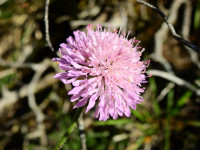
The inflorescence is a capitulum composed of numerous small flowers, surrounded by an involucre of bracts and often provided at the base with chaff or hairs. The fruit is a nutlet that presents specific adaptations for dispersal, often facilitated by insects such as apids, the main pollination agents.
Distribution and diversity
The family Dipsacaceae has a mainly Mediterranean and temperate distribution, with species widespread especially in southern Europe and some areas of western Asia. In the past, according to the Cronquist classification (1981), the family was considered autonomous within the order Dipsacales. However, the modern APG IV classification (2016) has integrated the genera of the family within Caprifoliaceae, thus expanding their taxonomic context.
The family included several genera, among which Cephalaria, Dipsacus, Knautia, Lomelosia, Pterocephalodes, Pterocephalus, Scabiosa, Succisa, Succisella and Triplostegia, with several dozens of species. Some of these are present and spontaneous in Italy, contributing to the local floristic biodiversity.
Main genera and representative species
Among the best-known genera of the former family Dipsacaceae are:
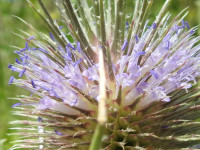
- Dipsacus: commonly known as teasel, it is characterized by globose and spiny capitula, with flowers that attract many pollinating insects.
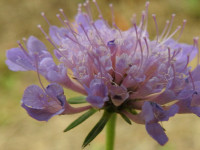
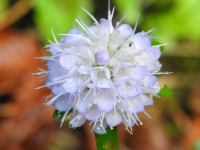
- Scabiosa: includes highly appreciated ornamental species, with capitulum inflorescences and flowers often blue or violet in color.
- Knautia: similar to Scabiosa, with colorful flowers and capitula that attract insects.
- Succisa: includes herbaceous plants with compact inflorescences.
In Italy, species such as Dipsacus fullonum (teasel) and various species of Scabiosa are commonly found in open environments, roadsides and meadows.
Etymology
The name “Dipsacaceae” derives from the type genus Dipsacus, whose name originates from the Greek “dipsa” meaning “thirst”. This name probably refers to the ability of the spiny capitula to collect rainwater, which in the past was used to alleviate the thirst of livestock.
Sources
- Wikipedia
Species of the family
4 species catalogued
Explore
Other botanical families