Botanical species
Dipsacus fullonum
L.
Teasel
Description
Morphological description
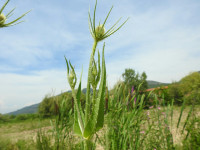
A biennial plant with a hemicryptophyte life cycle, the Teasel has an erect habit and can reach a height between 1 and 2 meters. The stem is robust, tubular, often forked at the apex, with a base diameter of about 2 cm. The stem surface is longitudinally striated and covered with soft, patent, and rather long spines (1–5 mm), giving the plant a spiny and rough appearance.
The leaves are characterized by a lanceolate or ovate-lanceolate shape, with a coarsely toothed margin and often equipped with scattered spines especially along the central vein. The basal leaves are arranged in a rosette, are large (up to 10-15 cm wide by 30-50 cm long), with a clasping base and lateral veins diverging at right angles. The upper leaves are generally smaller, entire, glabrous, and connate in pairs forming a sort of “cup” around the stem, a structure that collects rainwater.
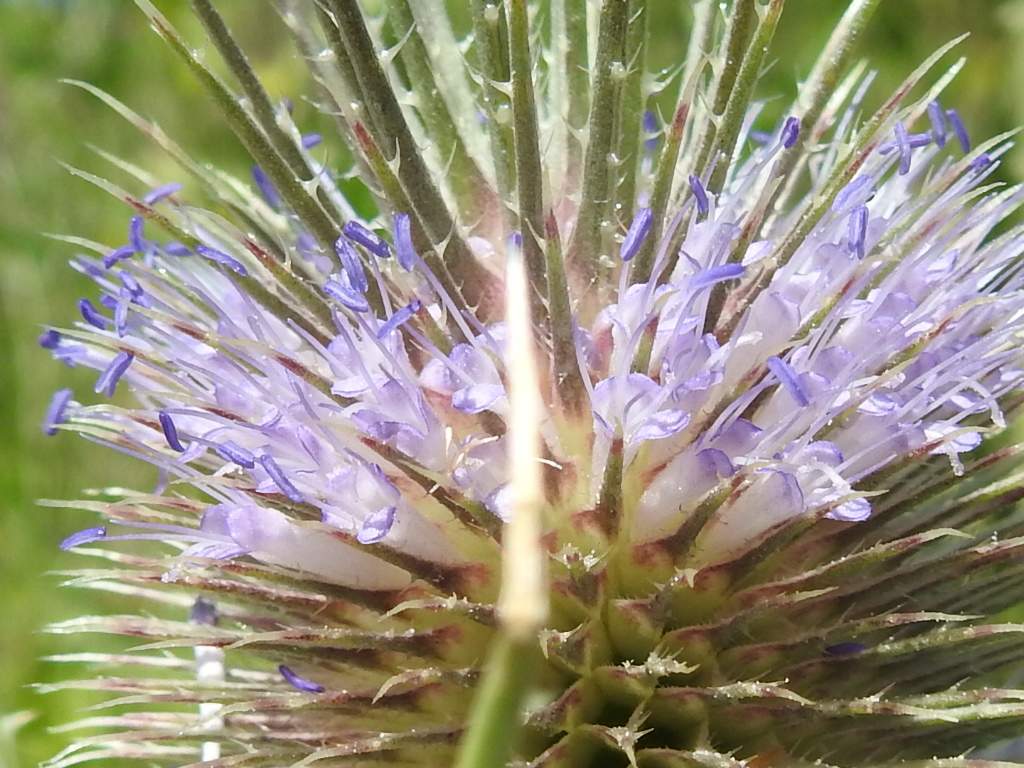
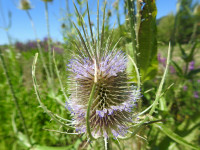
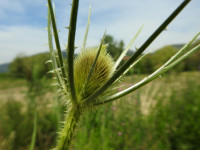
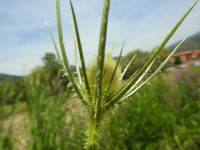
The inflorescence consists of capitula of ovoid or cylindrical shape, with variable dimensions between 3 and 8 cm in height and 2-4 cm in width. These capitula are wrapped by linear, spiny, and acuminate bracts, often longer than the flowers themselves. The bracts are curved and ascending, equipped with acuminate spines, which besides protecting the flowers play an important mechanical role in seed dispersal. The flowers, 8-10 mm long, are lilac or mauve in color, sometimes whitish, with a four-lobed corolla, where the upper lobe is more developed. Flowering starts from the central area of the capitulum and then progressively extends towards the ends, a mechanism that favors fertilization.
The fruits are small elongated achenes, about 5 mm long, characterized by a quadrangular involucre with four teeth at the corners and a cup-shaped calyx. The entire capitulum, with its spiny structures, is adapted to favor the “catapulting” of the achenes upon the passage of animals or wind, facilitating their dispersal.
The root system consists of a robust taproot, typical of biennial plants, which allows the plant to anchor firmly and to accumulate nutrient reserves for the biennial cycle.
Habitat and distribution
It is a common species in Italian territories and much of the Mediterranean basin, with a range extending from central and southern Europe to western Asia and North Africa. In Italy, it grows widely along roadsides, in uncultivated areas, ditches, rubble, and abandoned lands, from sea level up to about 1400 meters of altitude.
It prefers thermophilic and submontane habitats with sunny exposure. It favors moderately fertile soils, often calcareous or well-drained, and adapts to poor or disturbed soil conditions, sometimes becoming invasive.
Flowering period
Flowering occurs mainly between June and August, with possible variations related to latitude and altitude of the growth site. In some regions, flowering can extend until September. The progressive flowering phenomenon from the center of the capitulum towards the ends is a strategy that optimizes fertilization and seed production.
Ecology and pollination
The plant is pollinated by pollinating insects, attracted by the lilac color of the flowers and their compact arrangement. The staggered temporal arrangement of the flowers within the same inflorescence favors cross-fertilization.
The spiny and rigid structure of the involucre bracts, besides protecting flowers and fruits, facilitates the dispersal of achenes: upon the passage of animals or the slightest contact, the seeds are “catapulted” far from the mother plant thanks to the stiffening and elongation of the bracts themselves. This mechanism increases the probability of colonizing new environments.
Curiosities and traditional uses
The Teasel has a long history of use linked to wool processing. The spiny infructescences, called “teasel heads,” were used by wool workers for raising wool fabrics: rubbing the surface of the fabrics with the spiny capitula removed the surface fuzz, making the cloth softer and shinier. This practice, documented since the Egyptian era and mentioned in the capitularies of Charlemagne, played an important role in European textile chains, particularly in France and Italy, where the cultivation of the plant was encouraged until the 20th century.
From a medicinal point of view, the plant contains glycosides, scabioside, organic acids, and saponins and has been used in folk medicine as a sudorific, diuretic, aperitif, and depurative remedy. It was also employed to treat cracked skin and anal fistulas. However, medicinal uses should be considered historical and informative, without replacing modern medical prescriptions.
The Italian common name “Scardaccione” recalls the spiny and robust nature of the plant, similar to a thistle, while the scientific name is linked to ancient textile practices.
Etymology
The genus name derives from the Greek “dípsa,” meaning “thirst,” referring to the basin formed by the leaves connate at the base along the stem, which collects rainwater. The specific name “fullonum” refers to the historical use of the inflorescence in “fulling,” that is, the finishing of fabrics in the Middle Ages, when the capitula were used for wool processing and cleaning.
The Italian term “Scardaccione” probably derives from dialect and recalls the resemblance to spiny thistles, highlighting the characteristic appearance of the leaves and spiny bracts.
Sources
- Prof. S. Pignatti, Flora d'Italia
- Acta Plantarum – Flora delle regioni italiane (scheda di Marinella Zepigi)
- Tela Botanica / H. Coste, Flore descriptive et illustrée de la France
- World Flora Online (WFO)
Characteristics
Scheda botanica
| Famiglia | Dipsacaceae |
|---|---|
| Fioritura | giugno – agosto |
| Forma biologica | Biennials |
| Habitat | with lilac flowers, spiny plant |
Domande frequenti
- Quando fiorisce Teasel?
- Teasel fiorisce giugno – agosto.
- Che tipo di pianta è Teasel?
- Teasel è una Hemicryptophytes (Biennials) secondo la classificazione di Raunkiaer.
- A quale famiglia appartiene Teasel?
- Teasel appartiene alla famiglia botanica Dipsacaceae.
Where I found it (6 sightings)
Classification
- Kingdom
- Plantae
- Family
- Dipsacaceae
- Full name
- Dipsacus fullonum L.
- Life form
- Hemicryptophytes biennials
Similar species
Search for species with similar characteristicsFurther reading
Noticed an error in the identification? Write to me
Other species of the same family
Dipsacaceae
Explore
Other species of Dipsacaceae