Botanical species
Knautia arvensis
(L.) Coult.
Field Scabiosa
Description
Morphological description
Perennial herbaceous plant with a taproot, whose height typically ranges between 30 and 100 cm. The stem is erect, branched and ascending, with a surface covered by hirsute, tomentose and glandular hairs, with lengths varying between 1 and 2.5 mm, directed downwards. Stems often show purple spots and elongated internodes. The plant can produce underground stolons, contributing to its ability to spread.
The basal leaves are generally undivided or slightly lobed, ovate-lanceolate in shape, with dimensions that can reach 3-6 cm in length and 1 cm in width; they are hairy, herbaceous and green in color. The cauline leaves, especially the lower ones, are pinnatisect with 4-12 narrow segments per side, about 2-3 mm wide, with a shorter and acute apical segment. The leaf surface is covered by dense hairs and sometimes glandular hairs, giving a hirsute appearance.
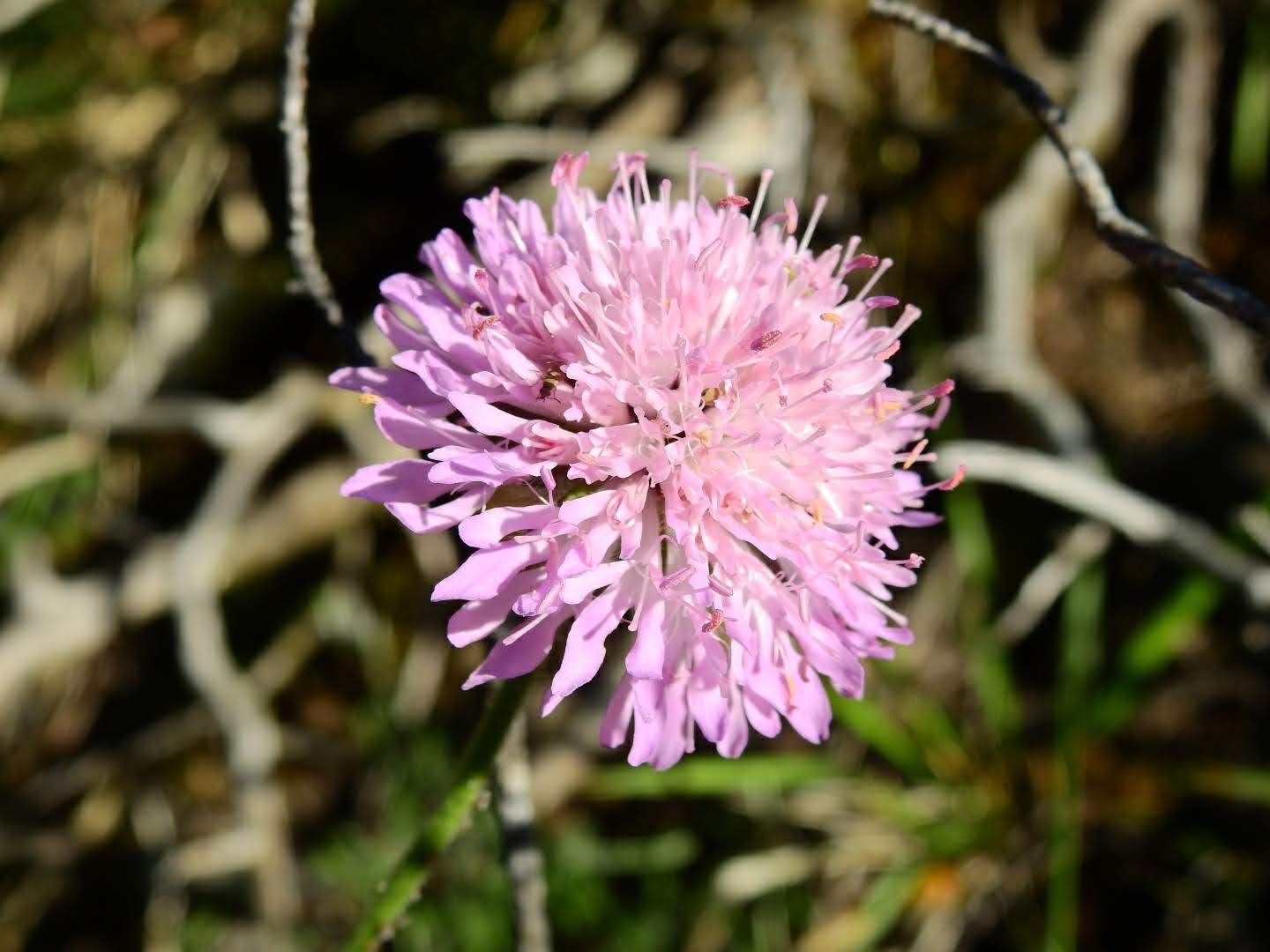
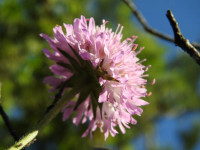
The capitula are hermaphroditic, flattened in shape and with a diameter varying between 2.5 and 4 cm, with involucres composed of 8-10 triangular scales, the largest up to 9-10 mm long. The bracts of the involucre are shorter than the flowers and about twice as long as wide. The calyx has 6 to 10 spinulose ribs with hairs 1-1.5 mm long at the base.
The corolla, 10-16 mm long, is blue-violet, lilac or pink in color, sometimes with purple tones. The marginal flowers are larger and form a more evident border compared to the inner ones. The fruits are achenes about 5-6 mm long, also covered by dense hairs, which facilitate their dispersal.
Habitat and distribution
This species is widespread in Europe, from the Eurasian region to the Alps and the Italian Peninsula, where it mainly prefers mountainous and hilly areas. In Italy it is commonly found on hills and in mountain and submontane meadows, with reports also in anthropized environments such as field margins and roadsides. It grows on well-drained soils, often calcareous or sub-calcareous, in sunny or partially shaded positions.
It is an adaptable species, found from hilly altitudes up to about 1500-1800 m, often in meadows, clearings, path edges and ruderal areas. Its presence in mountain environments is significant, where it contributes to the local herbaceous biodiversity.
Flowering period
The flowering period generally extends from May to October, with a peak between June and September. Flowering may vary slightly depending on latitude and altitude: in more southern areas and at lower altitudes it tends to start earlier and last longer, while at higher altitudes it can be shorter and concentrated in the summer months.
Ecology and pollination
The plant is pollinated by pollinating insects, particularly bees and butterflies attracted by the vivid blue-violet color and the nectar produced. The flower morphology, with four-lobed corollas of unequal size and larger marginal flowers, facilitates access to pollinating insects, which promote cross-fertilization.
Seed dispersal occurs thanks to the hairy achenes, which can be carried by the wind or attach to animal fur, favoring colonization of new habitats. The presence of underground stolons also allows vegetative reproduction, making the species capable of rapid expansion and, in some cases, behaving as a weed.
Curiosities and traditional uses
No significant food or medicinal uses for this species are reported in the consulted sources. However, its characteristic of easily colonizing field and path edges and its ecological adaptability make it an important element for soil stabilization and the conservation of mountain herbaceous habitats. Its presence in meadows also contributes to maintaining a rich fauna of pollinating insects.
Etymology
The generic name "Knautia" is dedicated to the German botanist Christian Knaut (1656-1716), physician and botanist. The specific epithet "arvensis" derives from Latin and means "of the fields," indicating the typical habitat of the plant, often found in fields and open meadows.
The Italian common name "Ambretta comune" refers to the amber or violet color of the flowers, although the tones can vary from pink to violet and blue. This popular denomination highlights the species' widespread presence and familiarity in the Italian countryside.
Sources
- Prof. S. Pignatti, "Flora d'Italia"
- World Flora Online (WFO)
Characteristics
Scheda botanica
| Famiglia | Dipsacaceae |
|---|---|
| Fioritura | maggio – ottobre |
| Forma biologica | Scapose |
| Habitat | with purple flowers, with pink flowers, with blue flowers |
Domande frequenti
- Quando fiorisce Field Scabiosa?
- Field Scabiosa fiorisce maggio – ottobre.
- Che tipo di pianta è Field Scabiosa?
- Field Scabiosa è una Hemicryptophytes (Scapose) secondo la classificazione di Raunkiaer.
- A quale famiglia appartiene Field Scabiosa?
- Field Scabiosa appartiene alla famiglia botanica Dipsacaceae.
Where I found it (8 sightings)
Classification
- Kingdom
- Plantae
- Family
- Dipsacaceae
- Full name
- Knautia arvensis (L.) Coult.
- Life form
- Hemicryptophytes scapose
Similar species
Search for species with similar characteristicsFurther reading
Noticed an error in the identification? Write to me
Other species of the same family
Dipsacaceae
Explore
Other species of Dipsacaceae