Botanical species
Succisa pratensis
Moench
Devil's-Bit Scabious
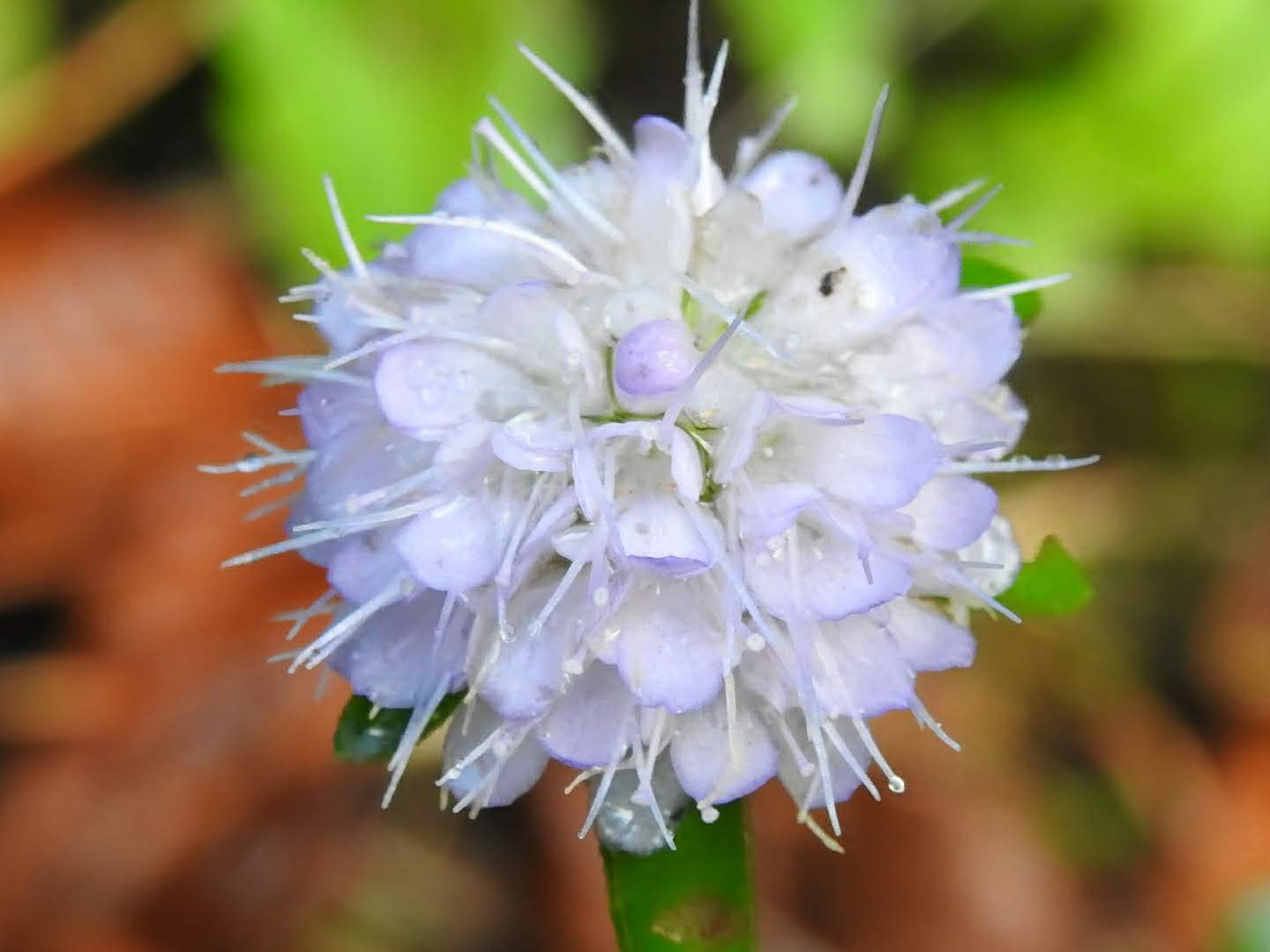
Description
Morphological description
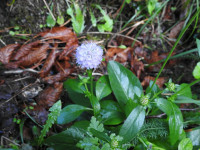
Perennial plant that can reach a variable height between 20 and 80 cm, with an erect habit and often branched in the upper part of the stem. The stem is cylindrical and has a pubescent surface, especially in the upper part, where one or two pairs of branches can also be observed.
The root system consists of an oblique, short, and superficial rhizome, characterized by a truncated shape at the base, without stolons. The basal leaves have a winged petiole 2-3 cm long and a lanceolate blade measuring 2-3 cm in width and 6-8 cm in length. The leaf margin is darkly dentate and the underside appears hirsute (i.e., covered with hairs). The cauline leaves, on the other hand, are smaller, linear, and also have dentate margins, arranged alternately along the stem.
The flower heads are initially spherical and become hemispherical at flowering, with a diameter ranging from 1.5 to 2.5 cm. They are borne on peduncles 4 to 15 cm long. The involucre is formed by two or three series of herbaceous, patent (i.e., open outward) scales, which at anthesis (peak flowering period) are exceeded by the flowers. The chaff accompanying the flowers are linear-spatulate and acute.
The flowers are regular, with a lilac or blue-violet corolla, rarely also presenting pink or white coloration. The corolla is 4-7 mm long, with four lobes, the lower one being more elongated. The style protrudes beyond the throat of the flower, a feature that facilitates pollination. The fruits are cypselae (dry indehiscent fruits) about 3-5 mm long, hirsute with hairs directed upwards, with an involucre reduced to 4 teeth and a calyx equipped with 4-5 dark and elongated bristles (twice as long as the calyx limb).
Habitat and distribution
This species is widely distributed in Europe, from the Eurasian continent to North Africa. In Italy it mainly grows in wet meadows and fresh woods, from the plains up to about 1600 meters altitude, with occasional reports up to 2400 meters. It prefers environments with variable exposure but is typically associated with moist or subhumid substrates, such as marshy meadows, forest clearings, and mountain pastures.
The plant is present throughout the Italian peninsula and in Mediterranean regions, where it finds suitable conditions especially in cool and humid areas. In the Mediterranean context, its presence is limited to microhabitats with constant humidity, given its preference for soils that are not too dry and often rich in organic matter.
Flowering period
Flowering generally occurs between June and August, with some extension up to September-October in cooler or mountainous areas. Overall, the peak flowering period is in the summer season, when temperature and humidity conditions are ideal for pollination and fruit maturation.
Ecology and pollination
The plant is a scapose hemicryptophyte: the stem is elongated and often leafless in the upper part, with perennial buds located at ground level. The flowers are all similar to each other, without differentiation between peripheral and central flowers, and have a corolla with four equal lobes (the lower one slightly elongated), indicative of adaptations to insect pollination.
The main pollinating insects are bees and butterflies, attracted by the lilac color and the nectar produced. The style protruding beyond the throat facilitates contact with pollinating insects. The plant is often gynodioecious, i.e., it presents individuals with hermaphrodite flowers and others with female flowers, a strategy that promotes genetic diversity.
Seed dispersal occurs through fruits equipped with hairs that can facilitate adherence to animals or transport by wind. The superficial rhizome also allows some clonal expansion of the plant.
Curiosities and traditional uses
The common name "Devil's-Bit Scabious" derives from a legend according to which the devil bit the rhizome of this plant to prevent its therapeutic use by humanity, recognizing its important healing properties.
Traditionally, Succisa pratensis has been used in phytotherapy for its anthelmintic (against intestinal worms), soothing, depurative, diuretic, febrifuge, expectorant, and emmenagogue properties. Teas prepared with the leaves were used to relieve cough, fever, and inflammations, while decoctions for external use were applied in the treatment of eczema and other skin eruptions.
The tender shoots are sometimes used in salads, while a green dye was obtained from the leaves. These food and medicinal uses testify to an ancient knowledge of the plant's virtues, although today it is advisable to use such remedies with caution and under medical supervision.
Etymology
The scientific name derives from the Latin "succidere," which means "to cut at the base" or "to truncate," probably referring to the rhizome characteristically interrupted or "bitten." The specific term "pratensis" indicates the typical habitat of the plant, i.e., meadows.
The Italian common name "Devil's-Bit Scabious" is linked to a popular legend widely spread in various European cultures, which attributes magical and healing powers to the plant, hindered by a demonic figure who supposedly "bit" its root.
Sources
- Prof. P.V. Arrigoni, "Flora analitica della Toscana", "Flora dell'Isola di Sardegna"
- Acta Plantarum - Flora delle regioni italiane (scheda di Gianluca Nicolella)
- Tela Botanica / H. Coste, "Flore descriptive et illustrée de la France"
- World Flora Online (WFO)
Characteristics
Scheda botanica
| Famiglia | Dipsacaceae |
|---|---|
| Fioritura | giugno – agosto |
| Forma biologica | Scapose |
| Habitat | with lilac flowers, Perennial plant |
Domande frequenti
- Quando fiorisce Devil's-Bit Scabious?
- Devil's-Bit Scabious fiorisce giugno – agosto.
- Che tipo di pianta è Devil's-Bit Scabious?
- Devil's-Bit Scabious è una Hemicryptophytes (Scapose) secondo la classificazione di Raunkiaer.
- A quale famiglia appartiene Devil's-Bit Scabious?
- Devil's-Bit Scabious appartiene alla famiglia botanica Dipsacaceae.
Where I found it (6 sightings)
Classification
- Kingdom
- Plantae
- Family
- Dipsacaceae
- Full name
- Succisa pratensis Moench
- Life form
- Hemicryptophytes scapose
Similar species
Search for species with similar characteristicsFurther reading
Noticed an error in the identification? Write to me
Other species of the same family
Dipsacaceae
Explore
Other species of Dipsacaceae