Botanical species
Myrtus communis
L.
Myrtle
Description
Morphological description
Myrtle is an aromatic evergreen shrub belonging to the Myrtaceae family, which can reach a variable height between 1 and 5 meters, sometimes assuming a small tree-like habit. The stem is lignified, gray in color with reddish hues especially in younger branches; the bark is peeling, flaking off in plates or fibrous strips in adult specimens. The branches are opposite, with dense branching and angular twigs.
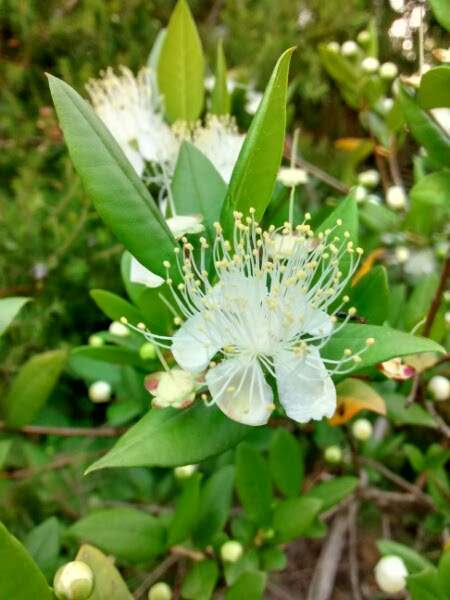
The leaves are simple, leathery, and lanceolate or elliptical in shape, generally measuring between 8-11 mm in width and 20-24 mm in length, although variability is high, with specimens showing smaller or larger leaves. The arrangement is opposite or sometimes whorled; they are sessile, with entire margins and an acute apex. The upper surface is glossy and dark green with a sunken midrib, while the lower surface is paler, matte, and has small aromatic glands. Crushed leaves emit an intense and pleasant scent, similar to that of orange, due to the presence of essential oils such as myrtenol.
The flowers are white, solitary or paired in the leaf axils, borne on long peduncles of 12-18 mm. The corolla is composed of five subround petals, about 7 mm in diameter, with hairy-glandular margins. The stamens are numerous (up to 180), longer than the petals, with yellow anthers, and a simple style with a single stigma, immersed among the stamens. The calyx has five free and acute sepals, persistent also on the fruit.
The fruit is a subglobose or ellipsoid berry, 6-10 mm in diameter, bluish-black and pruinose at maturity, sometimes whitish or mottled. It is crowned by the persistent rudiments of the calyx. The seeds, few per fruit, are kidney-shaped and measure about 2.5-3 x 2 mm.
The root system, although not detailed in sources, is typical of Mediterranean shrubs, with robust roots capable of anchoring the plant in often poor and arid substrates.
Habitat and distribution
Myrtle is a typical species of the Mediterranean maquis, preferring thermophilic and arid environments, often along coasts, with a clear preference for the western ones of the Mediterranean basin. In Italy it is mainly present along the coasts of Sardinia, Corsica, Capri, Naples, Gallipoli, and in some inland areas of Tuscany (province of Florence). Its range extends throughout the Mediterranean area, from the European basin to the North African basin and Western Asia.
It prefers habitats such as garrigues, maquis, fixed dunes, and marine shores, where it forms dense and wind-resistant shrubs. It grows from sea level up to about 500 meters altitude, adapting to different soil types but with a preference for sandy or poor, well-drained substrates. It is very drought-tolerant and adapts to sunny exposures and mild climates typical of Mediterranean regions.
Flowering period
Flowering generally occurs between May and July. In some Mediterranean areas with particular microclimates, flowering may vary slightly, but these months represent the main period of emission of the white, very fragrant, and visible flowers.
Ecology and pollination
Myrtle is mainly pollinated by pollinating insects attracted by the strong aromatic scent of the flowers, which emit a balsamic and resinous odor due to terpenes and essential oils. The presence of numerous long stamens facilitates contact with pollinators, ensuring good fertilization.
Seed dispersal occurs mainly thanks to frugivorous animals, such as birds and mammals, which feed on the bluish-black berries, thus contributing to the species' spread. The berries persist on the plant until about January, providing a food source during the winter months.
Curiosities and traditional uses
Myrtle has always been a plant of great ethnobotanical and cultural value in the Mediterranean. Its leaves, rich in essential oils such as myrtenol, geraniol, alpha-pinene, limonene, and cineole, are used in cooking to flavor meat, fish, sausages, and olives. The fruits are used in the preparation of liqueurs, including the famous Sardinian myrtle liqueur, and to flavor spirits and other beverages.
In medicine, myrtle has balsamic, astringent, antiseptic, and decongestant properties. Traditionally it has been used to treat urinary infections, bronchial congestion, dry cough, acne, gum infections, and hemorrhoids. The essence extracted from the flowers, known as "Water of angels," is an astringent tonic used in perfumery and cosmetics.
The wood, hard and compact, is used for making small handcrafted objects such as tool handles and walking sticks, as well as providing good charcoal for burning. The leaves, rich in tannins, were used for tanning leather.
Myrtle also has symbolic meaning in Mediterranean tradition, representing love and purity, and its fragrant flowers are often used in potpourris. The name "mortella," used in some regions, is linked to the flavoring of food products such as mortadella.
Etymology
The generic name Myrtus would derive from the Greek mythological figure Myrsine, a young woman transformed into myrtle by Pallas after a tragedy. The specific name communis indicates the common and frequent distribution of the species in the Mediterranean basin.
The Italian name "mirto" is historically also associated with the word "mortella," which indicates the traditional use of its leaves to flavor sausages such as mortadella.
Sources
- Prof. S. Pignatti, "Flora d'Italia"
- Acta Plantarum - Flora delle regioni italiane (scheda di Marinella Zepigi)
- Tela Botanica / H. Coste, "Flore descriptive et illustrée de la France"
- World Flora Online (WFO)
Characteristics
Scheda botanica
| Famiglia | Myrtaceae |
|---|---|
| Fioritura | maggio – luglio |
| Forma biologica | Shrubby |
| Habitat | with white flowers, edible plant, fragrant plant |
| Uso alimentare | Commestibile |
Domande frequenti
- Quando fiorisce Myrtle?
- Myrtle fiorisce maggio – luglio.
- È commestibile Myrtle?
- Myrtle è considerata commestibile. Verifica sempre le parti eduli e la preparazione corretta prima del consumo.
- Che tipo di pianta è Myrtle?
- Myrtle è una Phanerophytes (Shrubby) secondo la classificazione di Raunkiaer.
- A quale famiglia appartiene Myrtle?
- Myrtle appartiene alla famiglia botanica Myrtaceae.
Where I found it (1 sightings)
Classification
- Kingdom
- Plantae
- Family
- Myrtaceae
- Full name
- Myrtus communis L.
- Synonyms
- Myrtus communis L. subsp. tarentina (L.) Nyman; Myrtus communis L. var. tarentina L.; Myrtus tarentina (L.) Mill.
- Life form
- Phanerophytes shrubby
Similar species
Search for species with similar characteristicsFurther reading
Noticed an error in the identification? Write to me
Explore
Other species of Myrtaceae