Botanical family
Myrtaceae
Description
Botanical characteristics
The plants belonging to the family Myrtaceae are predominantly evergreen trees or shrubs, typical of tropical and subtropical areas. They have opposite leaves, rarely spiral, with a leathery texture and often rich in aromatic essential oils, which give them a characteristic scent. The leaves are generally simple, with entire margins and persistent throughout the year.
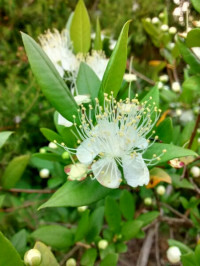
The flowers of these plants are hermaphroditic and actinomorphic, with a structure composed of 4 or 5 sepals and petals, often gamosepalous, and a very high number of stamens that stand out for their conspicuous presence and coloration. The calyx and corolla are small in size, so the attractive function for pollinators is mainly performed by the stamens. The carpels are 2 or 3 and form an inferior ovary. The inflorescence and fruit morphology vary within the family; the fruits can be capsules, nuts, or berries.
This floral structure, together with the presence of aromatic oils, is a distinctive trait of the family. Pollination occurs mainly through insects or hummingbirds, depending on the species.
Distribution and diversity
Myrtaceae are mainly distributed in the tropical and subtropical regions of the world, with a significant concentration in America and Australia, areas where these taxa have undergone notable evolution. Paleobotanical studies indicate that the family originated in the Paleocene, between sixty and fifty-six million years ago, with fossil pollen traces found in sediments dating back to the ancient supercontinent Gondwana.
The fragmentation of Gondwana during the Cretaceous led to geographic isolation of the groups, favoring rapid speciation and diversification of genera, especially in the Oceanian area.
The family includes about 130 genera, divided into two main subfamilies: Myrtoideae and Psiloxyloideae, and counts numerous botanical tribes reflecting the vast morphological and adaptive diversity of the species.
Main genera and representative species
Among the most important genera of Myrtaceae are:
- Eucalyptus: one of the best-known and widely distributed genera, very important both ecologically and economically.
- Myrtus: includes myrtle, a symbol species of the Mediterranean and Italian flora, appreciated for its aromatic properties.
- Syzygium: includes widely spread tropical species.
- Melaleuca: known for medicinal and ornamental properties.
- Callistemon: often cultivated for ornamental purposes, known as “bottle brush” for the shape of its flowers.
In Italy, the most representative species is Myrtus communis (myrtle), a typical evergreen aromatic shrub widespread in Mediterranean regions. Other genera present in Italy are very rare or absent in the wild state.
Etymology
The family name derives from the typical genus Myrtus, which in turn takes its name from the Greek “myrtos,” a term used in antiquity to indicate myrtle, a highly appreciated aromatic plant.
Curiosities and uses
Myrtaceae play a fundamental ecological role in tropical and subtropical forests, contributing to biodiversity and ecosystem stability.
From an economic point of view, many species are important for the production of aromatic essential oils used in perfumery, medicine, and food. Myrtle is known for its culinary and traditional medicinal uses in the Mediterranean basin. Eucalyptus, on the other hand, is widely cultivated for timber and essential oil production.
In ornamental horticulture, numerous species of this family are appreciated for their showy flowering and resilience, such as callistemon and melaleuca.
Sources
- Wikipedia
Species of the family
1 species catalogued
Explore
Other botanical families