Botanical species
Malva sylvestris
L.
Common Mallow
Description
Morphological description
It is a perennial herbaceous plant, sometimes biennial or even annual, with a variable habit from prostrate to erect or ascending. The typical height ranges between 30 and 120 cm, but in some cases the stems can reach up to 1.5 m in length. The stems are robust, woody at the base, longitudinally striated and covered with a rough pubescence, consisting of simple and sometimes stellate hairs, giving a rough surface to the stem.
The leaves are alternate, with a petiole 3 to 7 cm long, and a blade ranging from circular to suborbicular or pentagonal in shape, generally measuring between 5 and 10 cm, but can also reach 14 cm in diameter. The blade is deeply palmately lobed with 3-7 rounded or acute lobes, with a crenate-dentate margin and a generally cordate or slightly truncate base. The leaf surfaces are herbaceous and can be glabrous or weakly pubescent. The basal leaves form a fleshy and elongated rosette at ground level, while the cauline leaves are more divided and bear flowers in the axils.
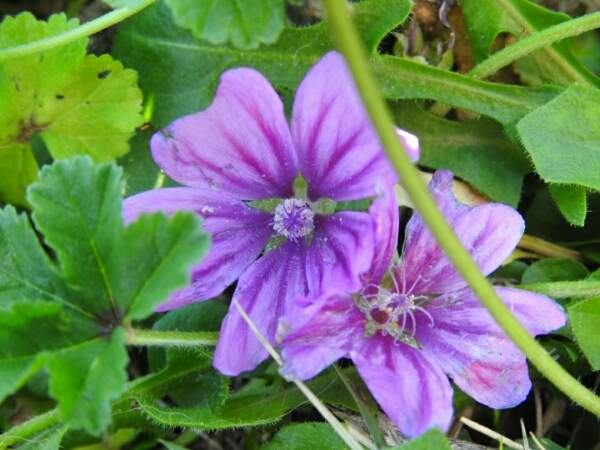
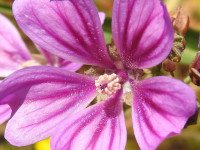
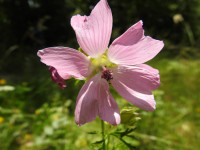
The flowers are solitary or grouped in clusters of 2 to 6, located in the axils of the upper leaves. They have a long peduncle (1-2.5 cm), a calyx formed by five triangular sepals with hairy margins and densely ciliate, and an epicalyx with hairy segments. The corolla consists of five bilobed petals, pink-violet in color with darker longitudinal stripes, which can vary from light pink to deep violet; the petals are 12 to 30 mm long and about 2.5-4 times the length of the calyx. The corolla has a scape-like habit, meaning it blooms on a floral axis often leafless. The stamens are numerous, united to form a column with fused filaments.
The fruits are schizocarps (polyachenes) disc-shaped, about 7-10 mm in diameter, consisting of 10-12 flattened, single-seeded mericarps, reticulated on the back, glabrous or weakly pubescent. The mericarps have thin and non-winged margins. The seeds measure about 1.5-2.2 mm.
The root system is taprooted, with a long and fleshy root that in the first year allows the formation of a basal rosette of leaves.
Habitat and distribution
Common Mallow is widely distributed throughout Italy and the Mediterranean basin, with a subcosmopolitan distribution including most of Europe, Western Asia, and North Africa. In Italy it commonly grows from 0 up to about 1,600 meters in altitude. It prefers anthropized and ruderal environments such as uncultivated lands, road margins, field edges, trampled places, and meadows, showing some tolerance to poor and disturbed soils.
The species prefers sunny or semi-shaded exposures and well-drained soils but can adapt to various conditions and is considered a weed in many areas. It is also frequent in thermophilous environments up to hilly and medium-altitude mountainous zones.
Flowering period
Flowering generally occurs from June to September, with possible geographic variations linked to local climate. In warmer climates flowering can start as early as late spring, while in cooler areas it can extend until early autumn. The flowers, striking for their pink-violet color and darker stripes, are particularly conspicuous during the summer months.
Ecology and pollination
Common Mallow is a melliferous plant highly appreciated by pollinating insects, particularly bees and other hymenopterans, which visit the flowers to collect nectar and pollen. The structure of the corolla, with bilobed petals and vivid coloration, is adapted to attract pollinating insects, promoting efficient sexual reproduction.
The fruits open into schizocarps that mainly disperse by falling near the parent plant, but can also be transported by animals or external agents, facilitating colonization of new habitats. The species thus has a mixed reproductive strategy, with a strong capacity for vegetative expansion and seed dispersal.
Curiosities and traditional uses
Common Mallow has always been appreciated for its multiple medicinal and nutritional properties. The young aerial parts, especially the leaves and shoots, can be consumed raw in salads (often mixed with other vegetables to mask their slightly bitter taste) or cooked as a vegetable. The unripe capsules are sometimes added to salads. Young cooked branches can be used as a side dish or to flavor soups, while fresh flowers are also suitable for frying in batter.
From a medicinal point of view, Common Mallow is known for its emollient, anti-inflammatory, expectorant, and laxative properties. It is rich in mucilages, flavonoids, anthocyanins, vitamins (B1, B2, C) and minerals such as potassium. Traditionally it has been used to soothe inflammations of the mucous membranes of the mouth and throat, gingivitis, toothache, skin irritations, itching, and as a mild laxative. Preparations based on infusions or poultices of leaves and roots are also used in cases of bronchitis, cough, stomatitis, hemorrhoids, and conjunctivitis.
In cosmetics, thanks to its emollient properties, it is used in toothpastes, mouthwashes, creams for sensitive skin, and to strengthen hair, particularly to reduce the yellowish tint of white hair in rinses.
Historically, Common Mallow has enjoyed great consideration: already in antiquity it was used as a universal remedy and food, with references by Pliny the Elder and other classical authors. In the Middle Ages it was considered a remedy for multiple ailments and associated with protective and aphrodisiac virtues.
Etymology
The genus name Malva derives from the Greek "malátto" (to soften) and "malákhe" (emollient), indicating the soothing and calming properties always recognized in these plants. The Italian name "malva selvatica" emphasizes the spontaneous distribution of the species in natural and ruderal territories.
Sources
- Prof. S. Pignatti, "Flora d'Italia"
- Acta Plantarum - Flora delle regioni italiane (scheda di Marinella Zepigi)
- Tela Botanica / H. Coste, "Flore descriptive et illustrée de la France"
- World Flora Online (WFO)
Characteristics
Scheda botanica
| Famiglia | Malvaceae |
|---|---|
| Fioritura | marzo – agosto |
| Forma biologica | Scapose |
| Habitat | edible plant, with purple flowers, with pink flowers |
| Uso alimentare | Commestibile |
Domande frequenti
- Quando fiorisce Common Mallow?
- Common Mallow fiorisce marzo – agosto.
- È commestibile Common Mallow?
- Common Mallow è considerata commestibile. Verifica sempre le parti eduli e la preparazione corretta prima del consumo.
- Che tipo di pianta è Common Mallow?
- Common Mallow è una Hemicryptophytes (Scapose) secondo la classificazione di Raunkiaer.
- A quale famiglia appartiene Common Mallow?
- Common Mallow appartiene alla famiglia botanica Malvaceae.
Where I found it (1 sightings)
Classification
- Kingdom
- Plantae
- Family
- Malvaceae
- Full name
- Malva sylvestris L.
- Synonyms
- Malva ambigua Guss.; Malva mauritiana L.; Malva sylvestris L. subsp. ambigua (Guss.) P.Fourn.
- Life form
- Hemicryptophytes scapose
Similar species
Search for species with similar characteristicsFurther reading
Noticed an error in the identification? Write to me
Other species of the same family
Malvaceae
Explore
Other species of Malvaceae