Botanical species
Malva arborea
(L.) Webb & Berthel.
Tree Mallow
Description
Morphological description
Biennial or short-lived perennial plant, with a shrubby or almost tree-like habit, Tree Mallow reaches a height between 1 and 3 meters. The stem is erect, robust and stocky, often lignified at the base with a diameter up to 7-8 cm, while the upper part appears rough-felted, characterized by a dense stellate pubescence that gives it a gray-whitish appearance.
The leaves are alternate, palmately shaped with 5-7 irregular lobes, generally shallow and with sharper upper lobes. The blade varies in size, from 5 up to 20 cm in width and length, with crenate margins and a cordate base. Both surfaces are covered by a dense stellate pubescence, particularly evident on the underside, giving a velvety and gray-felted appearance. The petiole is channelled and exceeds the leaf blade in length, reaching 3-8 cm.
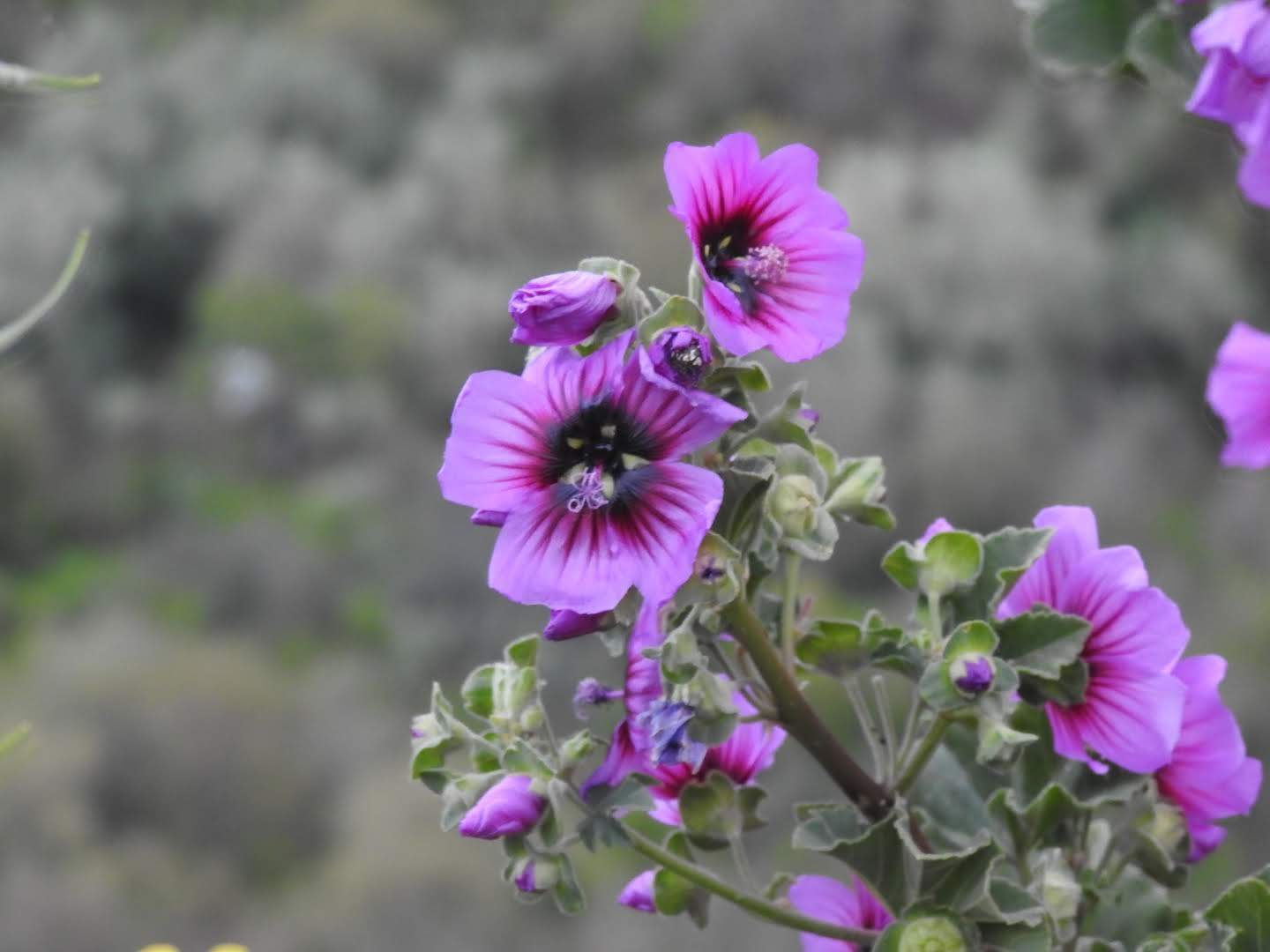
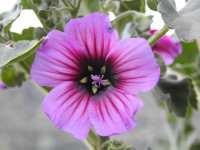
The flowers, grouped in axillary clusters, have a short peduncle about 0.5-1 cm long, often with a distal articulation. They are characterized by an epicalyx formed by 3 bracts fused at the base, wide and ovate, longer than the calyx and densely stellate, with obtuse apices. The calyx consists of 5 hairy, narrow and triangular sepals, about 3-4 mm long. The corolla is 3-4 cm wide, with 5 violet-purple petals, notched at the apex and with darker veins, while the base is blackish or dark violet. The staminal column (tube formed by the fusion of stamens) is 8-10 mm long, glabrous in the proximal part and densely hairy in the distal part; the anthers are purple. The style is branched into 6-9 stigmas.
The fruit is a discoid schizocarp, with a diameter of 8-11 mm, surrounded by the accrescent epicalyx that opens like a crown. It consists of 6-9 wedge-shaped mericarps with sharp margins and wrinkled or grooved surface, each containing a single seed of reniform shape, smooth and dark brown in color. The root system is not described in detail in the sources, but as in many Malvaceae it is presumably well developed and fibrous.
Habitat and distribution
Tree Mallow is a typically Mediterranean species, with a steno-Mediterranean range mainly extending along the central-western coasts of the Mediterranean basin. In Italy it is widespread especially in southern regions and the major islands, but it is also present in central and northern regions, particularly along coastal areas.
It prefers rocky habitats and coastal environments such as cliffs, rocks, and sandy beaches, often in areas with mild climate. It grows on well-drained soils, often calcareous, and tolerates sunny and windy exposure conditions typical of the littoral zone. The altitude range varies from 0 up to about 200-600 meters above sea level.
In many locations it is a spontaneous species, while in others it is naturalized or cultivated for ornamental purposes, especially for the beauty of its flowers.
Flowering period
Flowering extends from March to September, with possible continuation until late autumn depending on climatic conditions and latitude. In some areas, especially those with milder climates, flowering can also be observed in more temperate autumn or winter periods, up to January in particular cases. The flowers thus appear for most of the growing season, making the plant very showy.
Ecology and pollination
The species is pollinated by pollinating insects, attracted by the showy violet-purple flowers with dark veins that act as guides for pollinators. The flower structure, with the staminal column surrounding the style, favors entomophilous pollination. The main pollinators are bees and other pollinating insects, which collect nectar and pollen.
Seed dispersal occurs through the mericarps contained in the schizocarp fruit, which open like a crown releasing the seeds to the ground. The presence of the accrescent epicalyx may also facilitate dispersal by wind or water, especially in coastal environments, promoting colonization of new sandy or rocky areas.
Curiosities and traditional uses
Tree Mallow belongs to a family, the Malvaceae, known since ancient times for its medicinal properties. The parts used are the roots, leaves and flowers, employed both fresh and dried to prepare decoctions, infusions, powders and poultices.
Traditionally recognized properties include emollient, refreshing, sedative, laxative, expectorant (useful for the respiratory tract), anti-inflammatory, diuretic, vulnerary and skin-regenerating effects. Such uses are reflected in the Latin name “malva”, associated with the emollient and soothing action of plants in this genus.
The name Tree Mallow derives from the larger and more tree-like appearance compared to other Malva species, while “arborea” specifically highlights the woody and bushy habit.
In popular folklore the name Malva is sometimes interpreted as “male va” (evil goes), emphasizing an ancient belief in the therapeutic virtues of this plant in “driving away evils”.
Etymology
The genus Malva derives from classical Latin “malva”, which in turn comes from the Greek “μάλᾰχη” (malákhe), connected to the verb “μαλάσσω” (malássō) meaning “to soften”, recalling the emollient effect of plants belonging to this group.
The specific epithet “arborea” indicates the tree-like or shrubby habit of the plant, distinguishing it from other herbaceous Malva species.
The Italian common name “Malvone maggiore” refers to the larger size compared to other mallows and the more woody and imposing habit.
Sources
- Acta Plantarum - Flora delle regioni italiane (scheda di Silvano Radivo)
- World Flora Online (WFO)
Characteristics
Scheda botanica
| Famiglia | Malvaceae |
|---|---|
| Fioritura | marzo – settembre |
| Forma biologica | Biennials |
| Habitat | with purple flowers |
Domande frequenti
- Quando fiorisce Tree Mallow?
- Tree Mallow fiorisce marzo – settembre.
- Che tipo di pianta è Tree Mallow?
- Tree Mallow è una Hemicryptophytes (Biennials) secondo la classificazione di Raunkiaer.
- A quale famiglia appartiene Tree Mallow?
- Tree Mallow appartiene alla famiglia botanica Malvaceae.
Where I found it (7 sightings)
Classification
- Kingdom
- Plantae
- Family
- Malvaceae
- Full name
- Malva arborea (L.) Webb & Berthel.
- Synonyms
- Lavatera arborea L.; Lavatera eriocalyx Steud.; Lavatera veneta Mill.; Malva eriocalyx (Steud.) Molero & J.M.Monts.; Malva veneta (Mill.) Soldano, Banfi & Galasso
- Life form
- Hemicryptophytes biennials
Similar species
Search for species with similar characteristicsNoticed an error in the identification? Write to me
Other species of the same family
Malvaceae
Explore
Other species of Malvaceae