Botanical species
Malva alcea
L.
Greater Musk-mallow

Description
Morphological description
Perennial herbaceous plant with an erect habit, Greater Musk-mallow can reach a height between 30 and 120 cm. The stem is cylindrical, sometimes slightly rounded, covered by predominantly stellate hairs: in the lower part the hairs are scattered and bristly, while in the upper part the stellate pubescence becomes denser, often with pustulate hairs. The root system consists of a robust and deep taproot.
The leaves show considerable morphological variability along the stem. The basal leaves are suborbicular, cordate or sometimes with a slightly truncate base, with crenate or dentate margins and shallow lobes; they are long-petiolate and equipped with lanceolate and ciliolate stipules, deciduous. The cauline leaves, higher up, are deeply palmately parted or pinnatifid with 3-7 narrow lobes, incised or dentate with obtusely dentate margins and a narrow, acute apex. The leaf surface is covered by a stellate down, giving the plant a slightly grayish appearance.
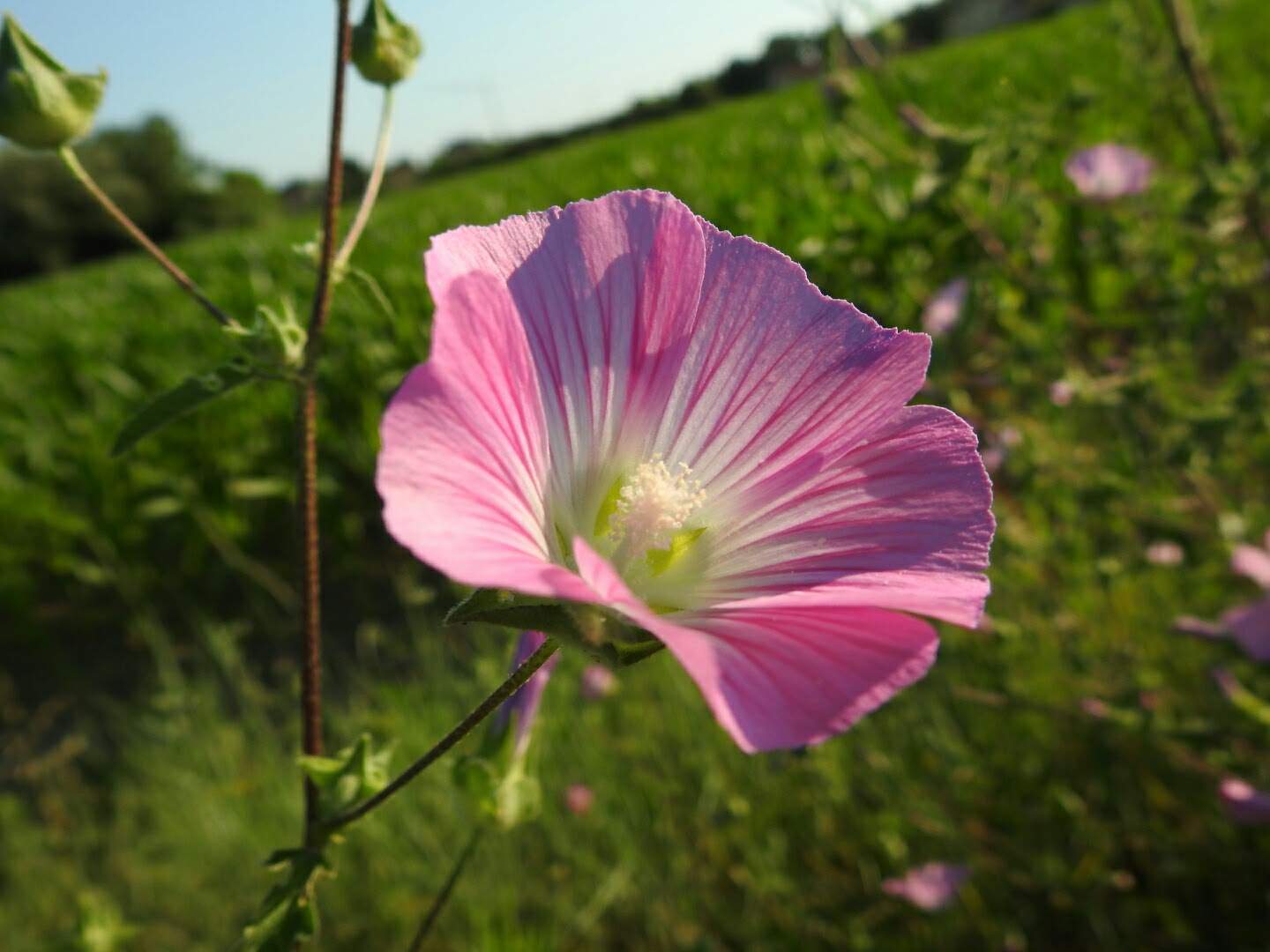
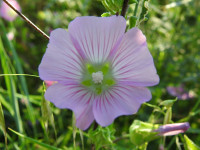
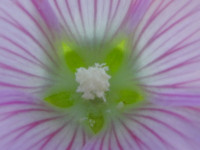
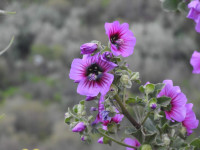
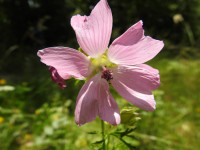
The flowers are solitary or gathered in small clusters in the axils of the upper leaves and at the top of the stem. They have a diameter of 4-5 cm and a corolla formed by five pink or violet-lilac petals, more rarely white, 20-35 mm long, about 2.5-4 times the length of the calyx. The petals are finely striated and deeply incised at the apex. The calyx is divided into five triangular lobes, more or less acute, covered by dense stellate pubescence and accompanied by an epicalyx (calyculus) formed by three oval-deltate segments, also pubescent, reaching the length of the calyx tube. The staminal column is about 9-10 mm long, with filaments wrapped in a tube around the ovary, and presents slight stellate hairs.
The fruit is a schizocarp formed by 18-20 reniform mericarps, 2.4-2.8 mm, smooth or finely wrinkled, gray-brown in color and sometimes pubescent on the back. At maturity they separate by drying of the receptacle. The seeds are brown, about 2.5 mm.
Habitat and distribution
Greater Musk-mallow is a species widespread in temperate and south-central Europe, with a stable presence from France to Ukraine, and well established in Italy and Mediterranean regions. In Italy it grows mainly in countryside environments, at the edges of roads, in cultivated fields, vineyards, ruderal environments and on nitrate-rich soils, from flat areas up to about 2,000 meters altitude. It prefers sunny exposures and calcareous or neutral soils, often in open woodland areas, hedges and meadows.
Flowering period
Flowering extends from June to September, with possible geographical variations related to the local climate. In warmer and temperate areas flowering can start as early as June, while at altitude or in cooler areas it can last until September.
Ecology and pollination
Greater Musk-mallow reproduces mainly sexually, thanks to entomophilous pollination. Its flowers, with brightly colored and large petals, attract numerous pollinating insects, particularly bees, bumblebees and butterflies, which facilitate cross-fertilization. The flower peduncles have clearly visible distal joints, with a length of 1.4-2 cm, allowing some mobility of the flowers and facilitating insect access. Seed dispersal occurs mainly by fruit dehiscence, with the mericarps separating and falling to the surrounding soil, where germination is favored by the presence of nutrient-rich soils.
Curiosities and traditional uses
Greater Musk-mallow has been known since antiquity for its medicinal and food properties. The genus name derives from the Greek “malakós”, meaning “soft”, referring to the emollient and soothing properties of its aerial parts, traditionally used to calm mucous membrane inflammations and respiratory disorders. The flower infusion is used as a sedative for insomnia and to relieve states of nervous excitement. The leaves, flowers, seeds and extracted oil are used both medicinally, for anti-inflammatory, expectorant and mildly laxative properties, and in cooking, as food. Historically, Greater Musk-mallow was one of the plants recommended in the “Capitulare de villis” of Charlemagne, confirming its importance in medieval agricultural and medicinal practices.
Etymology
The scientific name “Greater Musk-mallow” derives from the Greek “malakós” (“soft”), indicating the emollient properties of plants in the genus Malva, while “alcea” recalls an ancient Latin and Greek name used for similar plants. The Italian common name “Greater Musk-mallow” simply reflects the scientific name, without other widely used vernacular denominations. In other languages, the plant is known as “Greater musk mallow” in English, “Mauve alcée” in French and “Malva montés” in Spanish, highlighting its affinity with other species of the genus Malva and its presence in natural environments.
Sources
- Prof. P.V. Arrigoni, "Flora analitica della Toscana", "Flora dell'Isola di Sardegna"
- Acta Plantarum - Flora delle regioni italiane (scheda di Marinella Zepigi)
- Tela Botanica / H. Coste, "Flore descriptive et illustrée de la France"
- World Flora Online (WFO)
Characteristics
Scheda botanica
| Famiglia | Malvaceae |
|---|---|
| Fioritura | giugno – settembre |
| Forma biologica | Scapose |
| Habitat | with pink flowers, Perennial plant |
Domande frequenti
- Quando fiorisce Greater Musk-mallow?
- Greater Musk-mallow fiorisce giugno – settembre.
- Che tipo di pianta è Greater Musk-mallow?
- Greater Musk-mallow è una Hemicryptophytes (Scapose) secondo la classificazione di Raunkiaer.
- A quale famiglia appartiene Greater Musk-mallow?
- Greater Musk-mallow appartiene alla famiglia botanica Malvaceae.
Where I found it (4 sightings)
Classification
- Kingdom
- Plantae
- Family
- Malvaceae
- Full name
- Malva alcea L.
- Life form
- Hemicryptophytes scapose
Similar species
Search for species with similar characteristicsFurther reading
Noticed an error in the identification? Write to me
Other species of the same family
Malvaceae
Explore
Other species of Malvaceae