Botanical species
Malva moschata
L.
Musk Mallow
Description
Morphological description
Perennial herbaceous plant, generally ranging in height between 30 and 60 cm, characterized by an erect, angular stem covered with simple, patent, and scattered hairs, which can sometimes become stellate especially in the upper part. The stem is quadrangular and has a rough surface due to the presence of hairs.
The leaves are dimorphic: basal leaves have a petiole 3 to 8 cm long and a blade 5-6 cm in diameter, suborbicular or reniform, darkly lobed with rounded teeth and irregular margins. The cauline leaves are very different, often deeply divided into narrow laciniate segments 1-4 mm wide, with sharply pinnatifid and deeply incised segments. The leaf surface can be glabrous or weakly hairy, depending on the leaf area.
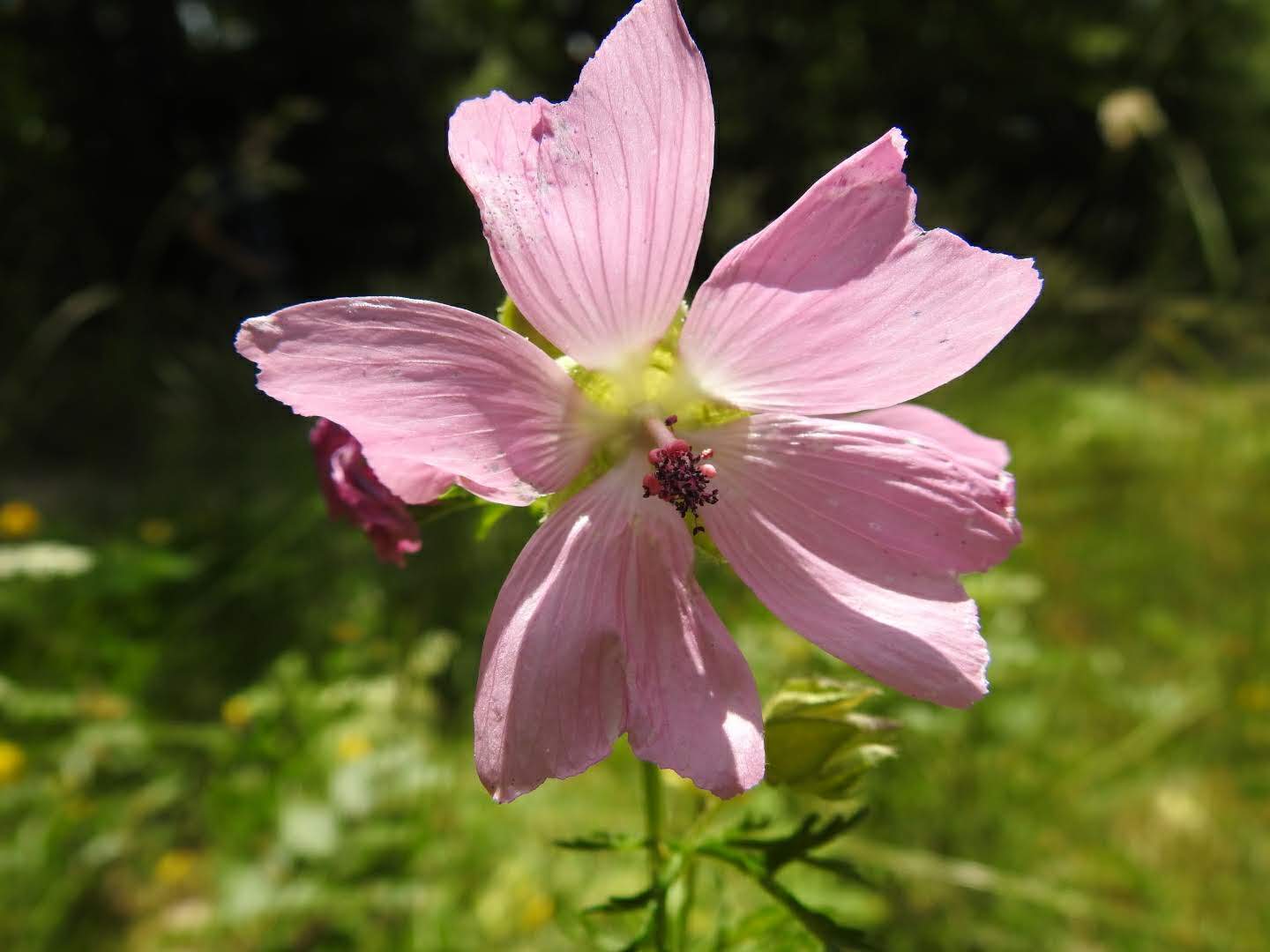
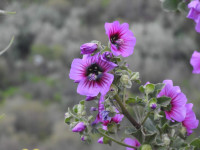
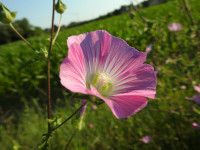
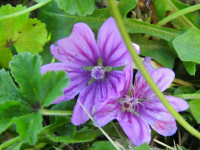
The flowers are solitary or gathered in small clusters, intense pink-purple in color, with petals 20 to 25 mm long (up to 35 mm according to some sources), notched at the apex, and arranged on a long peduncle that can reach up to 35 cm during fruiting. The calyx consists of two whorls: the epicalyx, external, is made up of 3 lanceolate, linear segments 5-6 mm long, much smaller than the sepals; the latter are ovate, 5-7 mm wide and 9-10 mm long, with broad triangular lobes. The stamens are numerous and fused into a tube surrounding the style, which bears 11-15 branched stigmas.
The fruit is a schizocarp composed of 12-16 mericarps arranged radially in a disc; each mericarp is 1.5-2 mm long, rounded in shape, with a dorsal surface densely covered by white hairs, while the sides are smooth and thin. The seeds are small, about 1.2-1.5 mm long.
The root system is typical of perennial herbs, with buds located at ground level, allowing the plant to reproduce and survive over time.
Habitat and distribution
The species is widespread throughout the Italian territory and Mediterranean regions, with a range extending from Western and Central Europe to North Africa (Morocco) and the Mediterranean area. It preferably grows in open habitats such as uncultivated lands, road edges, hedges, meadows, and forest clearings, especially on siliceous and nitrate-rich soils. It can be found from sea level up to about 1500 meters in altitude.
It prefers sunny or partially shaded exposures, in thermophilic and submontane environments, but is adaptable to various light and soil conditions.
Flowering period
Flowering typically extends from May to September, with a higher concentration in the summer months. In some more northern or mountainous areas, flowering may be shorter and concentrated in the warmer months.
Ecology and pollination
The plant is mainly pollinated by pollinating insects, including bees, bumblebees, and butterflies, attracted by the vivid color and abundant production of pollen and nectar. The flowers, hermaphroditic and actinomorphic, have a structure that favors insect visits, with stamens fused to form a column around the style, facilitating pollen transfer. Seed dispersal occurs mainly by falling to the ground, with the mericarps equipped with hairs that can favor some secondary transport by wind or animals.
Curiosities and traditional uses
The name “malva” derives from the Greek "malàtto" or "malàkhe," meaning “to soften” or “emollient,” referring to the soothing and calming properties common to many species of the genus. The specific epithet “moschata” refers to the musk scent, recalled by the Arabic term “musk.”
Musk Mallow has been known since antiquity for its medicinal properties: the leaves and flowers contain mucilages with emollient, anti-inflammatory, and mildly laxative action. They have traditionally been used to soothe internal mucous membrane disorders such as gastritis, laryngitis, and cough. Young leaves, boiled and seasoned, are edible and used in some local cuisines as a vegetable. In popular cosmetics, the leaves were used for refreshing and relaxing skin masks.
It is important to emphasize that food and medicinal uses should always be considered with caution and do not replace medical advice.
Etymology
The genus name “Malva” derives from ancient Greek terms related to the softness and emollient properties of the plant. The adjective “moschata” recalls the musky fragrance of the flowers, linked to the Arabic term “musk.” In Italian it is known as “Musk Mallow” to underline this typical olfactory characteristic.
Sources
- Prof. S. Pignatti, Flora d’Italia
- Acta Plantarum – Flora delle regioni italiane
- Tela Botanica / H. Coste, Flore descriptive et illustrée de la France
- World Flora Online (WFO)
Characteristics
Scheda botanica
| Famiglia | Malvaceae |
|---|---|
| Fioritura | maggio – agosto |
| Forma biologica | Scapose |
| Habitat | with pink flowers, Perennial plant, plant with dimorphic leaves |
Domande frequenti
- Quando fiorisce Musk Mallow?
- Musk Mallow fiorisce maggio – agosto.
- Che tipo di pianta è Musk Mallow?
- Musk Mallow è una Hemicryptophytes (Scapose) secondo la classificazione di Raunkiaer.
- A quale famiglia appartiene Musk Mallow?
- Musk Mallow appartiene alla famiglia botanica Malvaceae.
Where I found it (4 sightings)
Classification
- Kingdom
- Plantae
- Family
- Malvaceae
- Full name
- Malva moschata L.
- Life form
- Hemicryptophytes scapose
Similar species
Search for species with similar characteristicsFurther reading
Noticed an error in the identification? Write to me
Other species of the same family
Malvaceae
Explore
Other species of Malvaceae