Botanical family
Malvaceae
Description
Botanical characteristics
The Malvaceae are a family of herbaceous, shrubby, or sometimes tree-like plants, generally characterized by a covering of stellate hairs that gives the leaves and stems a velvety or tomentose appearance. The leaves are alternate, petiolate, and provided with stipules, often arranged spirally.
The flowers are hermaphroditic, actinomorphic (radially symmetrical), and pentamerous, generally solitary. The calyx is formed by five sepals that may be more or less fused at the base; moreover, an epicalyx (calyculus) is often present externally, consisting of free or fused parts. The corolla is composed of five petals, free or fused at the base of the staminal tube. The androecium is very characteristic: it presents numerous stamens whose filaments are fused to form a tube (monadelphous) that surrounds the style. The ovary is superior and pluricarpellate, formed by five or more carpels, each containing a single ovule.
The fruit is typically a poliachenous schizocarp, consisting of as many mericarps as there are carpels. These mericarps are generally indehiscent and separate at maturity by detachment, sometimes by destruction of the receptacle (as in Malva), or the fruit may be a loculicidal capsule.
Distribution and diversity
The Malvaceae are mainly distributed in temperate and tropical regions worldwide, with a greater presence in warm areas. The family includes about 250 genera and over 4,000 species, showing a remarkable variety of forms and ecological adaptations. Modern phylogenetic classification has expanded the concept of Malvaceae to include genera previously assigned to the families Bombacaceae, Sterculiaceae, and Tiliaceae.
Main genera and representative species
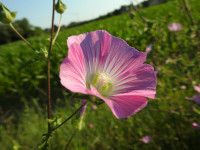
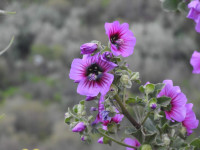
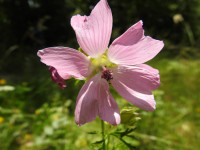
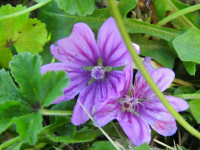
Among the most important genera of the family are Malva, Hibiscus, Gossypium (cotton), Abelmoschus (okra), Corchorus (jute), and Hibiscus (hibiscus). In Italy, species of the genus Malva are particularly common, such as Malva sylvestris, easily recognizable by their pink-violet flowers with darker veins.
Some species have great economic and cultural value: cotton (Gossypium spp.) for textile fibers; jute (Corchorus spp.) and kenaf (varieties of Hibiscus cannabinus) for fabric fibers; okra (Abelmoschus esculentus), a food plant widespread in tropical regions; and hibiscus, widely cultivated as an ornamental plant.
Etymology
The family name derives from the genus Malva, which in turn takes its name from the Latin "malva," a term used since antiquity to indicate plants with emollient and medicinal properties.
Curiosities and uses
The Malvaceae are of considerable ecological and economic importance. Besides the primary textile fibers (cotton, jute, kenaf), some species are used as food or ornamental plants. Okra, for example, is highly appreciated in the cuisine of various tropical areas, while hibiscus is known for its decorative flowers and use in herbal teas (hibiscus tea).
Some Malvaceae species are also used in phytotherapy for their emollient and soothing properties, especially in preparations against mucous membrane inflammations.
Sources
- Wikipedia
Species of the family
4 species catalogued
Explore
Other botanical families