Botanical species
Linum usitatissimum
L.
Flax
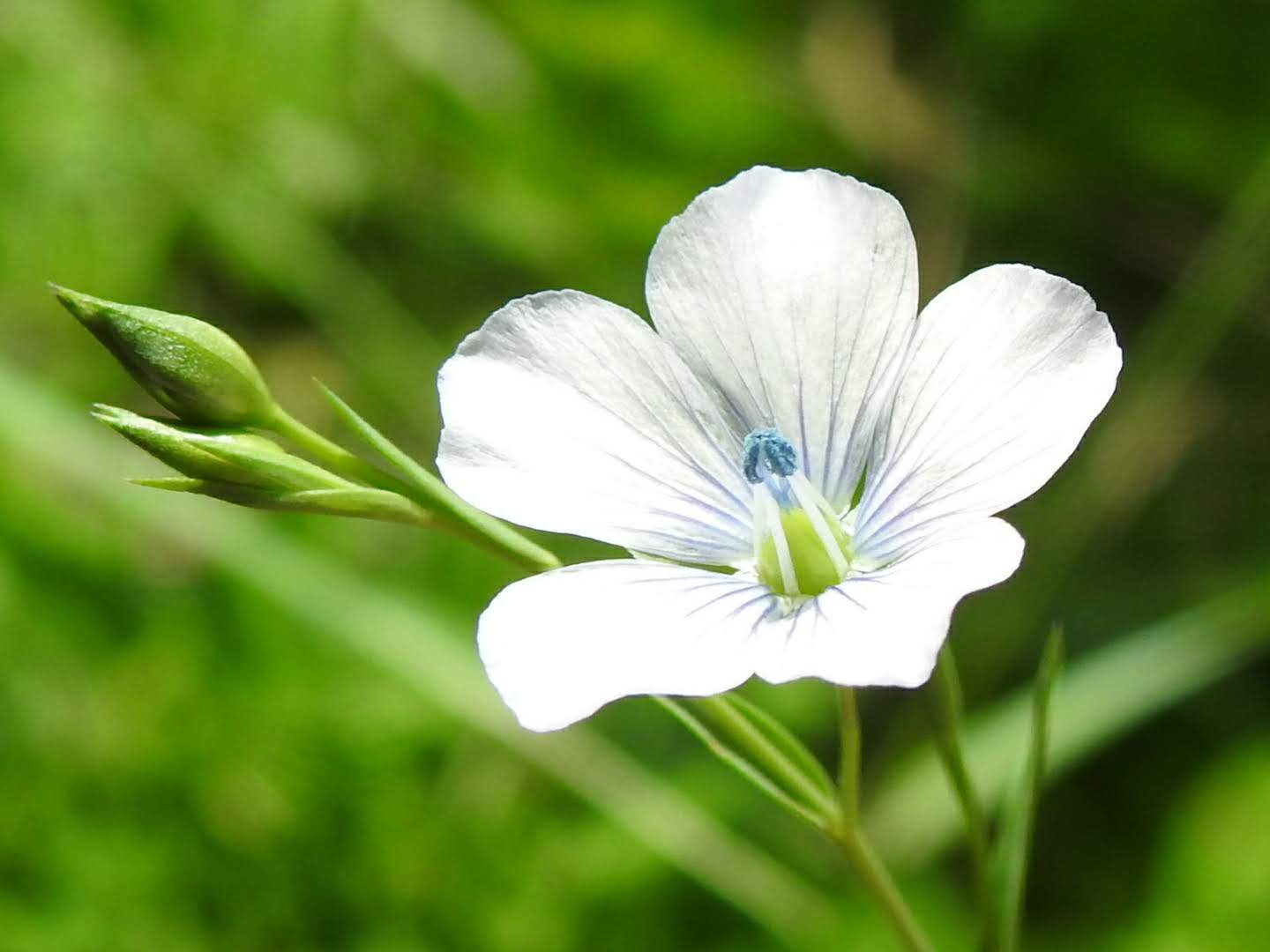
Description
Morphological description
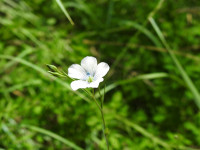
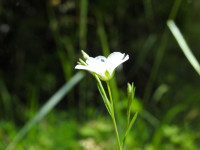
Flax is an annual herbaceous plant that reaches a height between 20 and 80 cm. The habit is scapose, meaning it has an elongated floral axis, often leafless, with a generally simple, erect, and glabrous stem, smooth in surface and tough in texture. The leaves are alternate, linear-lanceolate in shape, with entire margins and herbaceous texture; their size varies from 1 to 4 cm in length and 1.5–3 mm in width, with three prominent veins.
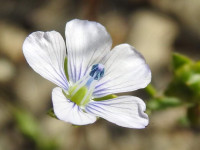
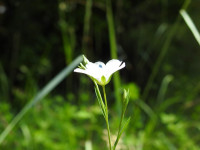
The flowers are solitary, placed at the apex of the floral axis in a scorpioid cyme 5 to 15 cm long. They have a scapose, elevated habit and are characterized by five elliptical or ovate sepals, 6-9 mm long, with membranous and ciliate margins at the upper part. The petals, about 12-15 mm long (about three times the length of the calyx), are intense blue or white, lanceolate in shape, and open shortly before anthesis. The stigmas are clavate in shape and exceed 0.8 mm in length.
The fruit is a woody capsule, oval in shape, 6-9 mm long and 5-15 mm wide, containing five double locules. The seeds are flattened, oily, brown in color, 3-4 mm long, and have a characteristic apex. The root system is not particularly developed, typical of cultivated annual plants, with relatively shallow roots.
Habitat and distribution
Flax is a species of uncertain origin, probably derived from Linum bienne through artificial selection. It is present throughout the Mediterranean basin and in adjacent areas of Central Europe and Western Asia, but is found only as a cultivated plant or occasionally escaped following cultivation. It is not recorded as truly wild.
In Italy and the Mediterranean, it grows mainly in hilly and mountainous environments, up to about 1200 m altitude, often in ruderal areas or cultivated lands. It prefers sunny exposures and well-drained soils, although its traditional cultivation is now almost abandoned. The species adapts to different soil types but is generally cultivated in fertile and moderately moist substrates.
Flowering period
The flowering mainly extends from May to July, with possible variations depending on altitude and latitude. In Italy, the flowering phase is concentrated in late spring and early summer, when the blue or white flowers open to allow pollination.
Ecology and pollination
Flax reproduces mainly through entomophilous pollination, with the intervention of pollinating insects attracted by the vivid color of the blue or white petals. The floral structure, with long petals and prominent stigmas, facilitates pollination by bees and other pollinating insects.
Seed dispersal occurs mainly through direct fall from the mature capsule, which opens to release the flattened and oily seeds. In cultivation, harvesting is done manually or mechanically before the capsules fully open to avoid spontaneous dispersal.
Curiosities and traditional uses
Flax is one of the oldest known textile plants, cultivated for over 5000 years in Mesopotamia, Egypt, and prehistoric Europe, as evidenced by archaeological finds. It has traditionally been cultivated for the fiber obtained from the stem, used for the production of fine fabrics, and for the seeds, from which linseed oil is extracted, known for its high content of unsaturated fatty acids and dietary and medicinal properties.
Flax fiber was obtained through maceration of the stems and subsequent spinning, and for millennia it was the most important textile fiber in Europe and the Mediterranean, only recently replaced by cotton, jute, and synthetic fibers. In Italy, cultivation is now almost abandoned.
Flax seeds are used in food, especially in animal husbandry, and for the production of flour and oil, also employed in medicine for their emollient and laxative properties. In folklore and popular culture, flax has a symbolic value linked to purity and domestic protection.
Etymology
The scientific name Linum derives from the Greek λίνον (línon), later passed to Latin as linum, which indicates the flax plant. The specific epithet usitatissimum is a Latin superlative meaning “very used,” “very common,” emphasizing the historical and cultural importance of the species.
The common Italian name “lino” also derives from Latin linum, and is present in many European languages with similar roots (e.g., French lin, German Lein). The word reflects the long tradition of using the plant for fibers and edible seeds.
Sources
- Prof. P.V. Arrigoni, "Flora analitica della Toscana", "Flora dell'Isola di Sardegna"
- Acta Plantarum - Flora delle regioni italiane (scheda di Giuliano Salvai)
- World Flora Online (WFO)
Characteristics
Scheda botanica
| Famiglia | Linaceae |
|---|---|
| Fioritura | maggio – luglio |
| Forma biologica | Scapose |
| Habitat | with white flowers, edible plant, with blue flowers |
| Uso alimentare | Commestibile |
| Uso officinale | Pianta officinale |
Domande frequenti
- Quando fiorisce Flax?
- Flax fiorisce maggio – luglio.
- È commestibile Flax?
- Flax è considerata commestibile. Verifica sempre le parti eduli e la preparazione corretta prima del consumo.
- Che tipo di pianta è Flax?
- Flax è una Therophytes (Scapose) secondo la classificazione di Raunkiaer.
- A quale famiglia appartiene Flax?
- Flax appartiene alla famiglia botanica Linaceae.
Where I found it (9 sightings)
Classification
- Kingdom
- Plantae
- Family
- Linaceae
- Full name
- Linum usitatissimum L.
- Life form
- Therophytes scapose
Similar species
Search for species with similar characteristicsNoticed an error in the identification? Write to me
Explore
Other species of Linaceae