Botanical species
Fumaria officinalis
L.
Common Fumitory
Description
Morphological description
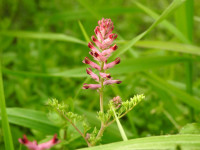
Annual herbaceous plant, Fumaria officinalis has an erect or sometimes subscandent habit, with branched, slender stems of greenish color often characterized by purplish shades. The height generally varies between 10 and 30 cm. The stem is glabrous and jointed, with thin branches supporting the terminal inflorescence.
The leaves are alternate, long-petioled, brown-green or glaucous in color, with a herbaceous texture. The leaf blade is bipinnatisect or tripinnatisect, with narrow and linear segments deeply incised up to the main vein; the derived segments are also divided once or twice, giving the foliage a finely divided and delicate appearance.
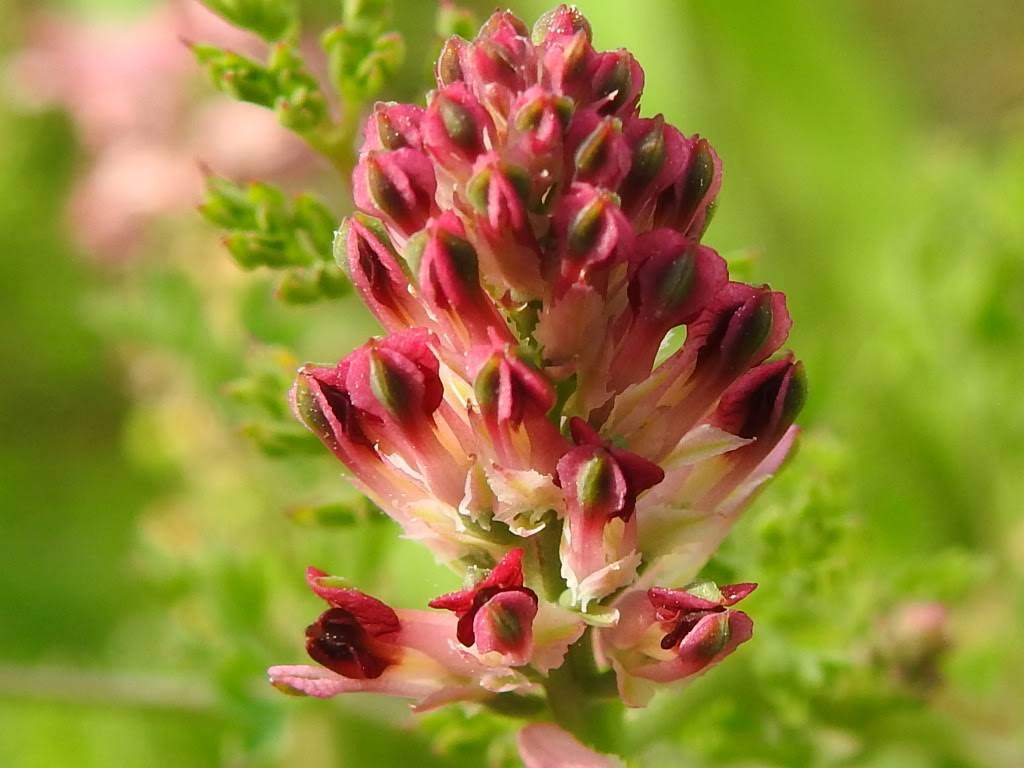
The flowers are grouped in terminal racemose inflorescences, opposite the leaves, which during flowering are dense and usually contain from 20 to 30 small flowers. Each flower measures about 6–7 mm in length and has bilateral (zygomorphic) symmetry. The corolla is composed of four petals of pink or purple color, with darker tones towards the throat. The two inner petals are oblong and fused at the apex, while the upper petal is provided posteriorly with a characteristic whitish spur, and the lower one is simple and free. The calyx is formed by two oval, toothed, and deciduous sepals, narrower than the corolla, about 1.5–3.5 mm long. There are six stamens arranged in two groups, with basifixed and dimorphic anthers of whitish or purplish color. The style is single and thin, ending with a bilobed stigma, sometimes with a small central tooth.
The fruit is a nuciform achene, round, green with a slightly rough surface, about 2 mm long and sometimes somewhat compressed and truncated at the apex. Each fruit contains a single seed with abundant endosperm.
The root system is taprooted, with a main root of white-yellowish color.
Habitat and distribution
Fumaria officinalis is a subcosmopolitan species, widely distributed in almost all temperate zones of the world, including the Mediterranean basin and Italy, where it is present from sea level up to about 1600 meters of altitude. It prefers anthropized habitats such as cultivated fields, uncultivated lands, road edges, paths, and ruins. It grows on soils of various nature, often disturbed, with predominantly sunny or semi-shaded exposure.
In Italy it is a very common and frequent species, often considered a weed due to its ability to rapidly colonize agricultural and uncultivated environments.
Flowering period
The flowering period generally extends from May to August, with possible variations linked to climatic and altitudinal conditions. In some regions, flowering can start as early as April and continue until September.
Ecology and pollination
Fumaria officinalis is visited by numerous pollinating insects, particularly bees, which collect pollen. The shape of the flowers, with the zygomorphic corolla and spur, is adapted to favor entomophilous pollination, in which insects, attracted by color and nectar, facilitate pollen transfer. The species is hermaphroditic and reproduces through seeds contained in achenes, which are mainly dispersed by falling near the mother plant.
Curiosities and traditional uses
Fumaria officinalis has been known since antiquity for its medicinal properties, as indicated by the specific name. It contains alkaloids (such as prototropine called fumarine), fumaric acid, bitter substances, flavonoids, and tannins. It has traditionally been used as a bitter herb with tonic action, slightly diuretic and laxative, vermifuge, and anti-inflammatory. In folk medicine it was used to improve liver and gallbladder functions, to relieve biliary colics and migraines related to digestive disorders, as well as for external treatments in cases of conjunctivitis, eczema, and dermatitis.
In the past, syrup obtained from the plant juice, mixed with damask rose, peach, or senna flowers, was considered an effective remedy against melancholy and hypochondria. The plant is also appreciated for its attractiveness to bees, which collect its pollen.
In French folklore, fumaria (called fumeterre) was such as to merit a day dedicated to it in the French republican calendar (March 3).
Warning: medicinal use must be carried out with caution, as in excess fumaria can cause drowsiness and has some toxicity.
Etymology
The genus name derives from the Latin fūmus, meaning “smoke”, which probably refers to the finely divided and light foliage appearance, similar to a cloud of smoke, or to the acrid odor the plant emits when burned, capable of causing tearing. An ancient medieval legend describes it as "smoke of the earth", as if it were born not from seeds but from smoke rising from the ground.
The specific name officinalis indicates the medicinal properties attributed to the plant.
The common Italian name “fumaria” also derives from Latin and recalls these same characteristics.
Sources
- Acta Plantarum - Flora delle regioni italiane (actaplantarum.org)
- Acta Plantarum - Flora delle regioni italiane (scheda di Marinella Zepigi)
- World Flora Online (WFO)
Characteristics
Where I found it (8 sightings)
Classification
- Kingdom
- Plantae
- Family
- Papaveraceae
- Full name
- Fumaria officinalis L.
- Life form
- Terofite scapose
Similar species
Search for species with similar characteristicsFurther reading
Noticed an error in the identification? Write to me
Other species of the same family
Papaveraceae
Explore
Other species of Papaveraceae