Botanical species
Fumaria capreolata
L.
White Ramping-Fumitory
Description
Morphological description
Annual herbaceous plant, glabrous, with a climbing and erect habit, light green or glaucous in color, often with a milky appearance. The stem, up to one meter long, is slightly grooved, branched and flexible; it spirals to cling to nearby plants or structures, facilitating its upward growth. The leaves are alternate, arranged in a basal rosette and along the stem; they are bipinnatisect, deeply divided into thin segments and incised-lobed, gray-green in color with frequent purple shades.
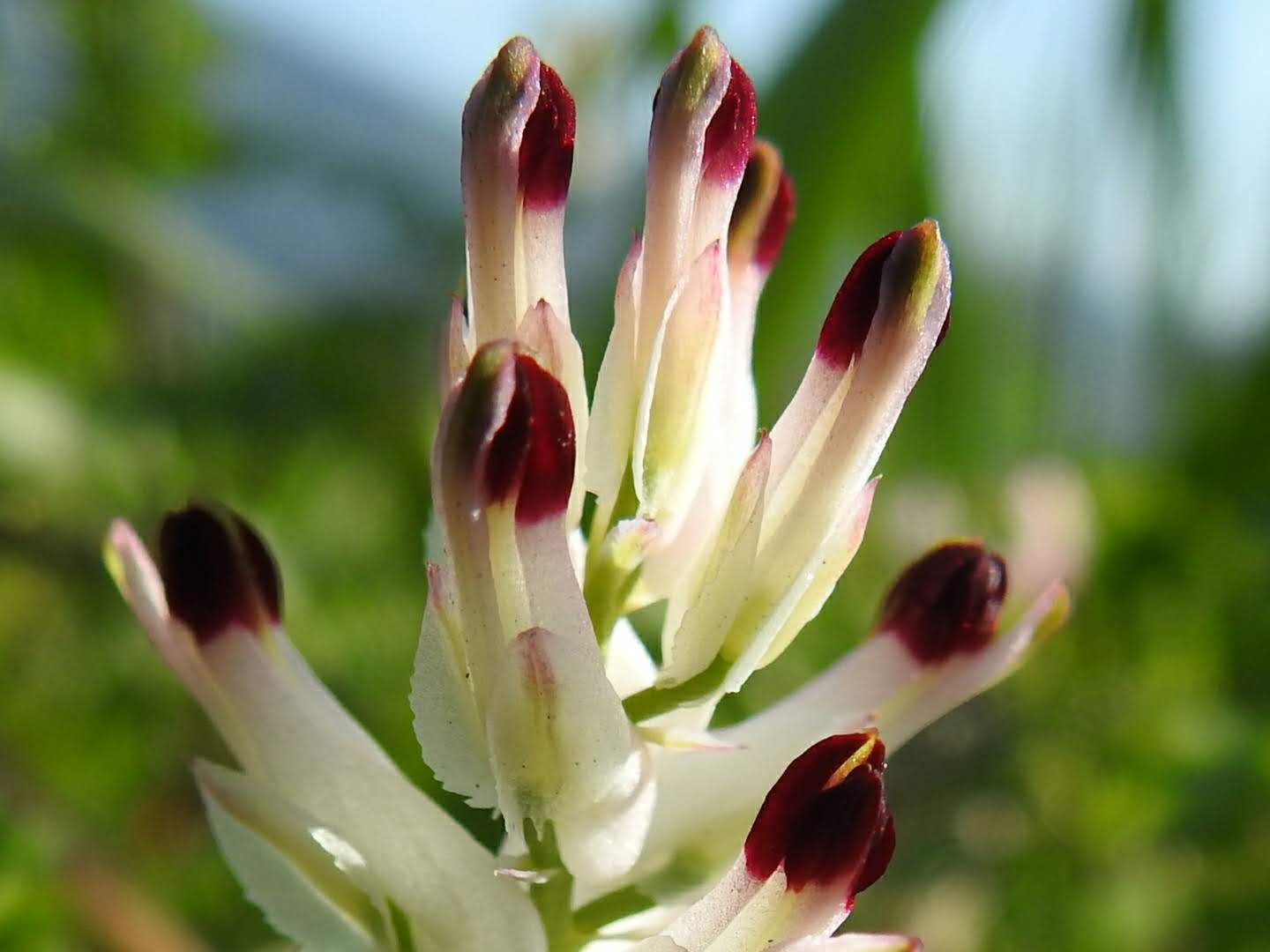
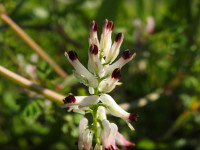
The flowers, hermaphroditic and bilabiate, are grouped in racemose inflorescences 6-8 cm long. Each flower measures between 9 and 14 mm in length and has a tubular shape with an apical spur. The corolla is composed of four petals: the upper one is compressed, while the three lower ones have the edge turned upwards. The external coloration of the petals is white, while the internal part is white near the base and fades into dark red or violet towards the apex. The sepals, two per flower, are oblong, white with a central green vein, slightly toothed and wider than the corolla, reaching about half its length. It also has two trifid stamens.
The peduncle supporting the flower, at maturity, folds into a hook and measures from one to three times the length of the basal bract. The flowers are initially erect but, with aging, they tilt downwards. The fruit is a small pendent achene, smooth, globose and slightly compressed, with a diameter of about 2-2.5 mm, containing numerous seeds.
The root system is not described in detail in the sources, but as an annual herbaceous plant it is presumed to have superficial fibrous roots suitable for well-drained soils.
Habitat and distribution
The species is mainly widespread in Mediterranean regions, with a range extending also northwards and eastwards into temperate Europe and North Africa. In Italy it commonly grows from the plains up to 1,200 meters altitude, preferring environments such as hedgerows, rocky places, cultivated or uncultivated fields, walls, vegetable gardens, vineyards and gardens. It adapts to variable soils but typically well-drained and rich in organic matter, with preferably sunny or partially shaded exposure. It is also present in low-altitude mountainous environments.
Flowering period
Flowering generally extends from December to May, with local variations due to climatic and altitudinal conditions. In the Mediterranean the most intense season is spring, while in more northern or mountainous areas flowering may concentrate between April and May.
Ecology and pollination
The plant, thanks to its climbing structure and bilabiate tubular flowers with a spur, is adapted to entomophilous pollination. Pollinating insects, especially bees and bumblebees, are attracted by the contrasting colors of the corolla (white with red-violet apex) and the nectar contained in the spur. The arrangement of the flowers in racemes facilitates access for pollinating insects.
Seed dispersal occurs through the pendent fruits, which detach easily and can be transported by animals or abiotic agents such as wind or water. The plant also exploits a rapid annual biological cycle to quickly colonize disturbed or marginal environments.
Curiosities and traditional uses
White Ramping-Fumitory is a medicinal species known since antiquity for its pharmacological properties. It is considered toxic but has been used in folk medicine and phytotherapy as a remedy for gastric colics, gastritis, skin inflammations and wounds. Its effects are mainly laxative, tonic, diuretic and purifying.
Besides medicinal use, the plant was also employed as a natural dye. The common name “fumaria” and the Latin name derive from the term "fumus" (smoke), probably due to the “misty” appearance of the gray-green leaves or the irritating smoke released when burned.
No significant alimentary or edible uses are documented, and its toxicity discourages direct consumption.
Etymology
The generic name “Fumaria” derives from the Latin fumus, meaning smoke. There are several explanations: some authors link the name to the misty and shaded appearance of the leaves, others to the fact that the plant, when burned, emits an irritating smoke. An ancient medieval legend told that the plant was born not from seeds but from the smoke of the earth (fumus terrae).
The specific epithet “capreolata” refers to the shape of the inflorescences, which divide and tangle like horns or branches, evoking the idea of “horns” or “branches” (from Latin capra, goat).
The Italian common name “White Ramping-Fumitory” refers to the predominant color of the flowers, mainly white with red-violet shades inside.
Sources
- Acta Plantarum - Flora delle regioni italiane (actaplantarum.org)
- Acta Plantarum - Flora delle regioni italiane (scheda di Marinella Zepigi)
- Tela Botanica / H. Coste, "Flore descriptive et illustrée de la France"
- World Flora Online (WFO)
Characteristics
Scheda botanica
| Famiglia | Papaveraceae |
|---|---|
| Fioritura | gennaio, febbraio, marzo, aprile, maggio, dicembre |
| Forma biologica | Scapose |
| Habitat | with white flowers, toxic plant, with purple flowers |
| Tossicità | Tossica — non consumare |
| Uso officinale | Pianta officinale |
Domande frequenti
- Quando fiorisce White Ramping-Fumitory?
- White Ramping-Fumitory fiorisce gennaio, febbraio, marzo, aprile, maggio, dicembre.
- È tossica White Ramping-Fumitory?
- White Ramping-Fumitory è una pianta tossica o velenosa. Non consumare nessuna sua parte senza aver consultato un esperto.
- Che tipo di pianta è White Ramping-Fumitory?
- White Ramping-Fumitory è una Therophytes (Scapose) secondo la classificazione di Raunkiaer.
- A quale famiglia appartiene White Ramping-Fumitory?
- White Ramping-Fumitory appartiene alla famiglia botanica Papaveraceae.
Where I found it (9 sightings)
Classification
- Kingdom
- Plantae
- Family
- Papaveraceae
- Full name
- Fumaria capreolata L.
- Synonyms
- Fumaria nemorosa Lojac.
- Life form
- Therophytes scapose
Similar species
Search for species with similar characteristicsFurther reading
Noticed an error in the identification? Write to me
Other species of the same family
Papaveraceae
Explore
Other species of Papaveraceae