Botanical species
Papaver rhoeas
L.
Corn Poppy
Description
Morphological description
Annual herbaceous plant, the common poppy presents a scapose habit with erect, branched stems covered with bristly, long and patent hairs, which give the plant a hirsute appearance. The height generally varies between 20 and 80 cm, with stems of light green color tending to yellowish. The root system consists of a white taproot, typical of therophytes.
The lower leaves are arranged in a basal rosette and are pinnatifid, with lanceolate or elliptical segments, dentate or crenate-dentate margin and acute apex; the base is long-petiolate. The cauline leaves are simpler, sessile and often triangular in outline with patent basal lobes. Both leaf surfaces are covered with soft and silky hairs. The basal leaves can reach 10 cm in length and 2 cm in width, while the cauline ones are smaller (3-7 cm).
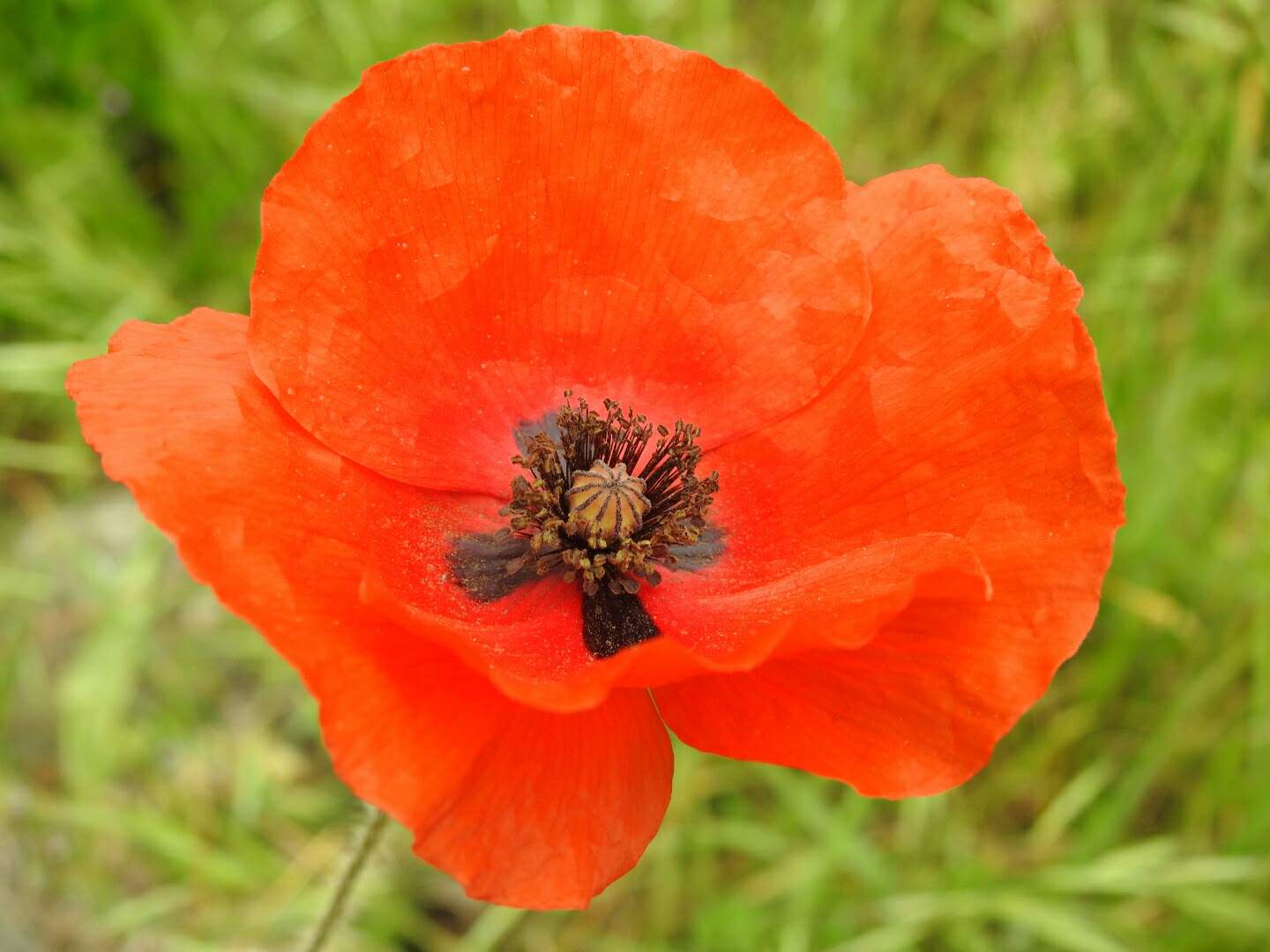
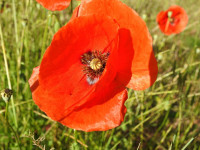
The flowers, large and showy, are solitary and positioned at the apex of long peduncles which are also hairy. The diameter of the corolla varies from 5 to 7 cm. The corolla is composed of four rounded petals, bright red in color, often with a dark spot at the base, but may occasionally show violet, pink, orange or white shades. The petals are delicate and very ephemeral, generally lasting only one day or slightly more. The calyx is formed by two green, bristly sepals that fall off at flowering. Numerous stamens with thin violet filaments and blackish anthers surround the glabrous obovoid ovary. The stigmas are from 7 to 12, arranged on a lobed disc with lobes overlapping at the margins.
The fruit is a glabrous capsule, oval-sub-spherical in shape, 7-18 mm long, with a flat and lobed stigma at the top. The capsule contains a large number of small, kidney-shaped, grayish and reticulated seeds, which at maturity come out through openings located at the base of the stigma. Each plant can produce from 10,000 to 20,000 seeds, which can maintain viability in the soil for up to 40 years.
The entire plant emits a characteristic odor and produces a white, acrid milky sap.
Habitat and distribution
The common poppy is a species widely distributed throughout the Italian territory and the eastern Mediterranean basin. It grows spontaneously in open environments such as cultivated fields, dry uncultivated lands, road edges, railways and ruderal areas. It is particularly frequent in cereals and other crops, where it can behave as a weed.
It prefers well-drained soils, medium texture, with sunny exposure. It adapts to different altitudes, from sea level up to hilly and medium altitude mountain areas. In the eastern Mediterranean regions and southern Europe it is commonly found up to about 900 meters of altitude.
Flowering period
Flowering mainly occurs from March to June, with peaks between May and July in more temperate areas. In Italy and Mediterranean regions, the period may vary slightly depending on local climatic conditions, anticipating in milder climate zones and delaying in cooler or mountainous ones.
Ecology and pollination
The common poppy is an entomophilous species, mainly pollinated by pollinating insects such as bees, bumblebees and butterflies, attracted by the bright color of the petals and the presence of numerous stamens rich in pollen. The ephemeral but abundant flowering favors rapid pollination.
Seed dispersal occurs mainly by barochory: at maturity, the capsule opens at small openings under the stigma, allowing the seeds to fall onto the surrounding soil. The large quantity of seeds produced and their long viability in the soil contribute to the species' ability to rapidly colonize new environments, often linked to agricultural activity or disturbed habitats.
Curiosities and traditional uses
The common poppy has a long history of ethnobotanical and cultural use. The petals, rich in anthocyanins, were used to obtain red dyes used as natural cosmetics for lips and cheeks. The seeds are edible and used in baking and in the preparation of sweets; from them an oil with good dietary, soothing and emollient qualities can be extracted.
In medicine, the plant is known for its astringent, sedative, analgesic, antispasmodic, anti-inflammatory and expectorant properties. It contains alkaloids, mucilages and resins, and although the presence of morphine is not confirmed, it has traditionally been used as a mild remedy against cough and respiratory inflammations. Historical applications included the treatment of toothache through infusions compresses and massage of reddened or rough skin.
From a folkloric point of view, the poppy has been a symbol of sleep and death in ancient myths, probably due to its sedative effect and the intense color of the flowers. In the past, popular games related to fresh capsules were widespread, such as creating "stamps" and "dolls".
Etymology
The genus name "Papaver" probably derives from Latin, which in turn refers to the Celtic "papa", a term indicating a pap or soft food, perhaps in reference to the traditional use of seeds and sap to promote sleep, especially in children.
The specific name "rhoeas" is connected to the Greek "rheo" (to flow away), recalling the ephemerality of the petals, easily detached and carried by the wind, or to "róia" (pomegranate), referring to the vivid red color of the flowers.
The common Italian name "papavero" also derives from the Latin "papaver", maintaining the historical root associated with the plant.
Sources
- Prof. S. Pignatti, "Flora d'Italia"
- Acta Plantarum - Flora delle regioni italiane (sheet by Marinella Zepigi)
- Tela Botanica / H. Coste, "Flore descriptive et illustrée de la France"
- World Flora Online (WFO)
Characteristics
Where I found it (6 sightings)
Classification
- Kingdom
- Plantae
- Family
- Papaveraceae
- Full name
- Papaver rhoeas L.
- Synonyms
- Papaver rhoeas L. var. strigosum Boenn.; Papaver strigosum (Boenn.) Schur
- Life form
- Terofite scapose
Similar species
Search for species with similar characteristicsFurther reading
Noticed an error in the identification? Write to me
Other species of the same family
Papaveraceae
Explore
Other species of Papaveraceae