Botanical species
Ecballium elaterium
(L.) A.Rich.
Squirting Cucumber
Description
Morphological description
Perennial herbaceous plant belonging to the Cucurbitaceae family, it is characterized by a bushy habit with creeping, rough and fleshy stems that can reach a height of about 80 cm. The stem is robust, succulent, without tendrils and covered with stiff hairs that give the entire plant a rough and slightly glaucous appearance.
The leaves are ovate-cordate or triangular heart-shaped, with variable dimensions from 3-7 cm wide and 4-10 cm long up to 8-20 × 6-15 cm depending on the specimens. They are thick, fleshy and green-gray in color, with the lower surface covered by a dense whitish pubescence (abaxial pubescence) that makes them lighter than the upper surface, which is also bristly. The leaf margin is wavy and toothed, while the petiole is long, robust and also covered with stiff hairs, measuring from 5 to 15 cm.
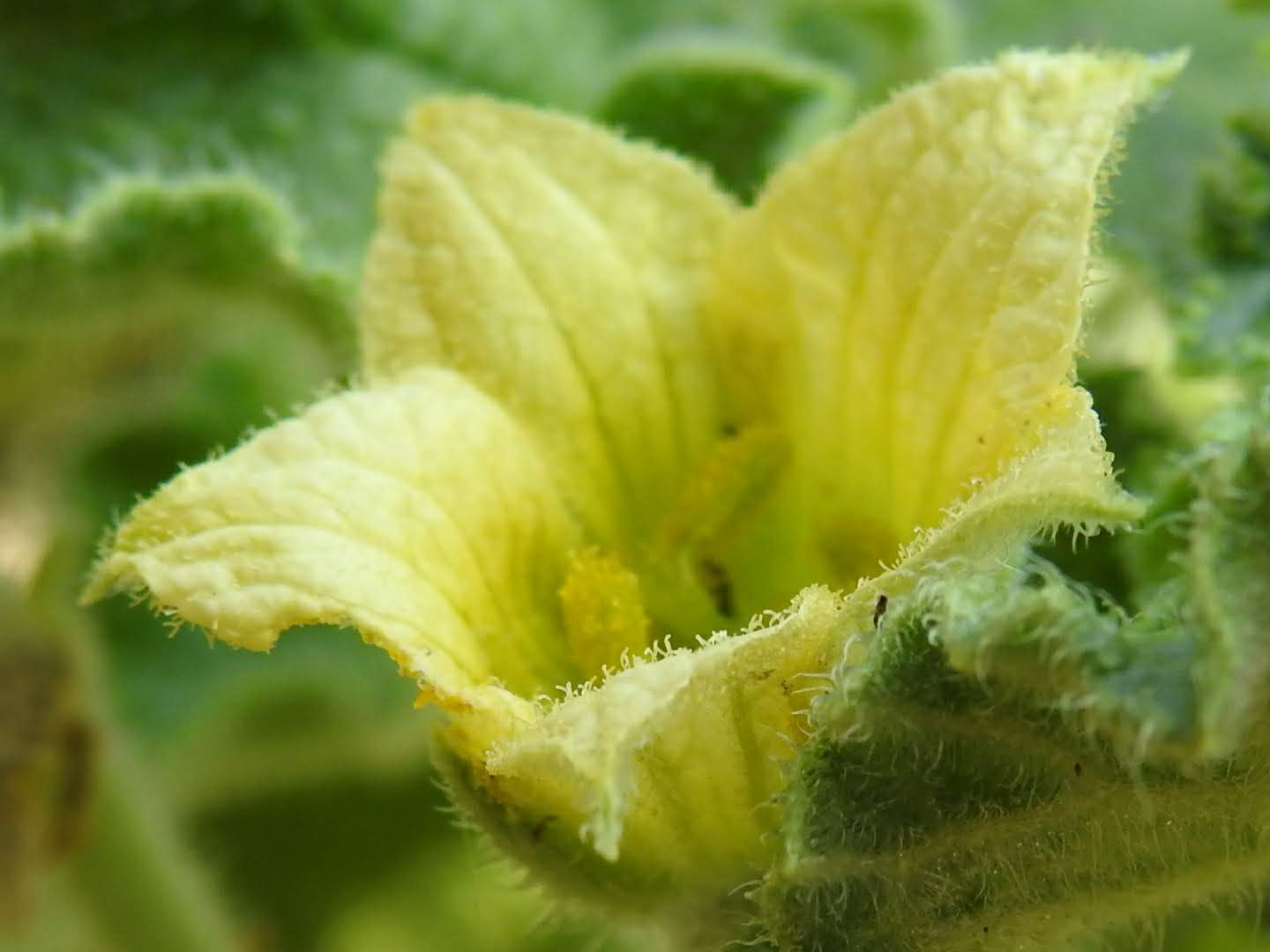
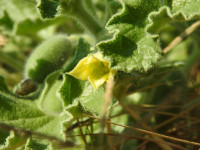
The flowers are monoecious and pale yellow, sometimes with green veins. The male flowers are grouped in axillary racemes, while the female flowers are solitary and shorter, placed directly on the branches. The corolla is rotate and formed by five ovate-oblong petals, with a diameter that can reach 15-30 mm. The sepals are lanceolate, about 5-6 mm long and densely pubescent, while the filaments are hairy at the base.
The fruit is an ovoid or oblong-ovoid berry, with variable dimensions between 1-2 cm wide and 2-5 cm long, covered with stiff and rough hairs of green-yellowish color. The peduncle is hooked, with the fruit attachment facing upwards. At maturity, due to the formation of internal gases caused by tissue decay, the fruit detaches violently from the peduncle projecting the seeds and the bitter mucilaginous liquid at a considerable distance (over one meter). The seeds are about 4 mm long and are immersed in a toxic and eye-irritating liquid.
The roots are robust, fleshy and tuberous, allowing the plant to survive in drought conditions.
Habitat and distribution
The species is widespread in the Mediterranean regions of Europe, Asia and Africa, with a range centered on the Mediterranean coasts but also extending towards more northern and eastern areas. In Italy it grows mainly in semi-arid and uncultivated areas, preferring stony, dry, sandy or rubble-rich soils, often near the coasts up to 800 meters of altitude.
It is common in the central-southern and insular regions, where it finds optimal environmental conditions for its development. It frequents road edges, abandoned lands, embankments and sunny exposed areas.
Flowering period
Flowering extends from May to September, with some possible local variations linked to the climate. During these months the characteristic yellow flowers can be observed, which contribute to the identification of the species.
Ecology and pollination
The yellow flowers attract various pollinating insects, which contribute to the plant's pollination. The species is monoecious, with male and female flowers separated on the same individual, favoring effective sexual reproduction.
Seed dispersal occurs in a particular way: the mature fruit suddenly detaches due to the internal pressure generated by gases produced by tissue decomposition. This ballistic mechanism allows the seeds to be projected at a considerable distance from the mother plant, facilitating the colonization of new habitats. The mucilaginous liquid in which the seeds are immersed is toxic and irritating, a defense mechanism that limits predation.
Curiosities and traditional uses
The common name "Squirting Cucumber" derives from the fruit which resembles a small watermelon but with very different characteristics, including toxicity and the seed projection mechanism.
The plant has been known since antiquity for its medicinal properties, although it is highly toxic. It contains active principles such as elaterin, elaterinide, cucurbitacins and alkaloids (cinoglossine and consolicine), which confer purgative, diuretic and antirheumatic properties. Traditionally it has been used as a remedy for renal edema, rheumatism and biliary problems, both internally and externally, although with great caution due to its toxicity.
In popular use, in some Mediterranean regions, the fruit juice was used as an emetic or to treat animal scabies. The plant is also considered a strong irritant, and contact with the fruit liquid can cause severe eye irritation and gastrointestinal disorders if ingested.
From an economic point of view, the species belongs to the same family as important food crops such as watermelon, melon, pumpkin and cucumber, although it is not used for food purposes due to its toxicity.
Etymology
The genus name derives from the ancient Greek “ekballein”, meaning "to throw out", referring to the characteristic way the fruit projects the seeds at maturity. The specific name “elaterium” derives from “elatèr”, a Greek term meaning "stimulating" or "stretching", probably referring to the purgative effects of the plant.
The Italian common name "cocomero asinino" recalls the appearance of the fruit similar to a small watermelon, but with peculiar properties and shapes that clearly distinguish it from other cultivated cucurbits.
Sources
- Prof. P.V. Arrigoni, "Flora analitica della Toscana", "Flora dell'Isola di Sardegna"
- Acta Plantarum - Flora delle regioni italiane (scheda di Marinella Zepigi)
- Tela Botanica / H. Coste, "Flore descriptive et illustrée de la France"
- World Flora Online (WFO)
Characteristics
Scheda botanica
| Famiglia | Cucurbitaceae |
|---|---|
| Fioritura | maggio – ottobre |
| Forma biologica | Creeping plants |
| Habitat | with yellow flowers, creeping plant, succulent plant |
| Tossicità | Tossica — non consumare |
Domande frequenti
- Quando fiorisce Squirting Cucumber?
- Squirting Cucumber fiorisce maggio – ottobre.
- È tossica Squirting Cucumber?
- Squirting Cucumber è una pianta tossica o velenosa. Non consumare nessuna sua parte senza aver consultato un esperto.
- Che tipo di pianta è Squirting Cucumber?
- Squirting Cucumber è una Hemicryptophytes (Creeping plants) secondo la classificazione di Raunkiaer.
- A quale famiglia appartiene Squirting Cucumber?
- Squirting Cucumber appartiene alla famiglia botanica Cucurbitaceae.
Where I found it (8 sightings)
Classification
- Kingdom
- Plantae
- Family
- Cucurbitaceae
- Full name
- Ecballium elaterium (L.) A.Rich.
- Synonyms
- Momordica elaterium L.
- Life form
- Hemicryptophytes creeping plants
Similar species
Search for species with similar characteristicsFurther reading
Noticed an error in the identification? Write to me
Explore
Other species of Cucurbitaceae