Botanical family
Cucurbitaceae
Description
Botanical characteristics
Plants belonging to the family Cucurbitaceae are mostly annual or perennial herbs, although some species appear as woody lianas, spiny shrubs, or even trees, as in the case of the genus Dendrosicyos. The stems are generally hairy and have a pentagonal cross-section. A distinctive feature of the family is the tendrils, supporting organs that develop at 90° to the leaf petioles at the nodes.
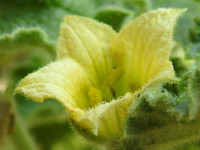
The leaves are alternate and palmately lobed, of variable shape but generally broad and divided into well-defined lobes. The flowers are unisexual and gamopetalous, that is, with petals united together, and typically pentamerous, meaning composed of five elements per whorl. Plants can be monoecious, with male and female flowers separate on the same plant, or dioecious, with male and female flowers on distinct plants. Female flowers have an inferior ovary.
The typical fruit of the family is called a pepo, a modified berry characterized by an outer rind that is more or less hard and a fleshy pulp containing numerous seeds. These fruits vary enormously in size and weight: ranging from very large specimens, such as the pumpkin which can reach 90-100 kg, to smaller fruits like the cucumber, which weighs only a few hundred grams.
Distribution and diversity
Cucurbitaceae are mainly widespread in tropical regions, where most species are found in the wild. However, some species are also native to temperate climate areas, such as Europe and North America, although in these cases many are cultivated as annuals during the warm season. The family includes more than 100 genera, with a predominantly tropical distribution.
Main genera and representative species
Among the best-known and most important genera from a food and agricultural perspective are Cucurbita, Cucumis, and Citrullus. Some of the species most familiar to humans include:
- Cucurbita pepo, from which zucchini, yellow pumpkin, and Naples pumpkin are derived
- Cucumis sativus, the cucumber
- Citrullus lanatus, the watermelon
- Cucumis melo, the melon
These species are among the first plants cultivated by humans both in the Old and New World and represent one of the plant families with the highest number of species used for food purposes.
Etymology
The name of the family derives from the Latin cucurbita, which means "pumpkin". This term reflects the historical importance and widespread use of pumpkin species in human nutrition and agricultural culture.
Curiosities and uses
Cucurbitaceae have very high ecological and cultural importance. Beyond their food use, which has very ancient roots, many of these plants are appreciated for their ornamental value. Moreover, several species are studied for their medicinal properties, although this aspect is not explored in the consulted sources.
From an agronomic point of view, all Cucurbitaceae species fear cold and must be cultivated under conditions that avoid sudden temperature changes to ensure optimal growth.
Sources
- Wikipedia
Species of the family
1 species catalogued
Explore
Other botanical families