Botanical species
Carpobrotus edulis
(L.) N.E.Br.
Hottentot-Fig
Description
Morphological description
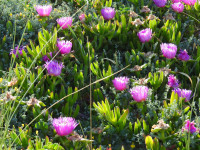
Succulent perennial plant, characterized by a creeping habit with herbaceous stems that can reach 2-3 meters in length. The stems are robust, about 10-15 mm thick, with winged internodes and persistent bark of leathery texture. The root system is fibrous, suitable for anchoring the plant in sandy and marine environments.
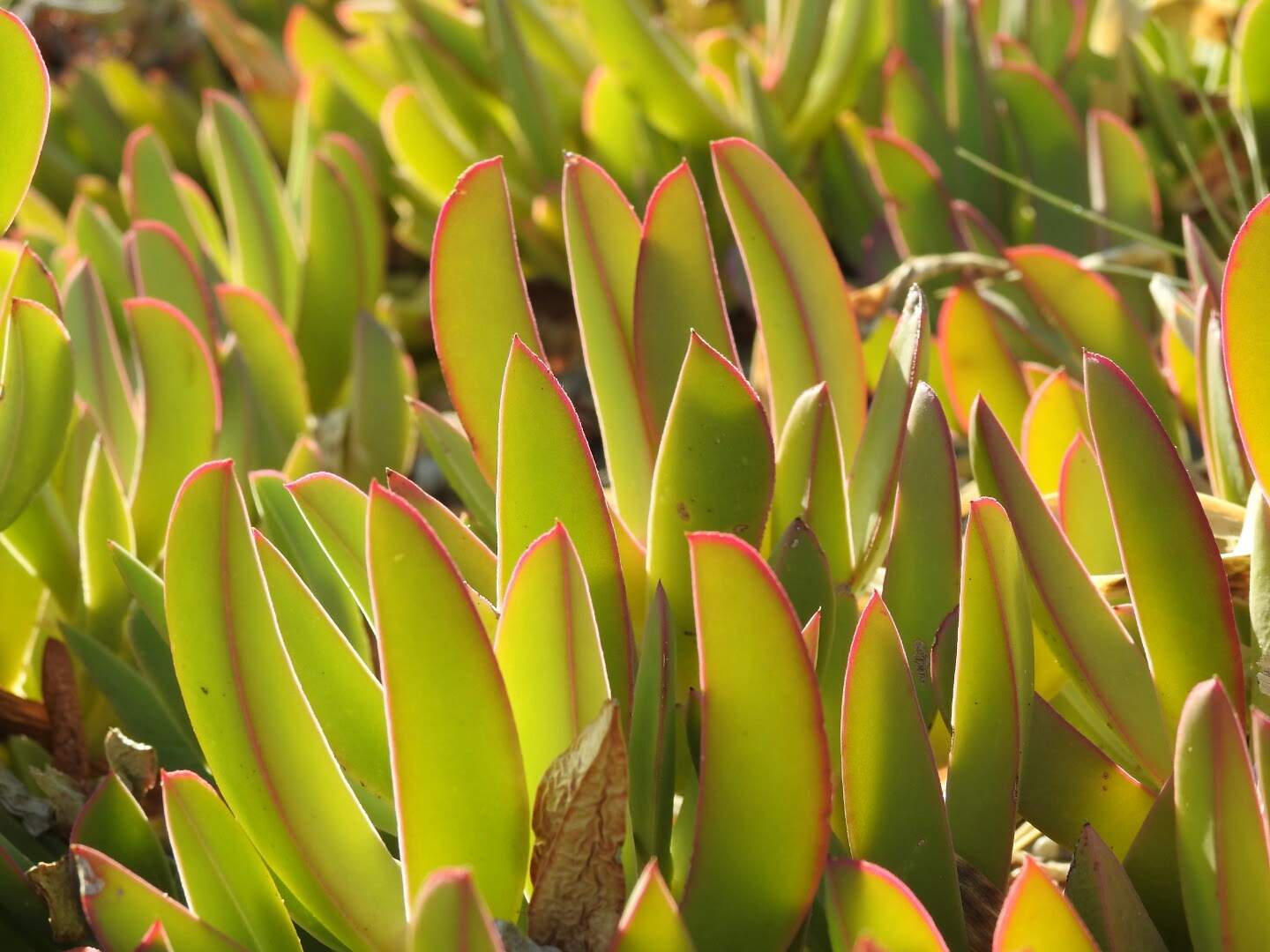
The leaves are opposite, fleshy and glabrous, dull or pale green in color, with an elongated shape ranging from linear to lanceolate. They are typically 8 to 12 cm long (sometimes up to 14 cm) and up to 13 mm wide, presenting a distinctly triangular cross-section with an acute apex. The upper surface is concave and the outer angle near the apex is slightly serrated.
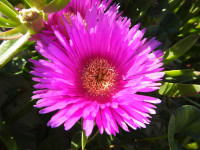
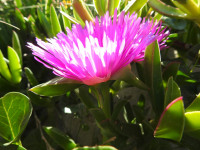
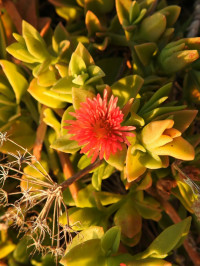
The flowers are solitary, pedunculate, of considerable size, with a diameter ranging from 6 to 10 cm. The corolla is composed of numerous petals (between 100 and 200) arranged in 2-4 (sometimes up to 5) series; the petals are initially bright yellow and tend to fade to fuchsia or pink with age. The numerous stamens, also yellow, are arranged in 4-7 series and can be simple or plumose. The stigmas, about 8-15 mm long, radiate above the fruit during maturation.
The fruit is a fleshy berry, club-shaped or subglobose, with a slightly depressed apex, yellowish in color and about 20-35 mm in size. Each fruit is divided into 7-14 locules and contains a high number of seeds, about 1000. The berry is indehiscent and produces small and numerous seeds.
Habitat and distribution
This species is native to the coastal areas of South Africa, but today it is widely naturalized in many Mediterranean regions, including Italy, where it is mainly found along sandy coasts and coastal dunes. It prefers marine environments, with full sun exposure and sandy or arid soils, often near the shoreline.
In Italy it is mainly present in southern and insular regions, in areas with a warm and dry Mediterranean climate. It grows from sea level up to modest altitudes, generally not exceeding 100-200 meters, where sandy and saline conditions favor it.
Flowering period
Flowering mainly occurs in spring and early summer, between April and May. The period may vary slightly depending on latitude and local climatic conditions, with earlier or prolonged flowering in warmer or temperate areas.
Ecology and pollination
The large and conspicuously colored flowers are adapted for pollination by pollinating insects, particularly bees and other hymenopterans attracted by the yellow petals that age to fuchsia. The presence of numerous stamens and abundant pollen production make the species very effective reproductively.
The fleshy fruits, rich in seeds, favor dispersal by frugivorous animals, which consume the berries and spread the seeds through their feces, thus contributing to the colonization of new sites, especially in coastal sandy environments.
Curiosities and traditional uses
The Hottentot fig is known for its edible properties: the fruits are sweet and can be eaten fresh or made into jams. The plant has been traditionally used in various cultures for food and medicinal purposes, especially for its emollient and soothing properties, effective in treating minor skin disorders or inflammations.
In ornamental use, thanks to its ability to quickly cover the ground and resist arid and saline conditions, it is often used for stabilizing coastal dunes and as a groundcover plant in Mediterranean areas.
The common name "Hottentot fig" derives from the Khoikhoi people (called Hottentots), the original inhabitants of South Africa, from which the species originates. The botanical term "Carpobrotus" derives from the Greek "karpos" (fruit) and "brotos" (edible), emphasizing the edibility of the fruit.
Etymology
The generic name Carpobrotus refers to the edible nature of the fruit (from Greek: "karpos" = fruit and "brotos" = edible). The specific epithet edulis means "edible" in Latin, also recalling the plant's food use.
The Italian common name "fico degli Ottentotti" recalls the original geographic origin of the species, associated with the Khoikhoi population (also called Hottentots), native to South Africa, from which the plant was introduced into the Mediterranean basin.
Sources
- Prof. S. Pignatti, Flora d'Italia
- Tela Botanica / H. Coste, Flore descriptive et illustrée de la France
- World Flora Online (WFO)
Characteristics
Where I found it (4 sightings)
Classification
- Kingdom
- Plantae
- Family
- Aizoaceae
- Full name
- Carpobrotus edulis (L.) N.E.Br.
- Synonyms
- Carpobrotus edulis (L.) L.Bolus, isonym; Mesembryanthemum edule L.
- Life form
- Camefite suffruticose
Similar species
Search for species with similar characteristicsNoticed an error in the identification? Write to me
Other species of the same family
Aizoaceae
Explore
Other species of Aizoaceae