Botanical species
Mesembryanthemum cordifolium
L.f.
Brack Mesemb
Description
Morphological description
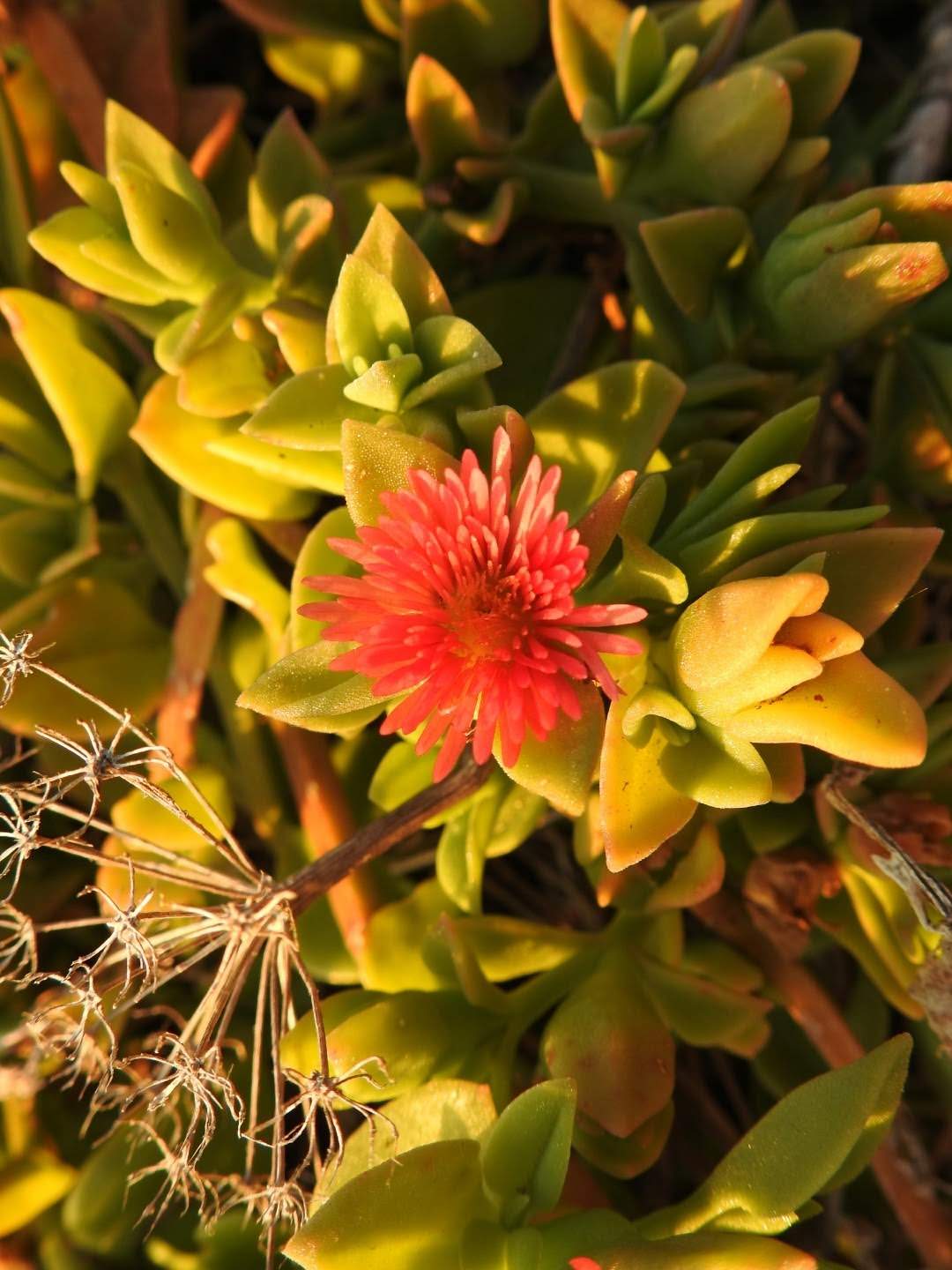
It is a perennial succulent plant, with a creeping or slightly erect habit, forming wide herbaceous mats often adhering to the ground. The maximum height reaches about 25 cm. The stem is quadrangular and robust, suitable to support the plant during its prostrate growth.
The leaves are opposite, fleshy and thick in texture, a typical characteristic of succulent plants, which allows water storage to withstand drought conditions. Their shape is distinctive, heart-shaped (cordate) with entire margins, flat and covered by transparent vesicular cells, which give a slightly "crystalline" appearance. These vesicular cells help reflect light and limit water loss.
The flowers are solitary, intense red or magenta in color, with numerous thin and slightly elongated petals. The flower diameter can reach 20 mm. Flowering is abundant and widespread along the stems, contributing to create patches of vivid color. The fruits are capsules without wings on the valves, a feature that differentiates the species from related ones.
The root system is generally superficial, suitable to anchor the plant in sandy or rocky soils typical of the coastal environments where it lives.
Habitat and distribution
The species prefers marine coastal environments, often in sandy or semi-shaded areas, where the substrate is well-drained and rich in sand. In Italy and the Mediterranean it is mainly found along the coasts, particularly in regions with mild and temperate climates, where it occurs at low altitudes, from sea level up to a few dozen meters.
Its presence is typical of psammophilous habitats, i.e., sandy environments exposed to marine conditions, such as coastal dunes and cliffs. It is a plant adapted to tolerate salinity and strong sunlight, thanks to its succulent features and leaf structure that limits evapotranspiration.
Flowering period
Flowering extends from December to April, with some variability depending on latitude and local environmental conditions. In milder climates, such as Mediterranean coastal ones, the species can flower over longer or earlier periods, while in other areas it may be limited to the central winter months and early spring.
Ecology and pollination
The flowers, thanks to their bright color and open structure, attract various pollinating insects, particularly bees and other generalist pollinators, which facilitate fertilization. The plant employs a predominantly entomogamous reproductive strategy (pollination by insects). Seed dispersal occurs through capsules which, once mature, release the seeds near the mother plant; the absence of wings on the valves suggests that dispersal mainly occurs by dropping and subsequent limited transport by external agents such as wind or water.
Curiosities and traditional uses
This species, thanks to its hardiness and decorative habit, is widely cultivated in Mediterranean gardens as a groundcover plant, especially in coastal areas or rock gardens. Although no specific traditional food or medicinal uses are known for Brack Mesemb, its ability to survive in arid and saline environments makes it an interesting subject for the recovery and stabilization of degraded or sandy soils.
Etymology
The generic name "Mesembryanthemum" derives from Greek and means “midday flower” or “midday bloom”, referring to the habit of many species to open their flowers only during the central hours of the day, when there is intense sunlight. The specific epithet "cordifolium" clearly indicates the shape of the leaves, “heart-shaped” (from Latin cordi- = heart, and folium = leaf). The Italian common name "erba cristallina a foglie cordate" instead recalls the translucent and fleshy appearance of the leaves, which seem crystalline, and their cordate shape.
Sources
- Tela Botanica / H. Coste, "Flore descriptive et illustrée de la France"
- World Flora Online (WFO)
Characteristics
Where I found it (2 sightings)
Classification
- Kingdom
- Plantae
- Family
- Aizoaceae
- Full name
- Mesembryanthemum cordifolium L.f.
- Synonyms
- Aptenia cordifolia (L.f.) Schwantes
- Life form
- Camefite suffruticose
Similar species
Search for species with similar characteristicsFurther reading
Noticed an error in the identification? Write to me
Other species of the same family
Aizoaceae
Explore
Other species of Aizoaceae