Botanical family
Aizoaceae
Description
Botanical characteristics
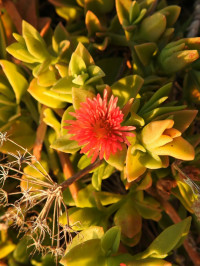
The plants belonging to this family are generally herbaceous, but some species may have a woody habit. A distinctive feature is the presence of succulent, more or less fleshy leaves, which lack stipules and can be arranged alternately or oppositely on the branches. The flowers are hermaphroditic and actinomorphic, that is radially symmetrical, and occur solitary or grouped in cymes. The calyx is pentamerous, composed of five sepals, while the corolla can be very developed with numerous petals or absent. The androecium is characterized by a large number of stamens, often arranged in multiple whorls. The ovary can be superior or inferior, multilocular, with five stigmas. The typical fruit is a capsule, which opens to release the seeds.
These botanical traits are common to many succulent species, but the combination of fleshy leaves without stipules, flowers with many stamens, and capsular fruits distinguishes this family from other related ones.
Distribution and diversity
The family has its greatest biodiversity in southern Africa, where most genera and species are found. However, some species are also present in other regions of the world, including tropical Africa, Europe, Asia, Australia, North America, and South America. Overall, the family comprises about 120 genera distributed in five main subfamilies, with a rich variety of species, many of which are adapted to arid climates and semi-desert environments.
Main genera and representative species
Among the most important genera are:
- Mesembryanthemum, known for its succulent species with showy flowers.
- Lithops, also called "living stones" for their mimicry with the surrounding environment.
- Carpobrotus, often used as an ornamental plant in coastal gardens.
- Delosperma, appreciated for its colorful flowers and resistance to harsh conditions.
- Aizoon, with herbaceous species widespread in various areas.
In Italy, some spontaneous or naturalized species are present especially in Mediterranean climates and arid environments, but most genera remain typical of extra-European areas.
Etymology
The name of the family derives from the Greek ἀεί (aeí), meaning "always", and ζῷον (zôon), meaning "living being". This name reflects the ability of many species of this family to survive in harsh conditions, thanks to their succulent characteristics that allow them to store water and remain vital even in arid environments.
Curiosities and uses
The plants of this family are mainly appreciated for their ornamental value, thanks to the peculiar shapes of the succulent leaves and often very decorative flowers. They are used in rock gardens, cold greenhouses, and succulent plant collections. Cultivation requires particular care: the leaves may dry out before the new growth phase, but it is important to avoid excessive watering during this period. They are not hardy and do not tolerate intense and prolonged cold. In summer they prefer sunny positions, while coloration is better with partial shade exposure. Propagation is often difficult, especially by cuttings, and sowing can be long and delicate, with a low germination rate.
Sources
- Wikipedia (Aizoaceae)
Species of the family
2 species catalogued

Explore
Other botanical families