Description
Botanical characteristics
The Lythraceae are a family of angiosperm plants that includes herbaceous, shrubby, and tree forms, as well as aquatic species. The habit ranges from herbs and shrubs to trees, with some species typical of wet areas, such as mangroves. The leaves are generally opposite, although they can also be alternate or whorled, with a simple structure.
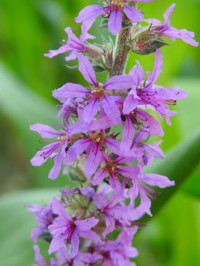
The flowers are often conspicuous and colorful, arranged singly or in various types of inflorescences, such as racemes or panicles, which can be terminal or axillary. The corolla consists of 4-6 sepals and petals, which are fused at the base. The stamens are numerous, in multiples of 4 or 6, arranged in two series. The ovary is usually superior and formed by 2-4 fused carpels. The most common fruit is a capsule that opens at maturity, although berries are found in rare cases.
Distribution and diversity
The family has a cosmopolitan distribution, concentrating mainly in temperate-warm and tropical climate regions, but also present in temperate-cold climate areas. Lythraceae prefer humid environments and are rare or absent in desert regions. They include over 600 species divided into about 28 genera, with remarkable diversity in both forms and habitats.
Main genera and representative species
In Italy the family is represented by some spontaneous genera including Ammannia, Lythrum, and Trapa. The genus Lythrum, from which the family name derives, includes herbaceous species typical of wet environments. The genus Trapa comprises aquatic plants known for their peculiar fruits. Other genera of interest, often cultivated as ornamentals also in Italian climates, are Lagerstroemia, appreciated for its showy flowering, and Punica, known for the species Punica granatum, the pomegranate.
Etymology
The family name derives from the type genus Lythrum, originally indicated by the name Lythrariae. The denomination was proposed in 1805 and refers directly to this genus, which represents the nomenclatural type.
Curiosities and uses
The Lythraceae include species of ornamental interest, such as Lagerstroemia, widely used to beautify gardens and parks thanks to its showy flowers. Some genera play an important ecological role in wet and aquatic environments, contributing to biodiversity and ecosystem stability. The pomegranate (Punica granatum), although not spontaneous in Italy, is known worldwide for its edible fruits and nutritional properties.
Sources
- Wikipedia (Lythraceae)
- Provided botanical database
Species of the family
1 species catalogued
Explore
Other botanical families