Botanical species
Valerianella carinata
Loisel.
Keeled-Fruited Cornsalad
Description
Morphological description
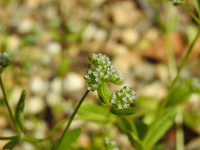
The plant has a scapose habit with dichotomously branched stems, which are thick at the base, from striated to narrowly winged and more or less rough to the touch. The stem develops in a branched and ascending manner, a characteristic that gives the plant a branched and compact appearance. Overall dimensions may vary, but generally the stems reach a contained height typical of annual herbaceous species.
The leaves are spatulate, with a truncate base and dentate margin, often darkly serrated. The upper leaves are sessile and have reticulated veins on the underside, with a width of about 6-9 mm and a length between 30 and 40 mm. The leaf base is semi-amplexicaul, meaning partially clasping the stem.
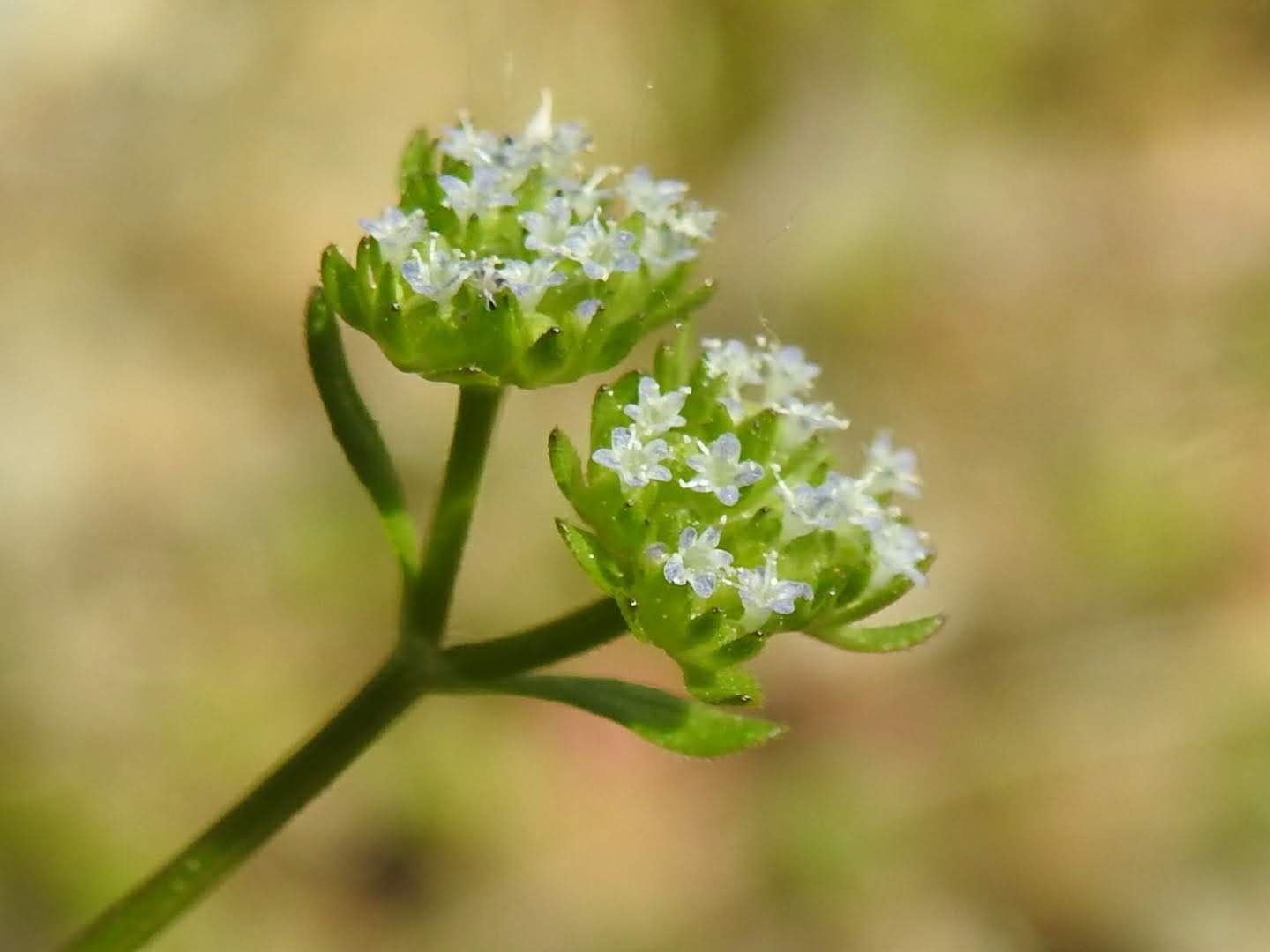
The inflorescence consists of 2-4 elongated dichotomies bearing dense clusters of small white or white-violet flowers, with corollas about 1.5 mm in diameter. The flowers, predominantly white in color, are typical of the family Valerianaceae and give the plant a delicate appearance.
The fruit is a prismatic-oblong achene, quadrangular with a deep longitudinal groove on one of its faces. It measures about 2 mm and is generally glabrous. The calyx is reduced to a short tooth of about 0.2 mm resting on the fruit, a distinctive element compared to related species. In cross-section, the fruit appears isodiametric, with the fertile locule slightly larger than the sterile one, which is partially fused and delimits the deep groove.
The root system, typical of annual herbaceous species from wet or semi-aquatic environments, is generally fibrous and shallow, suitable for stabilizing the plant in often soft or moist soils.
Habitat and distribution
The species is mainly found in hilly and medium-altitude mountainous areas, typically between 400 and 1,200 meters above sea level. In Italy it is found in environments such as cultivated fields, path edges, vineyards, and open areas with fresh and well-drained soils, but with a certain tendency to moisture, often near wetlands or with seasonal water presence.
The species prefers bright or partially shaded exposures, typical of open environments or field margins. At the Mediterranean level, it is mainly widespread in the central-northern regions, where climatic and soil conditions are favorable for its development.
The habitat is characterized by medium-textured soils, with good water retention capacity, but not excessively moist permanently, reflecting its adaptability to sub-aquatic conditions or temporarily wet soils.
Flowering period
Flowering mainly occurs between April and June, with variations depending on altitude and latitude. In the northernmost or mountainous regions, flowering may be concentrated in the central spring months, while in milder areas it can start as early as April.
This time window coincides with late spring, a favorable period for pollination and fruit dispersal before summer.
Ecology and pollination
The plant reproduces mainly through entomogamous pollination, attracting small pollinating insects such as bees and midges, attracted by the white flowers and their arrangement in dense clusters. The compact structure of the inflorescences and the small size of the flowers facilitate visits by small insects.
Seed dispersal mainly occurs by falling near the mother plant, with possible secondary transport by insects or water, given the preference for wet or sub-aquatic environments. The presence of the deep groove on the fruit may facilitate adhesion or transport in a wet environment.
Curiosities and traditional uses
No particular ethnobotanical or medicinal applications are known for this species, nor evidence of use in food or local folklore. However, many related species of Valerianella are appreciated for their edible properties, such as valerianella locusta, known as “lamb's lettuce” or “corn salad.”
The species, due to its presence in hilly and agricultural environments, can be considered indicative of fresh and well-managed soils, representing a useful element for the biodiversity of spontaneous crops.
Etymology
The genus name “Valerianella” is a diminutive of “Valeriana,” which derives from the Latin “valere” (to be well, to be strong), referring to the medicinal properties attributed to common valerian. The specific epithet “carinata” derives from the Latin “carina,” meaning “keel,” referring to the deep and characteristic groove present on one face of the fruit, similar to the shape of a boat’s keel.
The Italian common name “Keeled-Fruited Cornsalad” recalls the shape of the fruit and the delicate habit of the plant, with “gallinella” being a traditional name attributed to several species of the genus Valerianella due to their widespread presence in fields and meadows.
Sources
- Prof. S. Pignatti, "Flora d'Italia"
- World Flora Online (WFO)
Characteristics
Where I found it (7 sightings)
Classification
- Kingdom
- Plantae
- Family
- Valerianaceae
- Full name
- Valerianella carinata Loisel.
- Synonyms
- Fedia carinata (Loisel.) Steven; Masema carinatum (Loisel.) Dulac; Valeriana carinata (Loisel.) Christenh. & Byng; Valerianella locusta (L.) Laterr. f. carinata (Loisel.) Devesa, J.López & R.Gonzalo
- Life form
- Terofite scapose
Similar species
Search for species with similar characteristicsNoticed an error in the identification? Write to me
Other species of the same family
Valerianaceae
Explore
Other species of Valerianaceae