Botanical species
Valeriana rubra
L.
Valeriana rossa
Description
Morphological description
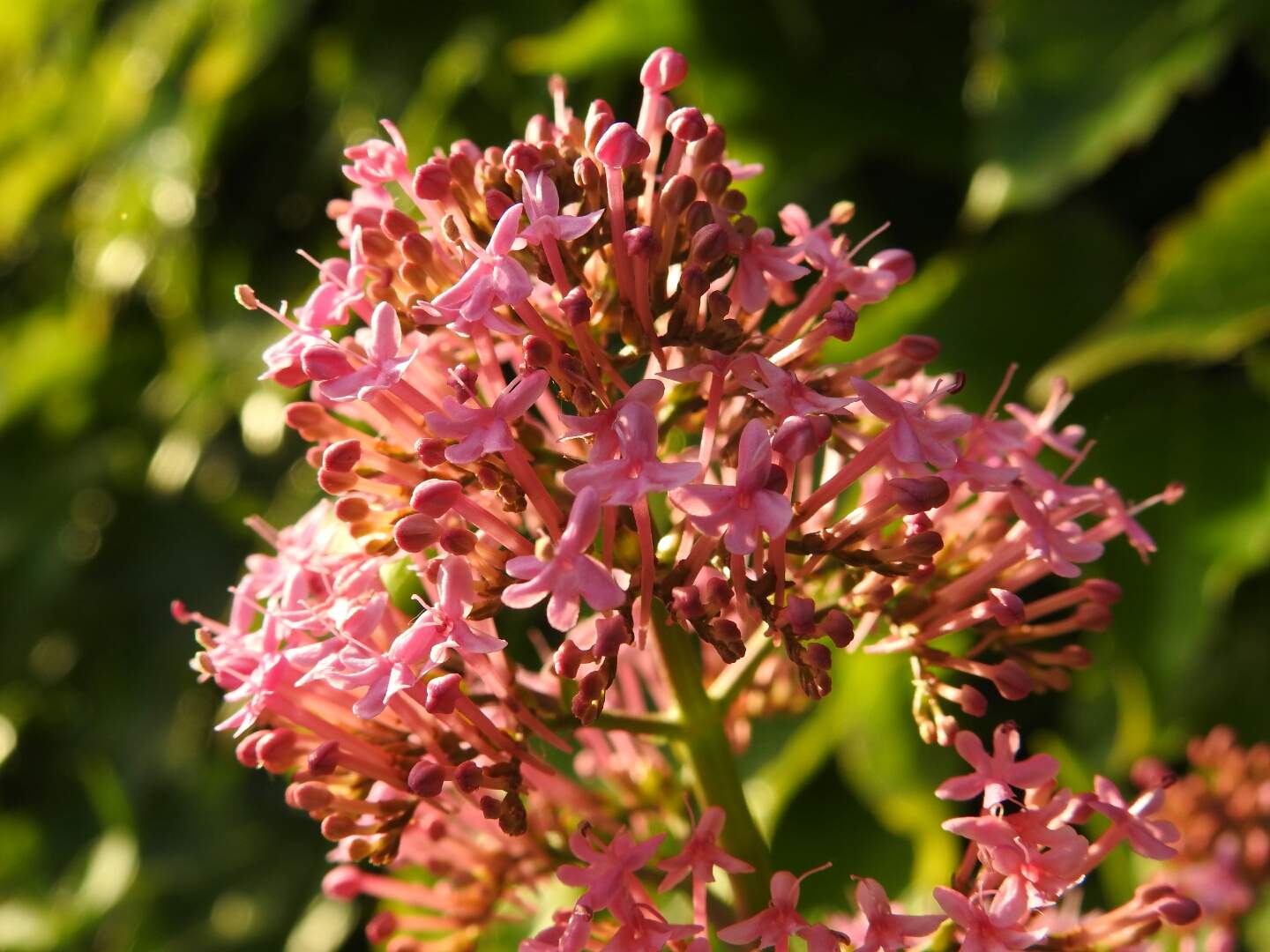
Perennial bushy plant, generally 30 to 70 cm tall, with a woody base and a glabrous, glaucous, and fleshy stem. The stems are erect or ascending-branched, cylindrical in section, smooth, chalky, and arise from a well-developed underground rhizome that allows the plant to survive over time. The habit is compact but branched, giving the plant a bushy appearance.
The leaves are arranged oppositely along the stems. The lower leaves are shortly petiolate or cuneate, while the upper ones are sessile and generally clasping, with a rounded base. The leaf shape is ovate-lanceolate, 8-12 cm long, 2-4 cm wide, with entire or slightly toothed margins. They are smooth, with an acuminate apex and glabrous surface, greenish-blue in color, giving a characteristic glaucous effect.
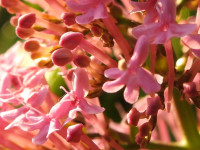
The flowers, hermaphroditic and zygomorphic, are gathered in dense corymbs that elongate to form a trichotomous paniculate structure with erect branches. The corolla is gamopetalous, about 9-10 mm long, varying in color from deep pink to reddish-violet, sometimes white, and has a conical tube equipped at the base with a linear spur 1-3 times the length of the inferior ovary. The corolla limb is divided into five unequal lobes. The stamens have glabrous filaments, often intense pink in color, with yellowish or pink anthers. The style is protruding and bears a trilobed stigma. The flowers are fragrant and attract insects for their pollination.
The fruit is a glabrous achene, topped by a persistent feathery pappus that facilitates anemochorous (wind) dispersal.
The root system is a thick and developed underground rhizome, which promotes the species' perenniality and its ability to colonize even difficult environments.
Habitat and distribution
This species has a typically Mediterranean distribution, with a steno-Mediterranean range extending along the Mediterranean coasts and including the Olive area. In Italy, it is present in all regions but is more common in the central-southern regions and the major islands (Sicily and Sardinia).
It grows on calcareous substrates, preferring open and sunny environments such as old walls, cliffs, rocky soils, road edges, and embankments. Its presence is reported from sea level up to about 1300 meters altitude.
In the Mediterranean area, it is also reported in Central and Southern Europe, Syria, and North Africa, and is naturalized in some areas of France and Corsica. It is often cultivated for ornamental purposes and can naturalize in anthropized environments.
Flowering period
Flowering extends from May to September, with some variations depending on latitude and altitude. In the warmer climates of central-southern Italy and the islands, flowering can start early in May and continue until early autumn. In cooler sites or at higher elevations, flowering may be more concentrated in the summer months.
Ecology and pollination
The plant is mainly pollinated by diurnal and nocturnal butterflies, attracted both by the vivid color of the flowers and their fragrance. The corolla with spur is adapted to host insects with long proboscises, thus facilitating pollination through visitation and contact with the reproductive organs.
The fruit, an achene equipped with a feathery pappus, is dispersed by the wind, allowing the species to colonize new open and rocky habitats.
Curiosities and traditional uses
Valeriana ruber has a long history of medicinal and traditional uses. The roots contain various active principles, such as tannins, resins, essential oils, and alkaloids, which confer sedative, antispasmodic, and antineuralgic properties. In the past, its roots were used as substitutes for common valerian (Valeriana officinalis).
The seeds, according to some historical sources, were used to prepare potions employed in embalming. Some populations traditionally considered the plant endowed with magical powers: dried and powdered roots were kept in sachets to protect homes from lightning, while the leaves were used in rituals to calm love quarrels and promote reconciliation between lovers.
Besides medicinal use, the plant is cultivated as an ornamental for the bright color of its flowers. The leaves, despite their strong and unpleasant odor, can occasionally be eaten raw in salads.
Etymology
The scientific name of the genus, Valeriana, derives from medieval Latin valeriana, attested already in the 10th century. The etymology remains uncertain: some hypotheses link it to the Roman province of Pannonia Valeria (in present-day western Hungary), where the plant was common; others associate it with the Latin verb valere (to be in good health), referring to the medicinal properties of the plant; further interpretations connect it to historical figures or Germanic terms, such as baldrian, linked to mythical figures or the god Baldur, emphasizing the magical value attributed to the species.
The species name ruber means “red” in Latin, referring to the characteristic color of the flowers.
In Italian, the common name “Valeriana rossa” refers precisely to the coloration of the flowers, which varies from intense pink to reddish-violet.
Sources
- Acta Plantarum - Flora delle regioni italiane (actaplantarum.org)
- Acta Plantarum - Scheda di Giuliano Salvai
- Tela Botanica / H. Coste, Flore descriptive et illustrée de la France
Characteristics
Where I found it (5 sightings)
Classification
- Kingdom
- Plantae
- Family
- Valerianaceae
- Full name
- Valeriana rubra L.
- Synonyms
- Centranthus ruber (L.) DC.
- Life form
- Camefite suffruticose
Similar species
Search for species with similar characteristicsFurther reading
Noticed an error in the identification? Write to me
Other species of the same family
Valerianaceae
Explore
Other species of Valerianaceae