Botanical species
Rumex crispus
Curled Dock
Description
Morphological description
Perennial herbaceous plant, Curled Dock has an erect habit, reaching a variable height between 30 and 120 cm. The stem is robust, cylindrical and angular, glabrous, often tinged with reddish-brown, and can be simple or branched especially in the upper part, with short ascending branches. The root system consists of a lignified and branched rhizome, reddish in color and fleshy in texture, which allows the plant to survive over the years.
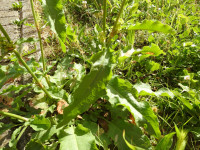
The basal leaves are large, long-petiolate with a grooved petiole, often with a characteristic membranous sheath at the base (ocrea). The blade is oblong-lanceolate or lanceolate, reaching dimensions up to 12 x 4 cm, with wavy and curled margins, smooth and glabrous on both sides. The cauline leaves are progressively smaller, linear-lanceolate, attenuated at the base, with shorter petioles, and alternately arranged along the stem.
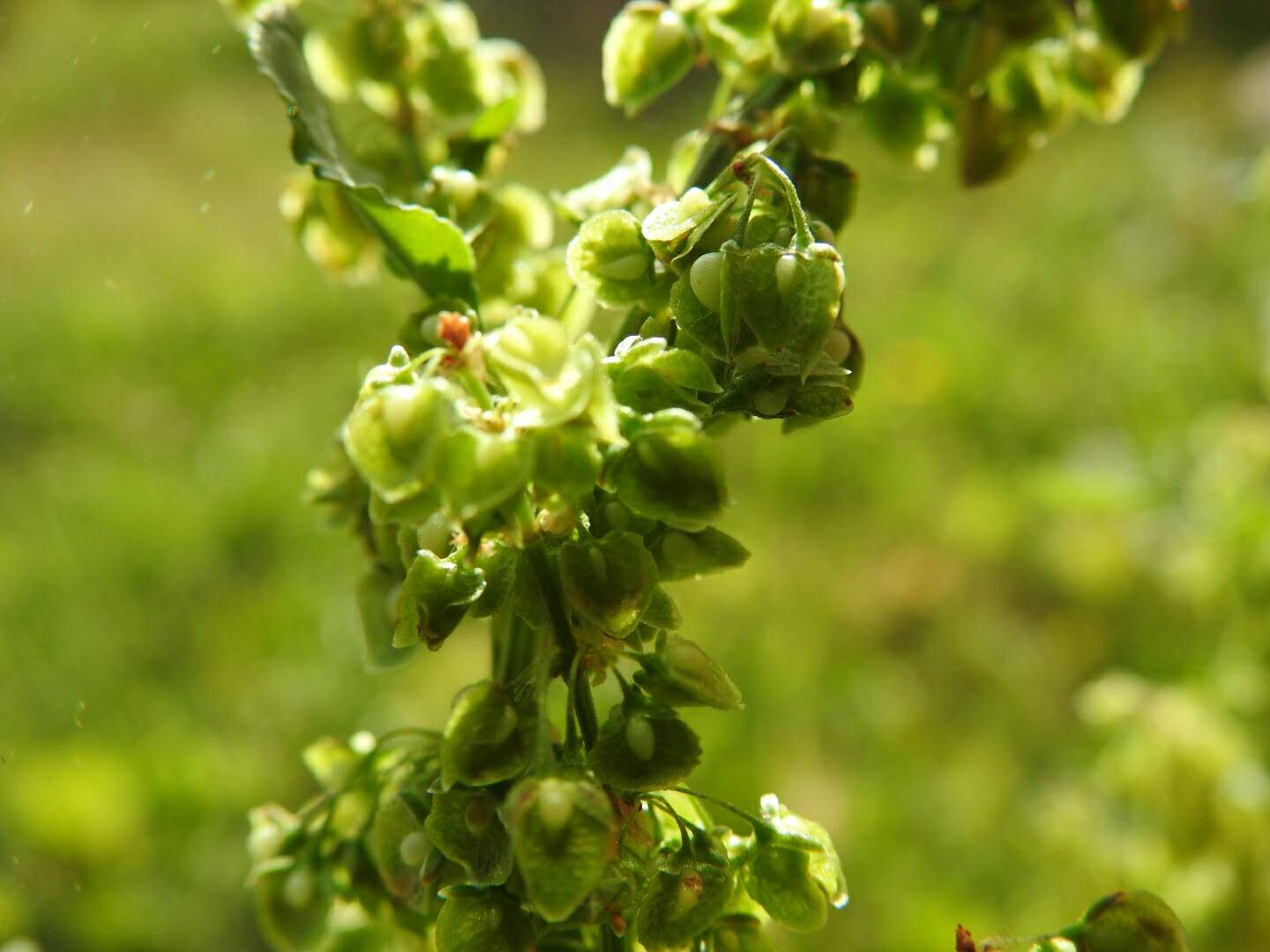
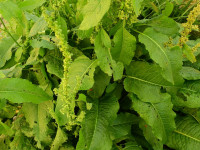
The inflorescence is a leafy panicle, composed of dense multiflorous verticillasters arranged along a terminal axis. The flowers are hermaphroditic or dioecious, with a sepaloid perianth composed of six tepals: three small, linear, and spreading outer ones, and three larger, triangular-cordate inner ones with a brown-orange callosity at the base. The pedicels are articulated at the lower part. The flower color is generally green or greenish, not very showy.
The fruit is an ovate-triangular achene, shiny and smooth, dark brown in color, about 2.5-3 mm long. The fruit valves are broadly oval or cordate, with entire or denticulate margins, reticulated, and fold downwards at maturity. This membranous envelope aids seed dispersal.
Curled Dock is an evergreen species and can be considered invasive due to its ability to spread rapidly in disturbed environments thanks to its rhizome.
Habitat and distribution
The species is widely distributed throughout the Italian territory and the Mediterranean basin, growing from the plains up to about 1,500 meters altitude. It prefers humid or mesic environments, with clayey or silty soils, frequently found along roadsides, in meadows, fallows, ruins, cultivated fields, orchards, and vineyards. It is typical of synanthropic environments and disturbed sites, where it behaves as a weed.
It is a subcosmopolitan species, present in almost all temperate zones of the globe, with distribution also in North America where it has naturalized. In the Mediterranean and Europe it is common in wet meadows, along watercourses and ditches, in subalpine and hilly areas.
Flowering period
Flowering occurs mainly between May and July, with possible extension until September in some areas. In Italy, the flowering phase generally falls within the summer months, with variations related to altitude and local climate.
Ecology and pollination
Curled Dock is a dioecious or polygamodioecious plant, with hermaphroditic or unisexual flowers. Its panicle inflorescence consists of dense flowers, which are generally pollinated by pollinating insects attracted by the compact structure and the presence of callosities and colored tepals.
Seed dispersal occurs mainly through the fruit, an achene equipped with membranous valves that facilitate anemochory (wind dispersal) and hydrochory (water dispersal). The rhizome also allows vegetative reproduction by clonal multiplication.
Curiosities and traditional uses
Curled Dock has a long history of use in ethnobotany and medicine. The young leaves are edible and can be consumed cooked or in soups, often mixed with other herbs. The plant is known for its medicinal properties: it is bitter, astringent, depurative, refreshing, and anti-anemic.
The roots, rich in iron and tannins, have traditionally been used as a tonic-reconstitutive, laxative, and anti-anemic, sometimes replacing rhubarb. The fruits, also rich in tannins, were used against diarrhea.
For external use, the leaves were applied in poultices to treat dermatitis, boils, and other skin conditions. In Western Europe, Curled Dock and related species have been used as a traditional remedy against nettle stings.
In North America, some native tribes adopted this European plant, using it for similar medicinal purposes, such as promoting suppuration of boils and wound healing.
Practically, some Rumex species have been used to extract tannins for leather tanning, while the large leaves of Rumex obtusifolius were used to wrap and preserve butter.
Etymology
The genus name Rumex derives from Latin and means "spear," referring to the lanceolate and pointed shape of the leaves. The specific epithet crispus highlights the characteristic appearance of the leaves, with wavy and curled margins.
The Italian common name "romice crespo" exactly reflects this morphological characteristic of the leaves, easily recognizable even to the naked eye.
Sources
- Prof. P.V. Arrigoni, "Flora analitica della Toscana", "Flora dell'Isola di Sardegna"
- Acta Plantarum - Flora delle regioni italiane (scheda di Marinella Zepigi)
- Tela Botanica / H. Coste, "Flore descriptive et illustrée de la France"
- World Flora Online (WFO)
Characteristics
Scheda botanica
| Famiglia | Polygonaceae |
|---|---|
| Fioritura | maggio – luglio |
| Forma biologica | Scapose |
| Habitat | edible plant, Perennial plant |
| Uso alimentare | Commestibile |
Domande frequenti
- Quando fiorisce Curled Dock?
- Curled Dock fiorisce maggio – luglio.
- È commestibile Curled Dock?
- Curled Dock è considerata commestibile. Verifica sempre le parti eduli e la preparazione corretta prima del consumo.
- Che tipo di pianta è Curled Dock?
- Curled Dock è una Hemicryptophytes (Scapose) secondo la classificazione di Raunkiaer.
- A quale famiglia appartiene Curled Dock?
- Curled Dock appartiene alla famiglia botanica Polygonaceae.
Where I found it (3 sightings)
Classification
- Kingdom
- Plantae
- Family
- Polygonaceae
- Life form
- Hemicryptophytes scapose
Similar species
Search for species with similar characteristicsFurther reading
Noticed an error in the identification? Write to me
Other species of the same family
Polygonaceae
Explore
Other species of Polygonaceae