Botanical species
Rumex obtusifolius
L.
Broad-Leaved Dock
Description
Morphological description
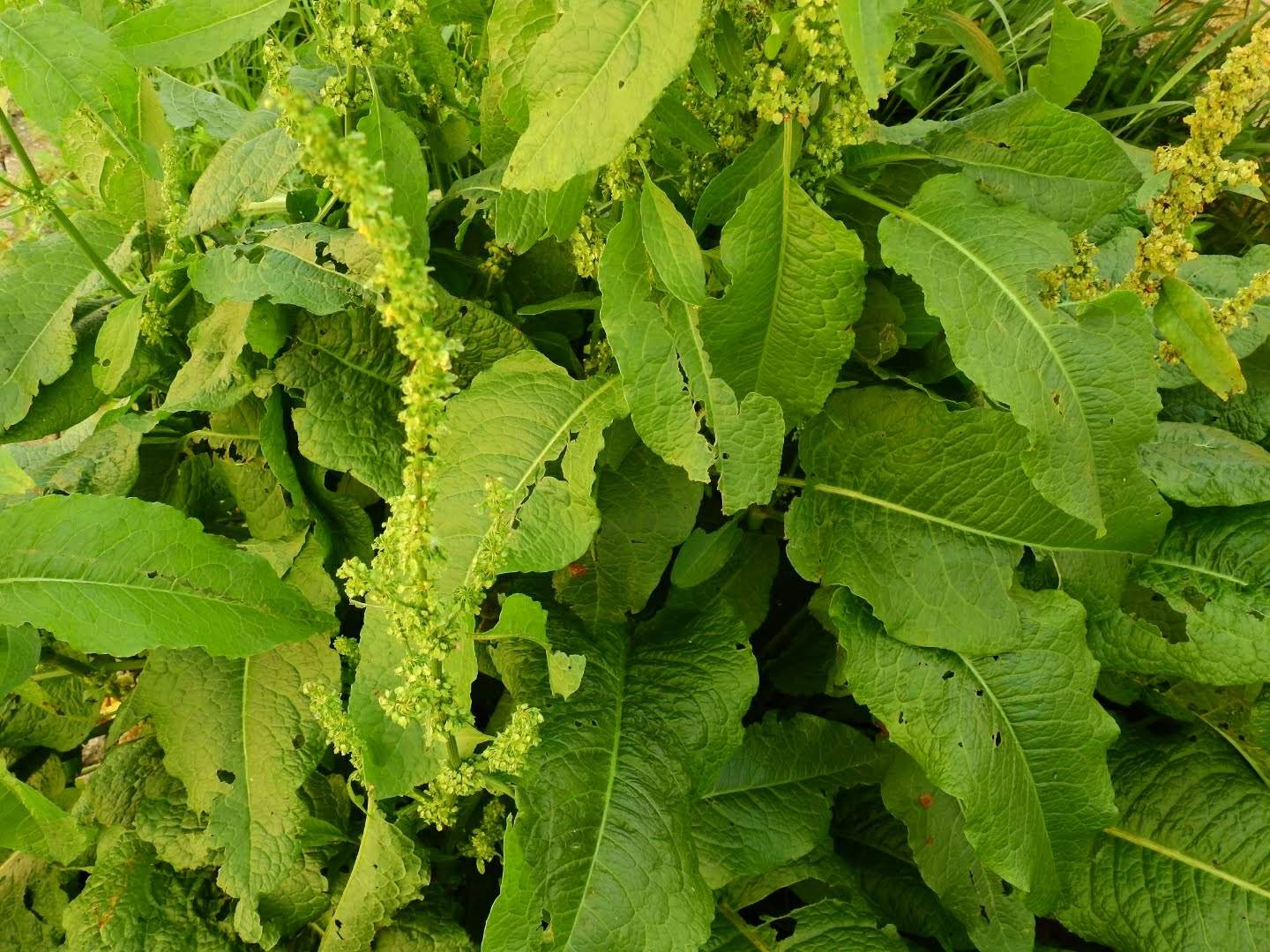
Perennial herbaceous plant generally 40 to 150 cm tall, characterized by a woody, fusiform rhizome, often about 1 cm in diameter, which develops vertically in the soil. The stem is erect, cylindrical, often grooved, smooth and sometimes shows violet or brownish shades. It can be branched especially in the upper part and often bears few flowering stems that emerge directly from the rhizome.
The basal leaves are large, with ovate-oblong or ovate blades, varying in size from about 6-9 cm wide and 9-22 cm long. The leaf base is distinctly cordate or subcordate, sometimes truncate, while the apex is rounded (obtuse) or subacute. The leaves have a petiole as long as or longer than the blade itself, equipped with a membrane called ochrea, typical of the Polygonaceae family. The lower surface of the leaves shows sparse pubescence, especially along the central vein. The cauline leaves are progressively narrower and lanceolate until becoming linear in the upper parts of the stem; they are alternate and with a shorter petiole, maintaining the ochrea.
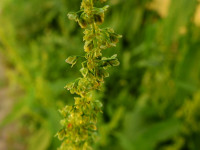
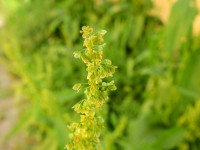
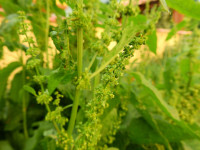
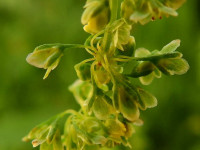
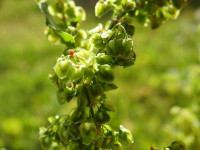
The inflorescence is terminal, occupying the upper part of the stem (about the distal two-thirds), and is a branched and wide panicle, usually lax during flowering and denser in fruiting. The branches are arched and spaced, with whorls of 10-25 small flowers each, lacking bracts in the upper parts. The flowers are small, with inner tepals ovate-triangular or deltoid, 3-6 mm long, with margins generally denticulate with 2 to 5 small sharp teeth. The tubercle is prominent, usually present on one valve. The fruits are brownish-reddish achenes, sized between 2 and 3 mm, wrapped in ovate-triangular valves equipped with well-developed teeth, longer than wide.
The root system consists of a superficial woody rhizome, which allows the plant to survive over the years and to spread locally.
Habitat and distribution
The Broad-Leaved Dock is a subcosmopolitan species, widespread in almost all temperate regions of the world. In Italy it is very common and found in practically all regions, from sea level up to the upper mountain and subalpine belt. It is frequent in ruderal areas, along roadsides, ditches, edges of cultivated fields, forest clearings, and dumps. It prefers well-drained, nutrient-rich soils with exposure ranging from full sun to partial shade. The species adapts to different soil types, including areas disturbed by human activity.
In the Mediterranean basin, the species maintains a similar distribution, adapting to anthropized environments and grassy or shrubby margins. Thanks to its robustness and colonizing ability, it is often considered invasive.
Flowering period
Flowering generally occurs between June and August, with possible variations depending on altitude and local climatic conditions. In colder climates or at higher elevations, flowering may start later and extend until September. During this period, the panicles develop and the flowers open to facilitate fertilization.
Ecology and pollination
The species is a scapose hemicryptophyte: the overwintering buds are located at ground level, while the floral axis is elongated and often leafless. The flowers are arranged in whorls and host numerous small flowers that attract pollinating insects, particularly hymenopterans and dipterans, which favor entomophilous pollination. The flower structure and inflorescence arrangement facilitate visits by these insects.
Seed dispersal occurs mainly through wind and water, but also by accidental transport due to human activities. The presence of the rhizome allows the plant to expand vegetatively, making it particularly resistant and difficult to eradicate in cultivated or disturbed environments.
Curiosities and traditional uses
The Broad-Leaved Dock is an edible and medicinal plant, historically used in herbal medicine and popular cuisine. The leaves, although rich in oxalic acid, are consumed in moderation in salads or cooked as a vegetable. It is important to limit its use to avoid negative effects such as gastrointestinal or renal disorders, especially in people with rheumatism, arthritis, gout, or kidney stones.
In the past, the large leaves were used to wrap and preserve butter, exploiting their robustness and ability to maintain freshness. The leaves were also used as a traditional remedy against nettle stings, applied directly to the skin to relieve itching and irritation.
From a medicinal point of view, the plant has been used to prepare decoctions and ointments, effective in treating some skin conditions and eruptions. The roots, rich in pigments, have been exploited for the production of natural dyes.
Despite traditional uses, it is appropriate to remember that medicinal and food applications are for informational purposes and should be approached with caution.
Etymology
The generic name Rumex derives from Latin and means "pole," "lance," or "arrow," recalling the pointed shape of some leaves of the genus species. The specific name obtusifolius combines "obtusus," meaning "blunt" or "rounded," with "folium" = "leaf," referring to the leaves with rounded margins and apex, a distinctive characteristic of the species.
The Italian common name "romice a foglie ottuse" derives directly from this morphological characteristic, which distinguishes the species from other related ones with sharper or toothed leaves.
Sources
- Prof. S. Pignatti, Flora d'Italia
- Acta Plantarum - Flora delle regioni italiane (scheda di Roberta Alberti)
- World Flora Online (WFO)
Characteristics
Scheda botanica
| Famiglia | Polygonaceae |
|---|---|
| Fioritura | giugno – agosto |
| Forma biologica | Scapose |
| Habitat | edible plant, Perennial plant |
| Uso alimentare | Commestibile |
Domande frequenti
- Quando fiorisce Broad-Leaved Dock?
- Broad-Leaved Dock fiorisce giugno – agosto.
- È commestibile Broad-Leaved Dock?
- Broad-Leaved Dock è considerata commestibile. Verifica sempre le parti eduli e la preparazione corretta prima del consumo.
- Che tipo di pianta è Broad-Leaved Dock?
- Broad-Leaved Dock è una Hemicryptophytes (Scapose) secondo la classificazione di Raunkiaer.
- A quale famiglia appartiene Broad-Leaved Dock?
- Broad-Leaved Dock appartiene alla famiglia botanica Polygonaceae.
Where I found it (5 sightings)
Classification
- Kingdom
- Plantae
- Family
- Polygonaceae
- Full name
- Rumex obtusifolius L.
- Life form
- Hemicryptophytes scapose
Similar species
Search for species with similar characteristicsNoticed an error in the identification? Write to me
Other species of the same family
Polygonaceae
Explore
Other species of Polygonaceae