Botanical family
Polygonaceae
Description
Botanical characteristics
The Polygonaceae are a family of predominantly herbaceous plants, including both annual and perennial species. In some cases, they also include shrubs or small trees. The typical habit is represented by herbs with alternate, simple, and petiolate leaves. A very important distinctive feature is the presence of stipules fused at the margins forming a membranous sheath called ocrea, which wraps around the stem.
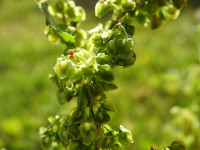
The flowers can be hermaphroditic or unisexual, and are actinomorphic (radially symmetrical). They are grouped in inflorescences and generally have a perianth formed by 3-6 sepal-like elements, united at the base and tending to enlarge and persist in the fruit. These elements can take on a petaloid appearance in some species, depending on the type of pollination (entomogamous or anemogamous). The androecium consists of 4-8 free stamens, while the ovary is superior, usually tricarpellary and unilocular, with 2-4 styles. The typical fruit is an achene, often trigonous or lenticular, characterized by an angular shape that recalls the family name.
Distribution and diversity
The Polygonaceae family is mainly distributed in boreal temperate regions, but extends to many other areas of the world, especially in temperate climates. It includes about 55 genera divided into 14 tribes and 3 subfamilies. Such taxonomic diversity includes herbaceous, shrubby, and arboreal forms, adapted to various environments.
Main genera and representative species
Among the best known and most important genera are:
- Fagopyrum, which includes buckwheat (Fagopyrum esculentum), an important food crop in alpine regions;
- Rheum, the rhubarbs, known for the roots from which bitter principles are extracted used in pharmacy and liqueur production, and some ornamental species;
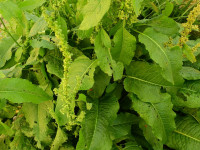
- Rumex, the docks, common spontaneous Italian species, whose leaves are used in cooking in soups or salads;
- Polygonum, a typical genus with often entomogamous species;
- Persicaria, Bistorta and Fallopia, which include widespread species of ecological and ornamental interest.
In Italy, several species are present mainly belonging to the genera Rumex, Polygonum, Persicaria, and Bistorta, frequent in wet environments, fields, and roadside margins.
Etymology
The name Polygonaceae derives from the Greek "poly" (= many) and "gonium" (= angle), and refers to the angular shape characteristic of the fruit (achene) typical of many species of the family.
Curiosities and uses
The family has some agrarian and pharmacological interest: buckwheat is an important crop for human nutrition, especially in mountainous areas. The roots of some Rheum species are used to extract bitter principles employed in medicine and liqueur production. Some spontaneous plants of the genus Rumex are edible and used in traditional cooking. Furthermore, some Rheum species are cultivated as ornamentals for their showy appearance.
Sources
- Wikipedia
Species of the family
2 species catalogued
Explore
Other botanical families