Botanical species
Portulaca oleracea
L.
Common Purslane
Description
Morphological description
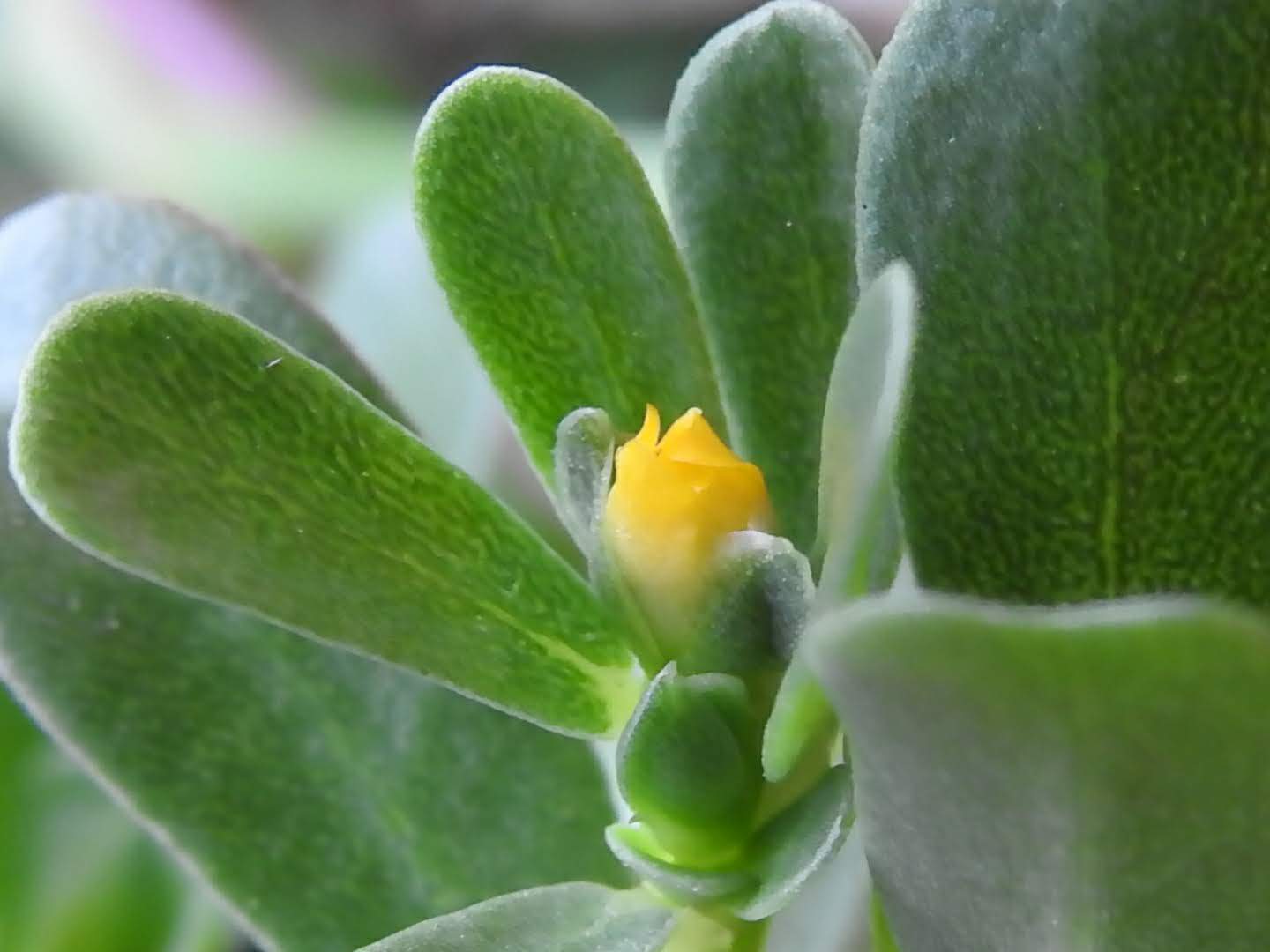
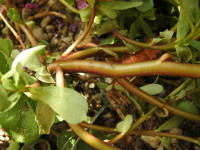
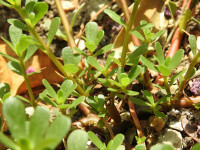
Annual plant, generally prostrate or ascending, sometimes erect, with variable height from 10 to 30 cm. The stem is cylindrical, often branched, hollow inside and with a reddish coloration. The surface of the stem is glabrous and fleshy, giving the plant a succulent and "fat" appearance.
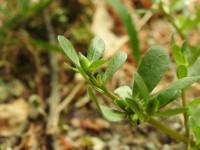
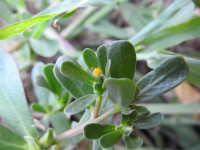
The leaves are opposite or subopposite, obovate or spatulate in shape, with sizes ranging from 0.6-1.6 cm up to 3 cm in length and 0.5-1.7 cm in width. They are sessile, fleshy, herbaceous and glossy, with a truncate or slightly retuse apex. The succulent texture is typical, adapting it to drought conditions.
The flowers are borne singly or in small groups of 2-6 in the leaf axils or at the tips of the branches. They are sessile, with 2 keeled sepals, irregular in shape and deciduous. The petals vary in number from 4 to 6, bright yellow in color, also very ephemeral. Numerous stamens (6-12) surround the style, which divides into 4-6 branches. The fruit is an ovoid or compressed-fusiform capsule, a few millimeters in size (about 2.5 x 7 mm), which opens circularly in the middle to release numerous black, shiny seeds with a dotted or granular surface.
The root system is fibrous, suitable for rapid anchoring and absorption in often poor or disturbed soils.
Habitat and distribution
It is a cosmopolitan species, widespread in temperate and warm regions worldwide. In the Mediterranean basin and in Italy it is very common in anthropized environments, such as cultivated lands, uncultivated areas, roadside edges, vineyards, disturbed areas and urban zones. It prefers well-drained soils, often sandy or gravelly, but also adapts to slightly more compact soils.
The species grows from sea level up to about 700 meters in altitude. It is a weed and opportunistic plant, exploiting open and disturbed spaces with full sun exposure.
Flowering period
Flowering extends from May to October, with some possible local variation depending on the climate. In warmer or Mediterranean climates, the presence of flowers can last throughout the growing season. The plant frequently fruits throughout the year in mild climate areas.
Ecology and pollination
Common Purslane presents a reproductive strategy based on easily accessible flowers, with yellow petals and numerous stamens that attract pollinating insects. The main pollinators are bees, flies and other generalist insects attracted by the yellow flowers and the presence of nectar.
Seed dispersal occurs through the capsule which opens suddenly, releasing numerous black and shiny seeds that can be transported by wind or animals, facilitating colonization of new habitats.
Curiosities and traditional uses
Common Purslane is an edible plant widely used in cooking in many cultures, especially for its young fleshy leaves and shoots, which are consumed raw in salads or cooked as a vegetable. It is also known for its vermifuge and antiscorbutic properties, used in traditional medicine.
Its slightly acidic taste and crunchy texture make it a valued ingredient in Mediterranean diets. Historically, it was considered a useful plant to cultivate or gather as a food resource during times of scarcity.
Etymology
The scientific name derives from Latin: Portulaca probably means "small port" or "small harbor plant," referring to its spread near wet or port areas in its native regions. The Italian name "porcellana" or "porcellana comune" derives from a popular corruption, probably due to the resemblance of the fleshy and glossy leaves to "porcelain skin."
Sources
- Prof. S. Pignatti, "Flora d'Italia"
- Tela Botanica / H. Coste, "Flore descriptive et illustrée de la France"
- World Flora Online (WFO)
Characteristics
Scheda botanica
| Famiglia | Portulacaceae |
|---|---|
| Fioritura | maggio – ottobre |
| Forma biologica | Scapose |
| Habitat | edible plant, with yellow flowers, succulent plant |
| Uso alimentare | Commestibile |
Domande frequenti
- Quando fiorisce Common Purslane?
- Common Purslane fiorisce maggio – ottobre.
- È commestibile Common Purslane?
- Common Purslane è considerata commestibile. Verifica sempre le parti eduli e la preparazione corretta prima del consumo.
- Che tipo di pianta è Common Purslane?
- Common Purslane è una Therophytes (Scapose) secondo la classificazione di Raunkiaer.
- A quale famiglia appartiene Common Purslane?
- Common Purslane appartiene alla famiglia botanica Portulacaceae.
Where I found it (3 sightings)
Classification
- Kingdom
- Plantae
- Family
- Portulacaceae
- Full name
- Portulaca oleracea L.
- Synonyms
- Portulaca cypria Danin; Portulaca granulatostellulata (Poelln.) Ricceri & Arrigoni; Portulaca macrantha Ricceri & Arrigoni; Portulaca nitida (Danin & H.G.Baker) Ricceri & Arrigoni; Portulaca oleracea L. subsp. granulato-stellulata (Poelln.) Danin & H.G.Baker; Portulaca oleracea L. subsp. nitida Danin & H.G.Baker; Portulaca oleracea L. subsp. papillatostellulata Danin & H.G.Baker; Portulaca oleracea L. subsp. sativa (Haw.) Čelak.; Portulaca oleracea L. subsp. stellata Danin & H.G.Baker; Portulaca oleracea L. var. granulatostellulata Poelln.; Portulaca oleracea L. var. sativa (Haw.) DC.; Portulaca oleracea L. var. trituberculata (Danin, Domina & Raimondo) J.-M.Tison; Portulaca papillatostellulata (Danin & H.G.Baker) Danin; Portulaca rausii Danin; Portulaca sardoa Danin, Bagella & Marrosu; Portulaca sativa Haw.; Portulaca sicula Danin, Domina & Raimondo; Portulaca stellata (Danin & H.G.Baker) Ricceri & Arrigoni; Portulaca trituberculata Danin, Domina & Raimondo; Portulaca zaffranii Danin
- Life form
- Therophytes scapose
Similar species
Search for species with similar characteristicsFurther reading
Noticed an error in the identification? Write to me
Explore
Other species of Portulacaceae