Botanical species
Polygala vulgaris
L.
Common Milkwort
Description
Morphological description
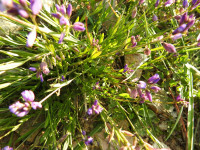
Perennial herbaceous plant generally 7 to 35 cm tall, characterized by a woody base and a branched stem at the origin, which then tends to assume an ascending habit. The stem is glabrous or slightly pubescent and may initially be prostrate before rising. The root system consists of a taproot accompanied by a lignified and cylindrical rhizome.
The leaves are arranged alternately along the stem. The basal leaves are generally larger, spatulate in shape with a rounded apex, 10 to 20 mm long and 2-4 mm wide, with an almost glabrous surface and a cuneate base. The upper leaves are lanceolate-linear, thinner and acute, with similar or slightly smaller dimensions than the lower ones, and do not form a basal rosette.
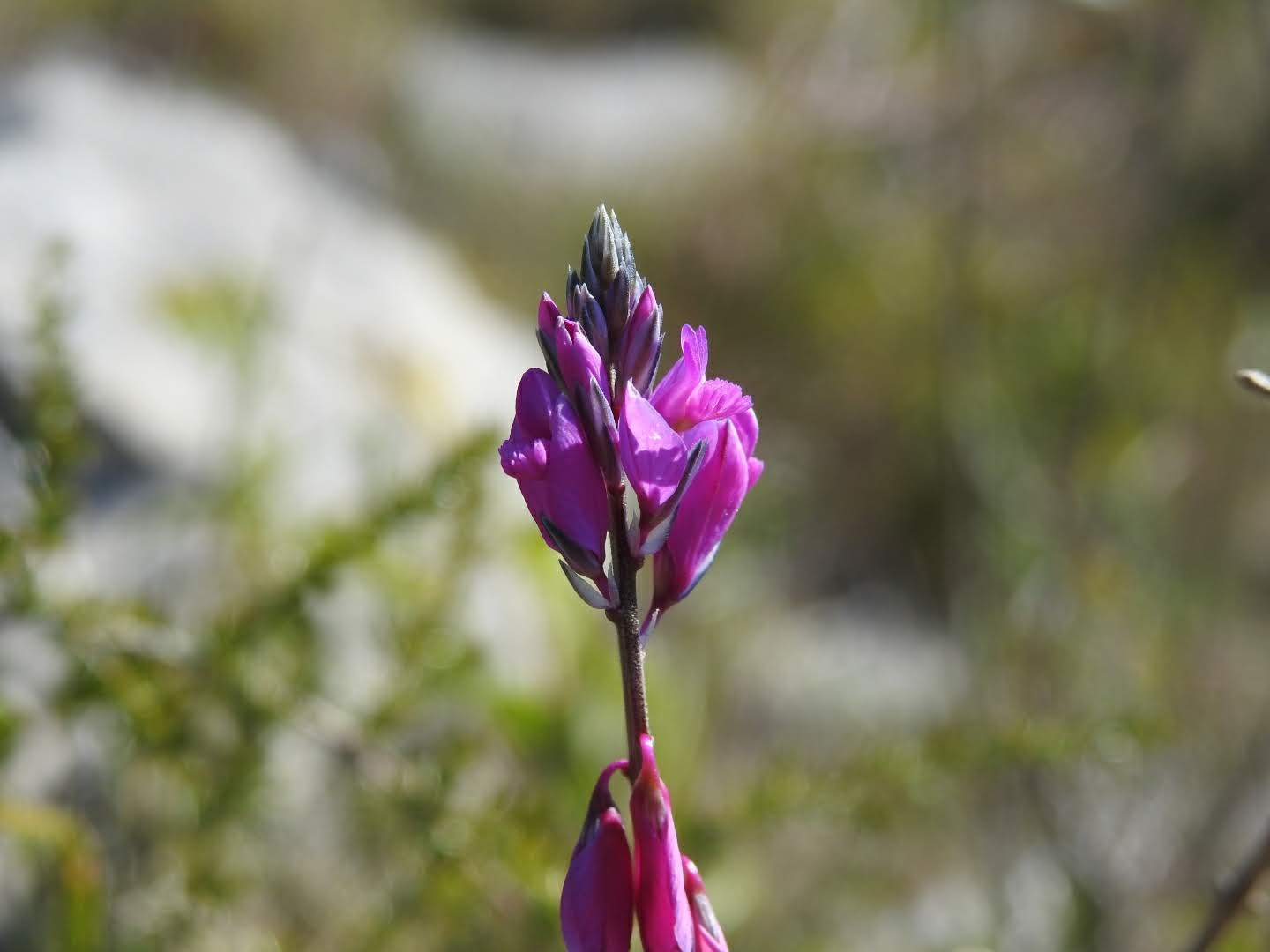
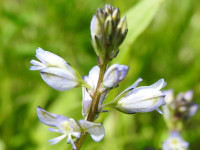
The flowers, blue, violet or occasionally white or pale pink, are gathered in elongated terminal racemes comprising 10 to 40 flowers. Each flower is hermaphroditic, zygomorphic and pentamerous, composed of five unequal sepals: three small greenish outer sepals and two much larger inner sepals transformed into colored wings with three branched veins. The wings are generally obovate-acuminate, 4 to 7 mm long, with a branched central vein. The petals are three, protruding from the wings, united at the base to form a corolla tube about 2.5-4 mm long, with the lower petal larger and keeled, characterized by a fringed appendage with 8-40 thin fringes. The eight stamens are monadelphous and fused to the corolla. The ovary is superior and bicarpellate.
The fruit is an oblong, heart-shaped capsule, laterally compressed, enclosed by persistent sepals and divided into two locules, each containing one or two hairy seeds. Each seed is equipped with a trilobed elaiosome with appendages about one third the size of the seed.
This species shows high polymorphism, with variants distinguished mainly by the size of the floral bracts, the shape of the wings and the number of fringes on the lower petal. For example, the subspecies oxyptera has narrower wings and fewer fringes.
Habitat and distribution
The species is widespread throughout Europe, from Western Europe to Western Asia and Japan, also present in North Africa (Algeria and Tunisia). In Italy it is common especially in the North, while it is rarer in the Central and Southern parts of the peninsula. It grows mainly in sunny environments such as meadows, pastures, grassy and open woodland areas, preferring acidic or neutral soils.
The growth altitude ranges from sea level up to about 2200 meters, with a more marked presence in hilly and mountainous areas up to the subalpine limit.
Flowering period
Flowering generally extends from May to July, with possible local variations depending on altitude and climatic conditions. In cooler or mountainous climates flowering may start later and last for a shorter time.
Ecology and pollination
The Common Milkwort is predominantly pollinated by insects (entomogamy), which are attracted by the showy flowers and colored wings. The petals and wings play a fundamental role in facilitating pollination, with a complex structure that allows insects to access the nectar while promoting pollen transfer.
Seed dispersal mainly occurs through myrmecochory, i.e. by ants attracted by the elaiosome, a fleshy structure attached to the seeds. Ants carry the seeds to their nests, thus contributing to the spread of the species.
Curiosities and traditional uses
The genus name derives from the Greek “polýs” (much) and “gála” (milk), referring to the ancient belief that the plant could increase milk production in cows. The species is also known by the common name “bozzolina.”
From a medicinal point of view, the root of this species contains a series of bioactive compounds such as glycosides (gaultherin), saponins, tannins, mucilages and bitter substances. These components confer galactogenic, antitussive, expectorant, sudorific, cholagogue, diuretic, antirheumatic and tonic properties. The glycoside gaultherin, in particular, releases methyl salicylate, justifying the traditional use of the plant as an antirheumatic.
In the past the Common Milkwort was used in infusions, syrups or powders for various respiratory ailments and as a general stimulant. However, it is important to emphasize that these uses are traditional in nature and do not replace official medical advice.
Etymology
The scientific name “Polygala” derives from ancient Greek and means “much milk,” linked to the popular belief that the plant increased milk production in cattle. The specific epithet “vulgaris” indicates that it is the most common species within the genus.
The Italian common name “poligala comune” reflects precisely its wide distribution and its belonging to the genus Polygala.
Sources
- Prof. S. Pignatti, "Flora d'Italia"
- Acta Plantarum - Flora delle regioni italiane (scheda di Daniela Longo)
- Tela Botanica / H. Coste, "Flore descriptive et illustrée de la France"
- World Flora Online (WFO)
Characteristics
Scheda botanica
| Famiglia | Polygalaceae |
|---|---|
| Fioritura | maggio – luglio |
| Forma biologica | Scapose |
| Habitat | with purple flowers |
Domande frequenti
- Quando fiorisce Common Milkwort?
- Common Milkwort fiorisce maggio – luglio.
- Che tipo di pianta è Common Milkwort?
- Common Milkwort è una Hemicryptophytes (Scapose) secondo la classificazione di Raunkiaer.
- A quale famiglia appartiene Common Milkwort?
- Common Milkwort appartiene alla famiglia botanica Polygalaceae.
Where I found it (19 sightings)
Classification
- Kingdom
- Plantae
- Family
- Polygalaceae
- Full name
- Polygala vulgaris L.
- Life form
- Hemicryptophytes scapose
Similar species
Search for species with similar characteristicsFurther reading
Noticed an error in the identification? Write to me
Other species of the same family
Polygalaceae
Explore
Other species of Polygalaceae