Botanical family
Polygalaceae
Description
Botanical characteristics
The Polygalaceae are a family of vascular plants including herbs, shrubs, trees, and lianas, characterized by a varied and often woody habit. The stems are generally round, occasionally angular or winged, and may have sessile or stalked glands (extrafloral nectaries) on the leaves and petioles. Some branches may be spiny and the plants can be glabrous or covered with unicellular hairs.
The leaves are simple, generally alternate, but rarely opposite or whorled, as in Polygala verticillata. They are stipule-free, with entire margins and pinnate venation; in some species they may be needle-shaped or scarious (as in Epirixanthes). The inflorescences are terminal or axillary, appearing as spikes, racemes, or panicles, and sometimes the flowers are solitary.
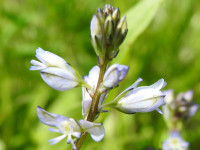
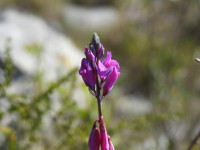
The flowers are hermaphroditic, generally zygomorphic and 5-cyclic, with 5 sepals of which two inner ones are often transformed into appendages shaped like broad or tubular wings, distinctive of the family. The corolla is formed by 3-5 petals, one of which is abaxial, keeled and fringed to form appendages. The stamens range from 4 up to 10, often fused into a staminal tube welded to the corolla, and all fertile (absence of staminodes). The pistil is formed by 2-3 syncarpous carpels with a superior ovary, containing a single ovule per locule.
The fruits vary from loculicidal capsules, often laterally compressed, to indehiscent drupes or berries, and in some genera they are single or double samaras. The seeds, one per locule, can be glabrous or hairy and often present an elaiosome, a structure that favors dispersal by ants (myrmecochory). Germination can be hypogeal or epigeal.
Distribution and diversity
This family is cosmopolitan, present on all continents except Antarctica, with a distribution ranging from tropical to temperate regions. It includes about 30 genera distributed in four main tribes: Carpolobieae, Moutabeae, Polygaleae, and Xanthophylleae, with a total number of species exceeding several hundreds.
Most species are concentrated in tropical and subtropical regions, with some genera widespread in America, Africa, Asia, and Australia. The tribe Xanthophylleae, for example, is typical of paleo-tropical areas and Southeast Asia, while the tribe Polygaleae has a broader and more diversified distribution.
Main genera and representative species
The best-known and representative genus is Polygala, which includes numerous herbaceous and shrubby species also widespread in Italy, such as Polygala vulgaris, common in meadows and pastures. Other important genera include:
- Securidaca, known for samara fruits, mainly distributed in tropical regions.
- Monnina, composed of shrubs and small trees.
- Muraltia, present in some Mediterranean and African regions.
- Xanthophyllum, consisting of evergreen trees and shrubs from tropical areas.
In Italy, the family is mainly represented by herbaceous species of the genus Polygala, appreciated for their flowering and adaptability to various habitats.
Etymology
The family name derives from the Greek πολύγαλα (Polygala), meaning "much milk" (from πολύς, poly = much and γάλα, gala = milk). This denomination probably refers to the ancient belief that some Polygala species increased milk production in cows.
Curiosities and uses
The Polygalaceae play an important ecological role especially for entomophilous pollination, attracted by the presence of nectars both in the flowers and extrafloral. Some species have seed dispersal mechanisms based on cooperation with ants, thanks to the presence of the elaiosome.
From a chemical point of view, plants of this family do not contain cyanogenic compounds but can accumulate alkaloids and triterpenoid saponins; in Polygala flavonoids such as kaempferol and quercetin are found. They are also known to accumulate aluminum in the plant tissue.
Some species are used in traditional phytotherapy for their medicinal properties, while others have ornamental value due to the beauty of their flowers. However, the family is not particularly known for widespread food uses.
Sources
- Wikipedia
Species of the family
2 species catalogued
Explore
Other botanical families