Botanical species
Mirabilis jalapa
L.
Marvel Of Peru
Description
Morphological description
Perennial herbaceous plant, Marvel Of Peru reaches a variable height between 0.5 and 1.5 meters. The habit is erect and very branched, with glabrous or slightly pubescent stems in the upper part, which often take on a reddish coloration. The stem nodes are swollen and, at the end of the vegetative cycle, the branches detach easily.
The root system consists of a large vertical tuber of blackish color, often deep in the soil, which constitutes the perennial storage organ.
The leaves are arranged oppositely along the stem, with ovate, ovate-triangular or subcordate shapes; the margins are entire and may be slightly ciliate. The leaf blade varies from 35 to 130 mm in length and from 20 to 80 mm in width, with an acuminate apex and subcordate or truncate base, often with long petioles (especially in the lower leaves) that shorten upwards until becoming subsessile.
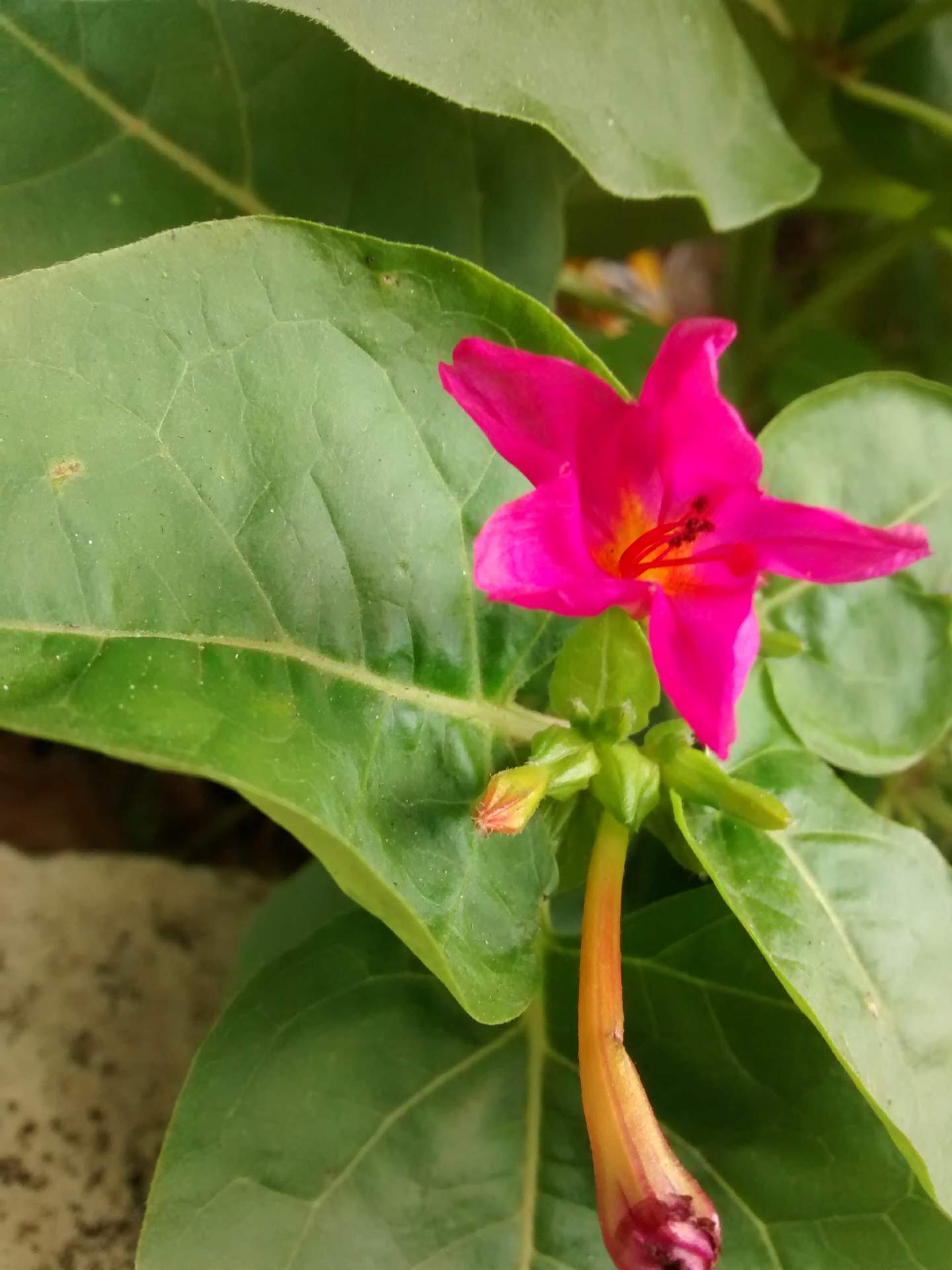
The inflorescence consists of terminal or axillary cymes, composed of groups of 3-7 hermaphroditic, aromatic and fragrant flowers, which open during twilight or nighttime hours. The calyx is replaced by an involucre formed by 5 triangular and acute bracts, fused at the base, 9-13 mm long. The petaloid perianth has the shape of a narrow funnel-shaped tube 25-50 mm long, pubescent, with a wide and pentagonal lobe. The flower colors can vary greatly even on the same plant and include shades of white, pink, red, fuchsia, yellow and variegated (spotted). The number of petals is 5, as are the stamens, which protrude from the perianth tube and have oval anthers.
The fruit is an oval, wrinkled and warty achene, about 7-9 mm long and black at maturity, wrapped by an accrescent involucre derived from the base of the flower.
Habitat and distribution
Native to South America, probably from Peru or Mexico, Marvel Of Peru is today an invasive neophyte species widely naturalized in Italy and the Mediterranean. In Italy it is present practically throughout the territory, from the plains up to 600 meters altitude, where it grows in fresh, well-drained and nutrient-rich soils. It is commonly found in anthropized environments such as flowerbeds, gardens, roadside edges and disturbed soils, often colonizing abandoned or cultivated areas.
The species prefers sunny or partially shaded exposures and adapts to various soil types, provided they are not excessively dry or poor.
Flowering period
Flowering extends from May to October, with greater intensity in the warm seasons. The flowers open mainly in the late afternoon and nighttime hours, remaining open all night and often fading in the early hours of the following morning. In more temperate or subtropical climates, flowering can begin already in spring (from October to April in warmer areas).
Ecology and pollination
Marvel Of Peru is mainly pollinated by nocturnal insects, particularly moths belonging to the family Sphingidae, attracted by the intense fragrance and vivid coloration of the flowers during twilight and nighttime hours. The protruding stamens facilitate contact with pollinating insects.
Seed dispersal occurs through the achene fruits enclosed in the accrescent calyx, which can be accidentally transported by animals or humans, contributing to the spread of the species in anthropized environments.
Curiosities and traditional uses
Mirabilis jalapa has been the subject of numerous genetic studies for its peculiar inheritance of hereditary traits, particularly for the chromatic variability of the flowers which does not always follow classical Mendelian rules. Carl Correns, one of the pioneers of genetics, used this species to demonstrate cytoplasmic inheritance.
Traditionally, the plant has been used in phytotherapy for its laxative properties, attributed to the similarity of the tubers with those of Ipomea purga, from which a well-known purgative called “jalápa” is extracted. In some South American cultures, Marvel Of Peru has also had ornamental and ritual uses.
In Italy and the Mediterranean basin it is mainly appreciated as an ornamental plant for its nocturnal flowering and vivid colors, but it is also considered an invasive species in some areas.
Etymology
The genus name, Mirabilis, derives from Latin and means “admirable” or “wonderful”, referring not so much to the individual beauty of the flowers, but to their uniqueness and chromatic variability which can manifest simultaneously on the same plant. The specific epithet, jalapa, refers to the Mexican city of Jalápa (Xalápa), probably due to the similarity of the plant’s tubers with those of Ipomea purga, native to that region and used for its laxative properties.
The Italian common name “Marvel Of Peru” precisely recalls the characteristic nighttime opening of its flowers, which bloom at dusk and spread an intense fragrance during the evening hours.
Sources
- Acta Plantarum - Flora delle regioni italiane (actaplantarum.org)
- Acta Plantarum - Flora delle regioni italiane (scheda di Anja Michelucci)
- Tela Botanica / H. Coste, Flore descriptive et illustrée de la France
- World Flora Online (WFO)
Characteristics
Scheda botanica
| Famiglia | Nyctaginaceae |
|---|---|
| Fioritura | maggio – ottobre |
| Forma biologica | Bulbous |
| Habitat | with white flowers, with fuchsia flowers, with yellow flowers |
Domande frequenti
- Quando fiorisce Marvel Of Peru?
- Marvel Of Peru fiorisce maggio – ottobre.
- Che tipo di pianta è Marvel Of Peru?
- Marvel Of Peru è una Geophytes (Bulbous) secondo la classificazione di Raunkiaer.
- A quale famiglia appartiene Marvel Of Peru?
- Marvel Of Peru appartiene alla famiglia botanica Nyctaginaceae.
Where I found it (1 sightings)
Classification
- Kingdom
- Plantae
- Family
- Nyctaginaceae
- Full name
- Mirabilis jalapa L.
- Synonyms
- Nyctago jalapa (L.) DC.
- Life form
- Geophytes bulbous
Similar species
Search for species with similar characteristicsFurther reading
Noticed an error in the identification? Write to me
Explore
Other species of Nyctaginaceae