Botanical family
Nyctaginaceae
Description
Botanical characteristics
The Nyctaginaceae are a family of plants that includes perennial herbs, shrubs, and lianas, characterized by a varied habit but generally with opposite leaves. The leaves are simple, entire, and without stipules, a distinctive feature of many species in this family. The flowers are gathered in axillary cymes, often protected by an involucre formed by five bracts, which can sometimes be showy and mistaken for petals.
The perianth is infundibuliform (funnel-shaped), with a long tube contracted above the ovary. The perianth limb is open, folded, and pentalobate, that is divided into five lobes. The family has five stamens, which are generally inserted inside the perianth tube. These characteristics are fundamental to distinguish Nyctaginaceae from other related families.
The fruit is usually an achene, often wrapped or accompanied by structures derived from the bracts or the persistent perianth, which facilitate dispersal.
Distribution and diversity
The Nyctaginaceae family is mainly distributed in the tropical and subtropical regions of the world, with some species extending into temperate zones. Their presence is particularly significant in the Americas, where most of the genera and species are found, but they are also present in other warm climate regions.
The exact number of genera and species varies depending on taxonomic sources, but it is estimated that the family includes several dozen genera and some hundreds of species. This diversity is associated with a variety of life forms and ecological niches, from herbaceous plants to shrubs and lianas.
Main genera and representative species
Among the most important genera of the Nyctaginaceae family stand out:
-
Bougainvillea: Probably the most well-known genus ornamentally, it includes climbing shrubs with very showy colored bracts surrounding the flowers, often white or yellowish. It is widely cultivated in Mediterranean and subtropical gardens.
-
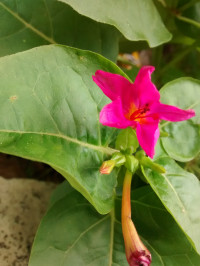
Mirabilis: Includes the species Mirabilis jalapa, commonly known as "four o'clock flower." This perennial herbaceous plant is famous for its fragrant flowers that open at dusk, hence the common name. It is often cultivated as an ornamental plant.
In Italy, Nyctaginaceae are not very represented as spontaneous species, but some cultivated or naturalized species can be observed in gardens and urban areas, especially Bougainvillea.
Etymology
The name of the family derives from the type genus Nyctaginia, which in turn originates from the Greek "nyktos" (νύκτος) meaning "night." This reference is probably linked to the behavior of some species such as Mirabilis jalapa, which opens its flowers in the evening or at dusk.
Curiosities and uses
Nyctaginaceae have an important role especially ornamental. Bougainvillea is one of the most appreciated plants for decorating gardens, terraces, and walls, thanks to its colored bracts that create intense and lasting chromatic effects. Mirabilis jalapa, besides its aesthetic value, is also known for its medicinal properties in some folk traditions, although such uses are not widely scientifically documented.
Ecologically, these plants can contribute to soil stabilization and provide food resources to various pollinating insects, especially in warmer regions where they are more widespread.
Sources
- Wikipedia
Species of the family
1 species catalogued
Explore
Other botanical families