Botanical species
Impatiens balfourii
Hook.f.
Balfour's Touch-Me-Not
Description
Morphological description
Annual herbaceous plant, with a scapose habit and height generally ranging between 40 and 120 cm. The stem is ascending, fleshy, glabrous, often reddish at the base, very branched and thickened at the nodes. It has rooting ability at the base, providing stability to the plant.
The leaves are arranged alternately along the stem, without stipules, with a winged petiole 1-2 cm long. The leaf blade is ovate or elliptic-lanceolate in shape, 3 to 7 cm long and 2 to 5 cm wide, with an acuminate apex. The margin is toothed, with 20-40 small teeth per side, each ending in a small reddish gland. The leaves have a prominent central vein with 8-13 pairs of lateral veins.
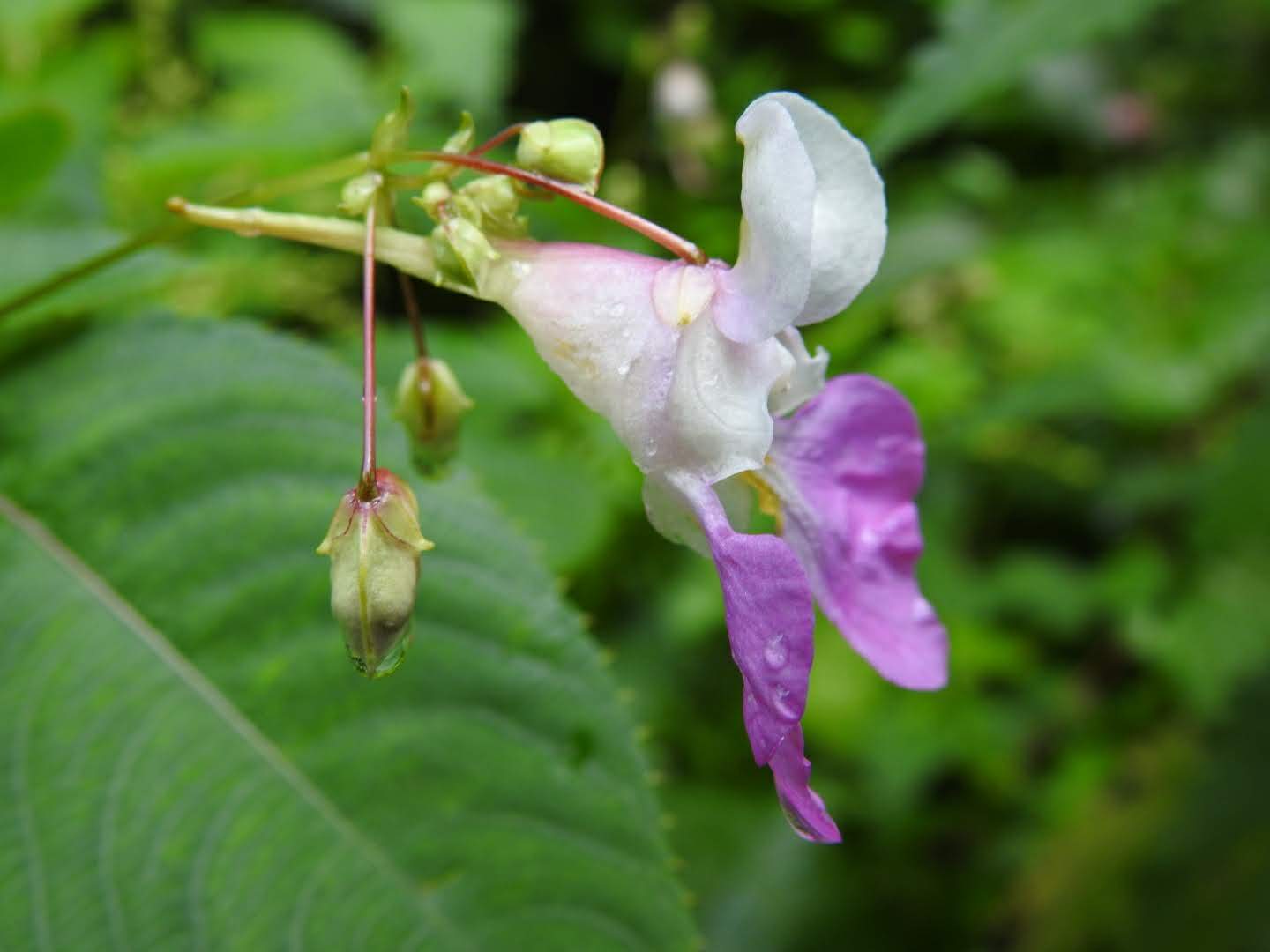
The inflorescence consists of axillary racemes, more or less corymbiform, bearing 3 to 8 flowers, supported by thin peduncles up to 10 cm long. The flowers are hermaphroditic, zygomorphic, composed of 5 sepals and 5 petals, with a 4-cyclic and 5-merous structure. The total length of the flower, including the nectar spur, is about 30-40 mm.
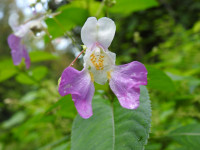
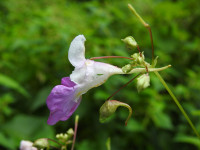
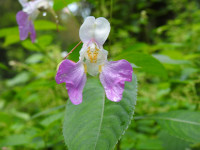
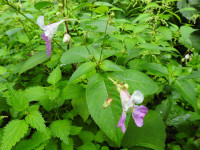
The flower colors vary from white to pale pink to purple, with a characteristic bicolor pattern: the front part (upper petal) is white-pink, while the lateral petals, often fused two by two, have a dark pink or violet hue. The throat of the flower is dotted with yellow. The spur is conical, straight or slightly curved, 12 to 18 mm long, and serves for nectar production.
The stamens (5) have fused anthers that surround the gynoecium, formed by 5 carpels united in a superior ovary. The style and stigma are very reduced.
The fruit is a glabrous, elongated polyspermous capsule (20-25 mm long, about 2 mm in diameter), which explosively dehisces at maturity, projecting the seeds up to 6 meters away, facilitating dispersal. The capsule has clearly visible longitudinal ribs.
The root system is rhizomatous at the base, with the ability to root also along the lower stem.
Habitat and distribution
Native to Asia, the species is now naturalized and rapidly expanding in many areas of Italy and the Mediterranean, where it often behaves as a weed. It preferably grows in cool and humid environments, such as riverbeds, uncultivated lands, road edges, and disturbed areas, typically between 100 and 600 meters of altitude.
It prefers well-drained but moist soils, with exposure from partially shaded to full sun. Its easy rooting ability and rapid growth make it competitive especially in anthropized or semi-natural areas.
Flowering period
Flowering generally extends from July to October, with possible local variation depending on climate and altitude. Under favorable conditions, flowering can start as early as the end of June and continue until the first autumn frosts.
Ecology and pollination
The plant is pollinated by pollinating insects, particularly bees and bumblebees, attracted by the nectar production contained in the spur. The flower morphology, with a zygomorphic shape and nectar spur, is adapted to entomophilous pollination, ensuring effective pollen transfer.
Seed dispersal occurs through an explosive mechanism of the capsule, which opens at the slightest touch, launching the seeds at a distance, favoring colonization of new habitats. This system, combined with rapid growth and rooting ability, contributes to the species' spread and invasiveness.
Curiosities and traditional uses
No traditional medicinal or food uses are documented for this species, unlike other Impatiens such as Impatiens noli-tangere or Impatiens glandulifera. Impatiens balfourii was mainly introduced for ornamental purposes, cultivated in greenhouses or outdoors as an annual, thanks to its showy and colorful flowers.
The genus name derives from the “impatient” behavior of the capsule, which suddenly opens at the slightest touch, launching the seeds far away.
Etymology
The scientific name of the genus, Impatiens, derives from the Latin "impatiens" (intolerant, impatient), referring to the explosive opening of the capsule. The specific name "balfourii" is a tribute to the English botanist John Hutton Balfour (1808-1884), who contributed to the study of Asian flora.
In Italian the species is known as “Balfour's Touch-Me-Not” or “Impaziente di Balfour”, recognizing both its belonging to the balsams group and its link to the botanist.
Sources
- Prof. S. Pignatti, Flora d'Italia, Edagricole, 1982
- Acta Plantarum - Flora delle regioni italiane (scheda di Marinella Zepigi)
- Tela Botanica / H. Coste, Flore descriptive et illustrée de la France
- World Flora Online (WFO)
Characteristics
Where I found it (6 sightings)
Classification
- Kingdom
- Plantae
- Family
- Balsaminaceae
- Full name
- Impatiens balfourii Hook.f.
- Synonyms
- Impatiens insignis auct., non DC.; Impatiens insubrica Beauverd; Impatiens mathildae Chiov.
- Life form
- Terofite scapose
Similar species
Search for species with similar characteristicsFurther reading
Noticed an error in the identification? Write to me
Explore
Other species of Balsaminaceae