Botanical species
Hydrocotyle vulgaris
L.
Marsh Pennywort
Description
Morphological description
It is a perennial herbaceous plant, characterized by a creeping habit with horizontal rhizoid underground stems, whitish and fragile, extending up to one meter in length and rooting at the nodes. The plant height generally varies from 5 to 30 cm, although it can occasionally reach 100 cm.
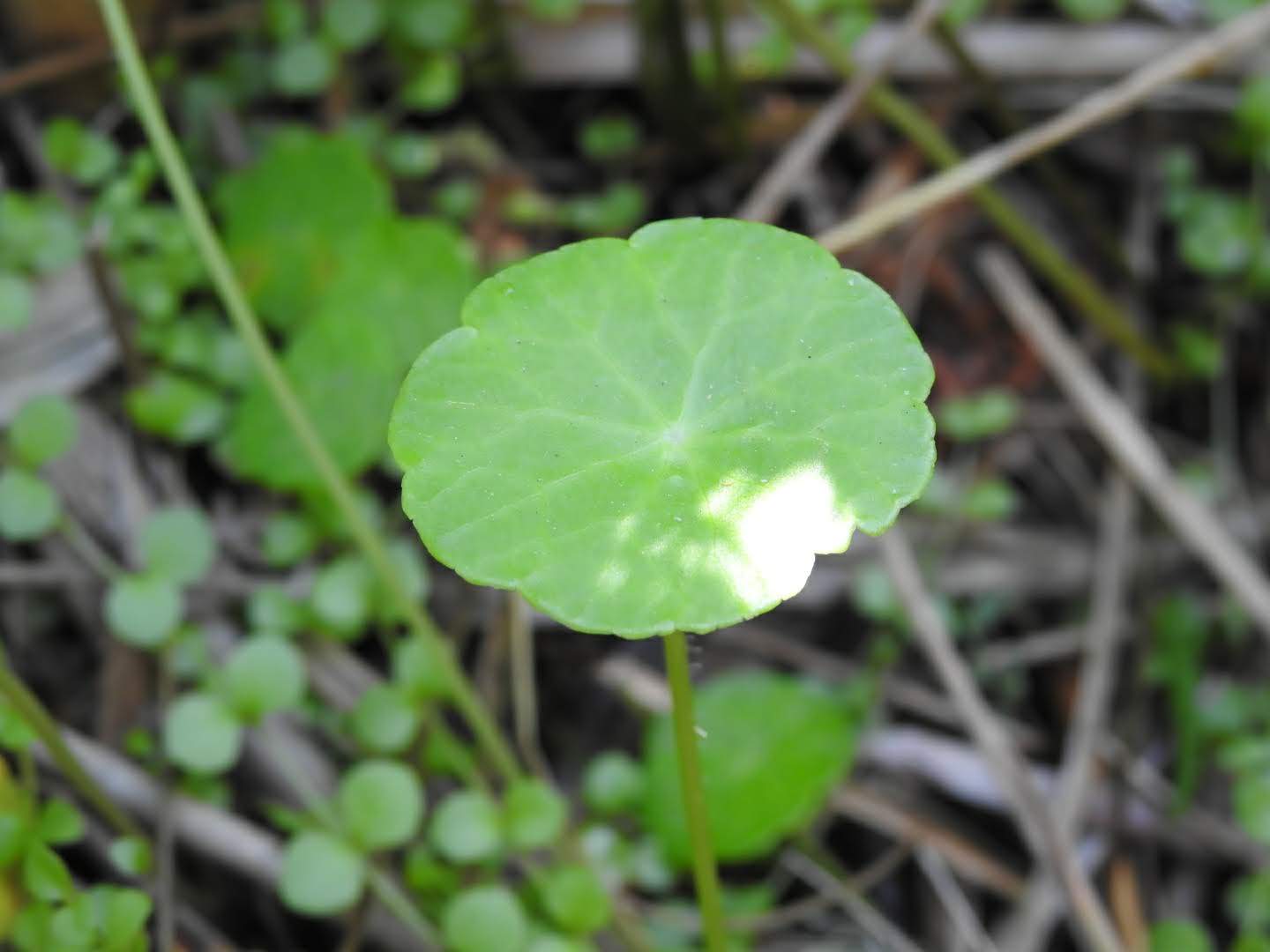
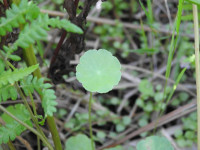
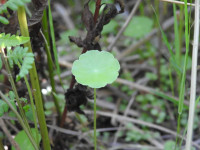
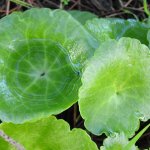
The leaves are orbicular, peltate (i.e., with the petiole inserted at the center of the blade), herbaceous and waxy, with sizes ranging from 1.5 to 6 cm in diameter, although commonly they measure between 3 and 4 cm. They have 7 to 9 palmate veins radiating from the center, with crenulate margins and shallow lobes, giving the leaf a rounded shape with slight indentations. The lower surface is reticulated and sometimes presents scattered patent hairs especially on the upper part of the petiole, which is thin, erect, and can reach a length of 5-10 cm.
The flowers are small, about 1 mm in diameter, hermaphroditic and subsessile, grouped in subcapitate inflorescences or glomerules (contracted umbel-like clusters), composed of 4-6 flowers each. These clusters are arranged on erect peduncles, shorter than the leaf petioles, emerging at the base of the leaves. The corolla consists of five petals colored white, white-greenish or pale pink, while the calyx has five small teeth. The five stamens are visible and the ovary is inferior with two bilocular styles.
The fruit is a suborbicular diachene (schizocarp), flattened, about 2 mm long, with about ten raised dorsal ribs. The surface has red or black papillae on the valleculae, which may facilitate dispersal.
The root system consists of a superficial rhizome, which develops horizontally in the substrate and allows the plant to easily expand through rooting at the nodes.
Habitat and distribution
Marsh Pennywort prefers wet and marshy environments, such as swamps, sphagnum bogs, muddy places and ditches, favoring moderately acidic substrates. It typically grows from flatland up to about 1000 meters above sea level, in environments typical of sub-Mediterranean and sub-Atlantic zones.
In Italy its presence is rather rare and localized, with sporadic and often extinct reports in regions such as Veneto, Friuli, Emilia, the Susa Valley, Tuscany, Umbria, Lazio, Campania and Sicily. It is also present in Corsica and more generally in the European-Caucasian area.
The habitat is generally characterized by wet or submerged soils, often with stagnant or slow-flowing waters, where the plant firmly anchors itself thanks to the rhizome.
Flowering period
Flowering mainly occurs between May and July. In some areas it can be a sporadic and inconspicuous event, as the flowers are very small and hardly visible, and the plant tends to flower rarely. No significant geographical variations in the flowering period are known.
Ecology and pollination
Marsh Pennywort, like many plants of wet environments, produces small and inconspicuous flowers, which tend not to directly attract showy pollinating insects. Pollination probably occurs through small pollinating insects, such as aphids or gnats, attracted by the inconspicuous flowers. A component of self-pollination is not excluded, given the low visibility and frequency of flowering.
Seed dispersal occurs through diachenes equipped with papillae, which facilitate adhesion and transport in wet environments. The plant also spreads through the creeping rhizome, which allows it to effectively colonize extensions of wet ground.
Curiosities and traditional uses
Historically, Marsh Pennywort was considered in folk medicine useful for expelling kidney and bladder stones. It was appreciated for its sudorific, diuretic and purifying properties, although such uses are today little documented in modern phytotherapy.
The flowers of this species were long considered absent, as they are extremely small and hardly visible, so much so that until the end of the 16th century it was thought that the plant did not flower. Flowering is indeed rare and inconspicuous.
There are no traditional food uses or significant references in folklore related to this plant.
Etymology
The genus name derives from Greek: "hýdor" means "water" and "kotýle" or "kotýlis" indicates a "small bowl" or "cup", referring to the aquatic environment in which the plant grows and the concave shape of its leaf blade.
The specific epithet "vulgaris" is a Latin term meaning "common", alluding to the originally fairly wide distribution of the species in Europe.
The Italian common name "soldinella acquatica" refers to the small size of the plant and its predominantly aquatic habitat.
Sources
- Prof. S. Pignatti, "Flora d'Italia"
- Acta Plantarum - Flora delle regioni italiane (scheda di Anja Michelucci)
- World Flora Online (WFO)
Characteristics
Scheda botanica
| Famiglia | Araliaceae |
|---|---|
| Fioritura | maggio – luglio |
| Forma biologica | Rhizomatous |
| Habitat | creeping plant |
Domande frequenti
- Quando fiorisce Marsh Pennywort?
- Marsh Pennywort fiorisce maggio – luglio.
- Che tipo di pianta è Marsh Pennywort?
- Marsh Pennywort è una Geophytes (Rhizomatous) secondo la classificazione di Raunkiaer.
- A quale famiglia appartiene Marsh Pennywort?
- Marsh Pennywort appartiene alla famiglia botanica Araliaceae.
Where I found it (7 sightings)
Classification
- Kingdom
- Plantae
- Family
- Araliaceae
- Full name
- Hydrocotyle vulgaris L.
- Life form
- Geophytes rhizomatous
Similar species
Search for species with similar characteristicsNoticed an error in the identification? Write to me
Other species of the same family
Araliaceae
Explore
Other species of Araliaceae