Botanical species
Gentiana pneumonanthe
L.
Marsh Gentian
Description
Morphological description
Perennial herbaceous plant generally 20 to 50 cm tall, with occasional specimens reaching up to 80 cm. The stem is erect, simple or sparsely branched, cylindrical and slightly compressed on the sides, sometimes winged and glabrous, with scales present in the basal part and leaves mainly in the upper part. It does not have a basal rosette.
The leaves are opposite, sessile, lanceolate-linear, typically 3-6 cm long and 3-4.5 mm wide. They are one-nerved, with margins slightly revolute downward, often curved and keeled, with an obtuse apex. The lower leaves are smaller and almost scale-like.
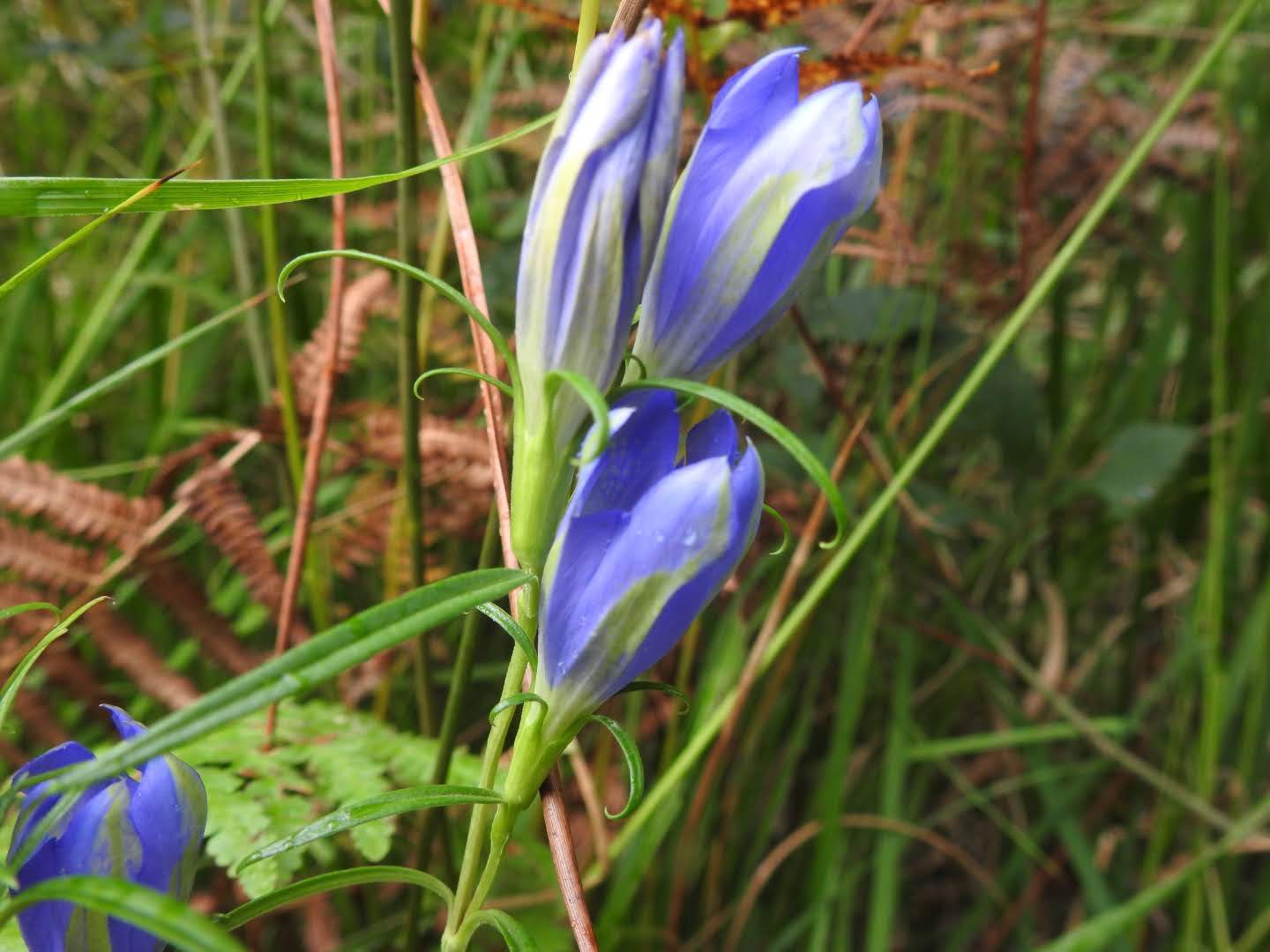
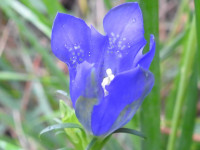
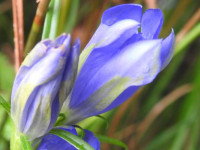
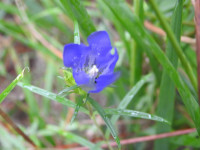
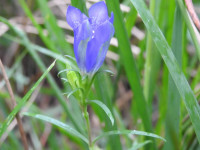
The flowers are generally 3-6 per individual, but can reach up to 10, arranged in the axils of the upper leaves; the upper ones are sessile, while the lower ones are pedunculate with peduncles 1-2 cm long. The calyx has a narrow tube 5-7 mm long, divided about halfway into 5 lanceolate-linear teeth 6-8 mm long. The corolla is an intense blue-violet, with a conical or narrow bell-shaped tube 2.5-5 cm long, opening in the upper quarter into 5 acute, ovate, and denticulate lobes, slightly spreading. Inside, the corolla shows greenish bands dotted with light green, with a whitish base and small green dots often surrounded by a whitish halo.
The stamens have pubescent filaments, with anthers fused together. The fruit is an ellipsoid capsule, pedunculate (peduncle about 1.5 cm), 16-20 mm long and 3-4 mm wide, opening in the upper half to release numerous finely reticulated seeds, not winged and brown-grayish in color.
The root system consists of a woody, cylindrical, vertical root, white-yellowish in color, about 2-3 mm in diameter.
Habitat and distribution
This species is typical of wet and peaty environments, preferring marshy meadows, molinia grasslands, and peat bogs without running water. It grows mainly in hilly and submontane areas, up to medium-high altitudes, widespread throughout the Alpine arc and in some areas of the Apennines, including the Abruzzo region (Piano delle Cinquemiglia). It is present in various Italian regions but is now considered rare and strongly declining due to reclamation and transformation of original marsh habitats.
At the Mediterranean level, it is a Eurosiberian species, typical of the temperate-cold regions of Eurasia, with sporadic and localized presence.
The preferred soil is moist, peaty, with a high water retention capacity, usually in shady or semi-shady environments with exposure ranging from partial shade to full sun.
Flowering period
Flowering extends from June to October, with a peak in the summer months. The duration and intensity of flowering may vary slightly depending on latitude and altitude but generally remain within this time frame.
Ecology and pollination
Marsh Gentian is mainly pollinated by pollinating insects, particularly butterflies and bees, attracted by the intense color of the flowers and their particular shape. The narrow bell-shaped corolla may favor the entry of medium-small sized insects that can reach the nectar.
The seeds are dispersed at maturity by falling from the dehiscent capsule; they are not equipped with wings or special structures for long-distance dispersal, so spread occurs mainly locally, facilitated by stagnant waters in wet habitats.
Curiosities and traditional uses
The Italian common name “genziana mettimborsa” has ancient origins and a symbolic meaning linked to the medicinal value attributed to the plant. According to local traditions, the Marsh Gentian was considered a precious plant, to be kept as a treasure in bags, for its numerous therapeutic virtues.
The root of the plant contains bitter glucosides, active principles known to stimulate gastric secretion and used in the preparation of bitters and digestive tonics. In folk medicine, the roots were used as antipyretics and to treat gastric disorders, exploiting the tonic and bitter properties of the plant.
Historically, the species was widespread in traditional medicine especially in Alpine and Apennine areas, but its use today is limited and mainly of herbal or phytotherapeutic interest.
Etymology
The scientific name of the genus derives from Gentius, king of the Illyrians who lived in the 2nd century BC, to whom Pliny attributes the discovery of the medicinal properties of gentians. The specific name “pneumonanthe” derives from Greek: “pneuma” (wind, breath) and “anthos” (flower), translatable as “flower of the wind”, probably referring to the delicate bearing and the open and windy habitat of the plant.
The Italian common name “mettimborsa” refers to the traditional consideration of the plant as a “treasure to put in the bag” for its healing virtues, a nickname that underlines its importance in folk medicine and its preciousness.
Sources
- Prof. S. Pignatti, Flora d'Italia
- Acta Plantarum - Flora delle regioni italiane (scheda di Marinella Zepigi)
- World Flora Online (WFO)
Characteristics
Scheda botanica
| Famiglia | Gentianaceae |
|---|---|
| Fioritura | giugno – ottobre |
| Forma biologica | Scapose |
| Habitat | with purple flowers, with blue flowers, Perennial plant |
Domande frequenti
- Quando fiorisce Marsh Gentian?
- Marsh Gentian fiorisce giugno – ottobre.
- Che tipo di pianta è Marsh Gentian?
- Marsh Gentian è una Hemicryptophytes (Scapose) secondo la classificazione di Raunkiaer.
- A quale famiglia appartiene Marsh Gentian?
- Marsh Gentian appartiene alla famiglia botanica Gentianaceae.
Where I found it
The sighting locations of this species are not public for conservation reasons.
Classification
- Kingdom
- Plantae
- Family
- Gentianaceae
- Full name
- Gentiana pneumonanthe L.
- Life form
- Hemicryptophytes scapose
Similar species
Search for species with similar characteristicsFurther reading
Noticed an error in the identification? Write to me
Other species of the same family
Gentianaceae
Explore
Other species of Gentianaceae