Botanical species
Centaurium erythraea
Rafn
European Centaury
Description
Morphological description
Biennial or annual herbaceous plant, with an erect habit and height varying between 10 and 60 cm. The stem is generally simple, rarely branched at the base or in the middle, while branching is more frequent in the upper part; it is glabrous, quadrangular in section with about 6 prominent sub-winged ribs. The root system is taproot, deep.
The basal leaves form a persistent rosette, are sessile with an oblanceolate, elliptical or obovate blade, on average 3-5 cm long and 1-1.5 cm wide, with entire margin and 3-7 well-marked parallel veins. The cauline leaves are opposite, sessile, narrower and lanceolate or oblanceolate, smaller than the basal ones and often more lanceolate or linear.
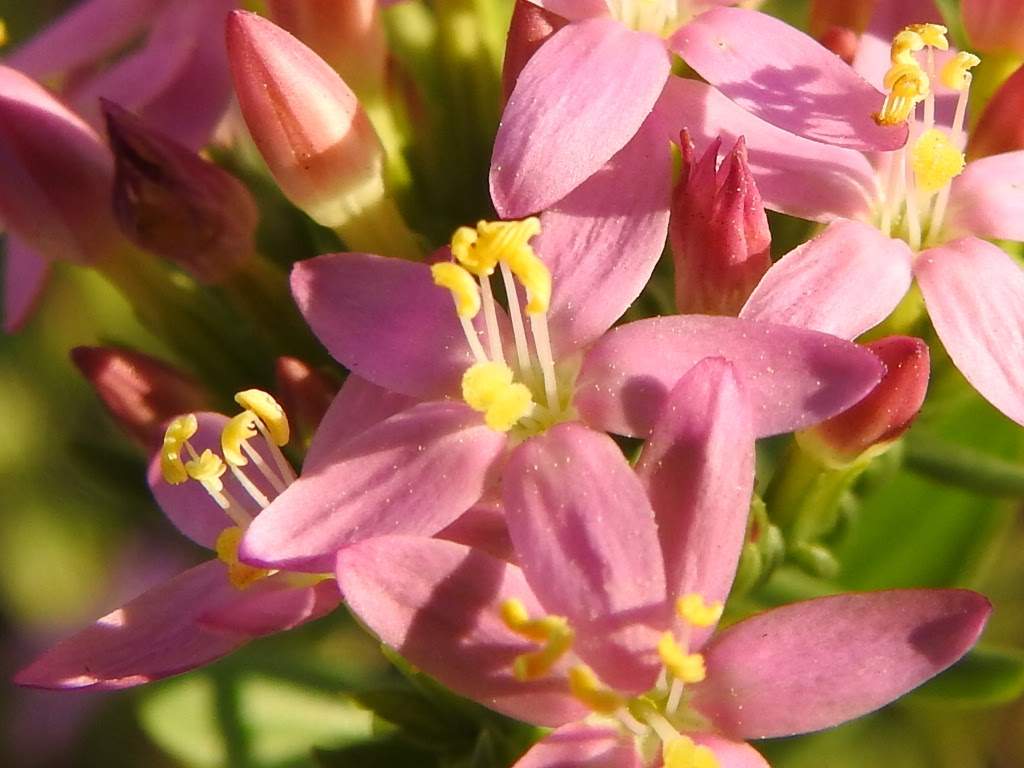
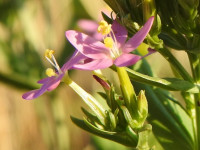
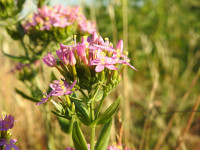
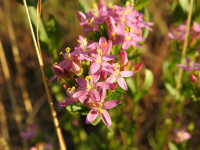
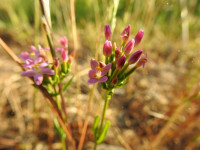
The inflorescence is terminal, corymbose or corymb-umbelliform, often leafy with bifurcate cymes. The flowers are pentamerous, rarely tetramerous, with a funnel-shaped corolla of pink color, which can vary from pale pink to intense pink, rarely white. The corolla is formed by five oval petals with pointed apex, 5-6 mm long, generally shorter than the corolla tube, which measures between 6 and 10 mm. The calyx is 4-6 mm long, with five strap-shaped, linear and acuminate lobes, about half or three quarters the length of the corolla tube, with five prominent angles and evident ribs.
The stamens are five, with yellow anthers about 1.5 mm long that coil spirally after dehiscence. The style is single, with a strongly bilobed and deciduous stigma. The fruit is a cylindrical or fusiform capsule, about 10 mm long, with a thin and papery wall, composed of two locules containing numerous small, globose seeds, brown in color with a reticulated and papillose surface.
The entire plant has a very bitter taste, due to the presence of bitter compounds such as the glucoside eritaurine, gentiopicrine and other active principles typical of Gentianaceae.
Habitat and distribution
Thermophilic species, widespread throughout the Italian territory from the plains to the high hills, generally up to 1500 m altitude. It prefers sunny or slightly shaded environments, frequently growing in forest clearings, glades, dry meadows, path margins and sandy or well-drained soils.
It is common in Mediterranean regions and much of temperate Eurasia, with presence also in North Africa. In Italy, besides the peninsula, it is widespread in the major islands, particularly Sardinia and Sicily, which represent a center of genetic variability for the species.
Flowering period
Flowering occurs mainly from May to September, with possible variations related to altitude and latitude. In general, in warmer climates and Mediterranean areas flowering can start as early as May, while in cooler zones it extends until September.
Ecology and pollination
The species is mainly pollinated by pollinating insects that visit the flowers for nectar and pollen, attracted by the bright pink color and the funnel-shaped form of the corolla. The flowers open only during daylight hours and close by noon or in case of cloud cover, a behavior that regulates pollination according to environmental conditions.
Seed dispersal occurs through the falling of the capsule, which opens releasing the small papillose seeds, favoring limited short-distance propagation, but the species is also able to expand thanks to its genetic variability and adaptability to different habitats.
Curiosities and traditional uses
The common name “European Centaury” recalls the popular tradition linked to the mythological figure of the centaur Chiron, who was said to have discovered the therapeutic virtues of the plant. Historically, the plant was known as “fel terrae” (bile of the earth) for its intense bitter taste.
The plant has long been used as a popular and medicinal remedy, especially for its digestive, stomachic, tonic, carminative and febrifuge properties. In the past, it was employed as a substitute for quinine in the fight against malaria, particularly in Southern Italy. The leaves and flowering tops are collected and dried to prepare decoctions, infusions and mother tinctures.
Some traditional uses include the use of crushed green leaves to disinfect wounds and as a healing agent, as well as being used as a post-shampoo treatment for hair care. However, an overdose can cause gastrointestinal irritation, vomiting and diarrhea.
During the Middle Ages, the plant was widely cultivated in abbey gardens and by the Gauls for its therapeutic virtues. Today it is also used in the preparation of vermouth, a liqueur with eupeptic effects on gastric secretion.
Etymology
The genus name “Centaurium” derives from John Hill and refers to the small “Centaurea minor” cited by Bauhin, recalling the mythological figure of the centaur Chiron, who according to legend used this plant for its medicinal properties.
The specific name “erythraea” derives from the Greek “erythros”, meaning “red”, alluding to the color of the flowers, which vary from bright pink to pale pink. The Italian common name “centaurea maggiore” reflects popular tradition and the resemblance to other species of the genus Centaurea, although it belongs to a different family (Gentianaceae).
Sources
- Prof. S. Pignatti, "Flora d'Italia"
- Acta Plantarum - Flora delle regioni italiane (scheda di Nino Messina)
- Tela Botanica / H. Coste, "Flore descriptive et illustrée de la France"
- World Flora Online (WFO)
Characteristics
Scheda botanica
| Famiglia | Gentianaceae |
|---|---|
| Fioritura | maggio – settembre |
| Forma biologica | Biennials |
| Habitat | with pink flowers |
Domande frequenti
- Quando fiorisce European Centaury?
- European Centaury fiorisce maggio – settembre.
- Che tipo di pianta è European Centaury?
- European Centaury è una Hemicryptophytes (Biennials) secondo la classificazione di Raunkiaer.
- A quale famiglia appartiene European Centaury?
- European Centaury appartiene alla famiglia botanica Gentianaceae.
Where I found it (8 sightings)
Classification
- Kingdom
- Plantae
- Family
- Gentianaceae
- Full name
- Centaurium erythraea Rafn
- Life form
- Hemicryptophytes biennials
Similar species
Search for species with similar characteristicsFurther reading
Noticed an error in the identification? Write to me
Other species of the same family
Gentianaceae
Explore
Other species of Gentianaceae