Botanical species
Blackstonia perfoliata
(L.) Huds.
Yellow-Wort
Description
Morphological description
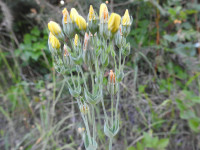
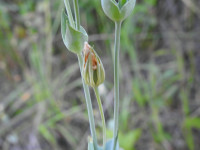
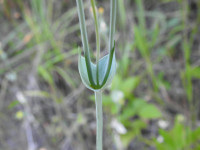
Annual or perennial herbaceous plant, generally 10 to 50 cm tall, characterized by an erect, robust, glabrous and glaucous stem, which can be simple or branched in the upper part. The stem surface is smooth and slightly waxy, giving a bluish or gray-green appearance. The leaves are opposite, sessile and generally fused at the base around the stem, giving a perfoliate appearance, from which the specific name derives. The basal leaves are ovate-lanceolate in shape, while the cauline leaves are more triangular or lanceolate, with entire margins and often mucronate. The sizes range from 6 x 12 mm for the basal leaves to 8-14 x 15-26 mm for the median ones, which are generally from one-sixth to one-third the length of the internodes.
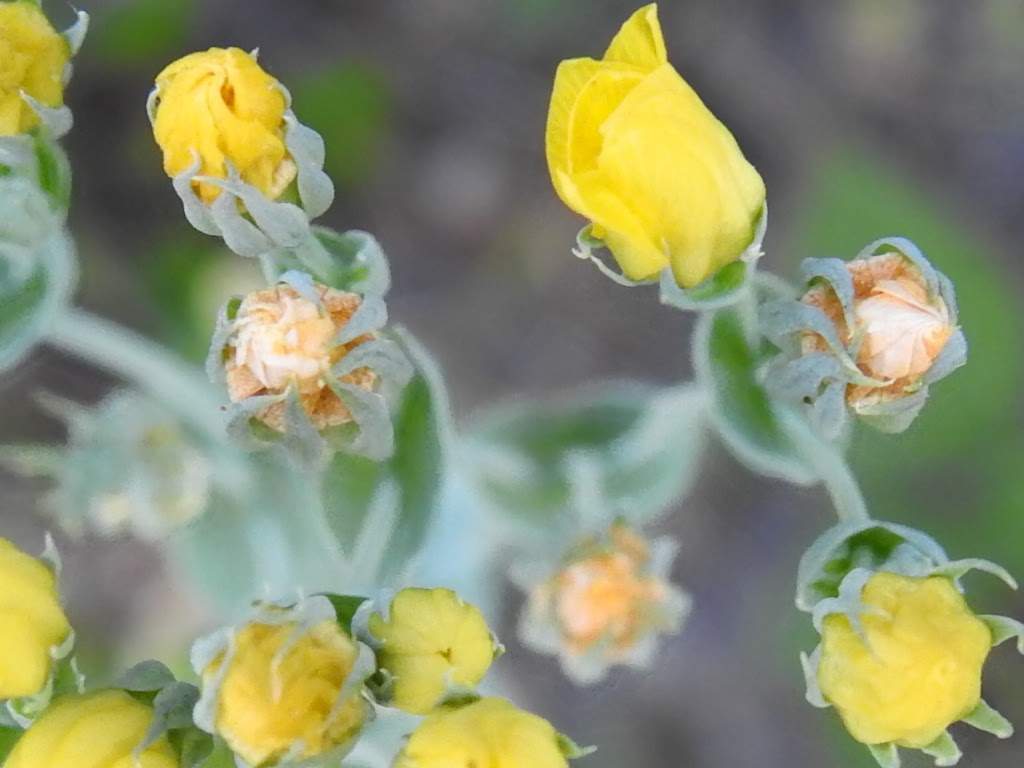
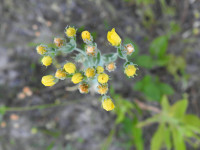
The flowers are arranged in terminal inflorescences, more or less forked, with peduncles 2-4 cm long. The corolla is funnel-shaped and about 10-15 mm in diameter, bright yellow tending to yellow-green, with 6-8 lobes arranged radially and lobed with often twisted margins in the bud. The calyx is deeply divided into linear lobes, about 9-10 mm long, with a prominent median nerve and separated almost to the base. The androecium includes 6-10 stamens with anthers from oblong to linear that do not twist after dehiscence. The style is filiform and deciduous, with a bilobed stigma.
The fruit is an ellipsoid capsule, 6-10 mm long, dehiscent by two valves (septicidal), surrounded by the persistent calyx and the withered corolla. The seeds are numerous, small, with a reticulate-alveolate surface and brown-black coloration. The root system is typical of Mediterranean herbaceous plants, with fibrous roots but not particularly developed.
Habitat and distribution
This species has a predominantly eurymediterranean distribution, with a range extending along the Mediterranean coasts and reaching north and east, also including some temperate continental areas. In Italy it is present in several regions, preferably growing in humid habitats or on clayey and sandy soils, such as depressions, wet meadows, pine woods and road edges. It is common up to an altitude of about 1400 meters above sea level.
It prefers sunny or partially shaded exposures, with well-drained substrates but with some capacity to retain moisture. It frequents transitional environments between wet and dry areas, such as clearings and forest edges or disturbed areas.
Flowering period
Flowering occurs between May and August, with a possible extension until September in some more southern areas or with favorable microclimates. The flowering period is fairly constant throughout the Mediterranean range, but may undergo slight altitudinal or climatic variations.
Ecology and pollination
The plant is mainly pollinated by pollinating insects, attracted by the bright yellow coloration of the flowers and their funnel-shaped corolla which facilitates access to nectar and pollen. Among the pollinators are various hymenopterans (bees, bumblebees) and other phytophagous insects that visit the flowers to feed.
Seed dispersal occurs through the dehiscence of the septicidal capsules, which open releasing the seeds onto the surrounding soil. The reticulate surface of the seeds may favor some degree of anchoring to the substrate, while the presence of the persistent calyx could aid in secondary dispersal by wind or animal passage.
Curiosities and traditional uses
The plant is known to contain a bitter glycoside called genziopicrin, which gives it bitter-tonic properties similar to those of Genziana lutea. Traditionally, in folk medicine, it was used as an infusion to stimulate appetite and aid digestion.
In the past, Yellow-Wort was also used as a source of natural dye for fabrics, thanks to the yellowish pigmentation of the flowers, although this use has now fallen into disuse.
Despite its medicinal properties, it is important to emphasize that pharmaceutical and food uses are for informational purposes only and do not replace official medical or scientific indications.
Etymology
The genus name derives from the 18th-century English botanist James Blackstone, to whom the denomination is dedicated. The specific name "perfoliata" refers to the characteristic of the cauline leaves, which are almost completely fused at the base around the stem, giving a perfoliate appearance.
The Italian common name "centauro giallo" recalls the bright color of the flowers and is linked to the popular tradition of associating plants with bitter and tonic powers to the mythological figure of the centaur, symbol of strength and medicine.
Sources
- Prof. S. Pignatti, Flora d'Italia
- Acta Plantarum - Flora delle regioni italiane (scheda di Mirna Medri)
- Tela Botanica / H. Coste, Flore descriptive et illustrée de la France
- World Flora Online (WFO)
Characteristics
Scheda botanica
| Famiglia | Gentianaceae |
|---|---|
| Fioritura | maggio – agosto |
| Forma biologica | Scapose |
| Habitat | with yellow flowers, Perennial plant |
Domande frequenti
- Quando fiorisce Yellow-Wort?
- Yellow-Wort fiorisce maggio – agosto.
- Che tipo di pianta è Yellow-Wort?
- Yellow-Wort è una Therophytes (Scapose) secondo la classificazione di Raunkiaer.
- A quale famiglia appartiene Yellow-Wort?
- Yellow-Wort appartiene alla famiglia botanica Gentianaceae.
Where I found it (6 sightings)
Classification
- Kingdom
- Plantae
- Family
- Gentianaceae
- Full name
- Blackstonia perfoliata (L.) Huds.
- Synonyms
- Gentiana perfoliata L.
- Life form
- Therophytes scapose
Similar species
Search for species with similar characteristicsFurther reading
Noticed an error in the identification? Write to me
Other species of the same family
Gentianaceae
Explore
Other species of Gentianaceae