Botanical family
Plumbaginaceae
Description
Botanical characteristics
Plumbaginaceae are a family of angiosperm plants characterized by hermaphroditic, actinomorphic, and pentamerous flowers, that is, composed of five elements for each whorl. The flowers have a calyx formed by five completely fused sepals, which form a membranous and often colored (coralline) structure, persistent also in the fruit. The petals may be fused only at the base, as in the genus Limonium, or form a well-developed tube, as in the genus Plumbago. There are five stamens and five carpels fused into a superior ovary with multiple locules.
The inflorescence appears in spikes of 1 to 5 flowers, organized in panicles or capitula; each spikelet is wrapped by two bracts, externally protected by one or more scales. The fruit is a nut surrounded by the calyx, which takes on an appearance similar to a capsule, often poricidal (with openings for seed dispersal).
The species of the family are mostly suffruticose or herbaceous, adapted to live in arid or saline environments, thanks to the presence of glands that secrete substances such as lime, salt, or resin. The leaves are arranged spirally and lack stipules. Pollination is entomogamous, that is mediated by insects such as lepidoptera and hymenoptera; sometimes self-fertilization occurs. Pollen dimorphism and the presence of heterostyly (different flower forms within the same species) are often observed.
Distribution and diversity
Plumbaginaceae have a cosmopolitan distribution, extending from arctic zones to tropical ones. They are particularly associated with habitats such as steppes, marshes, and marine coasts, environments often characterized by extreme conditions of salinity or aridity.
The family includes numerous genera and species, with a predominance of perennial plants, often shrubby, but also including lianose forms. They are widespread worldwide and many of them are cultivated for ornamental purposes.
Main genera and representative species
Among the best-known genera of the family Plumbaginaceae are:
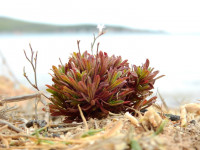
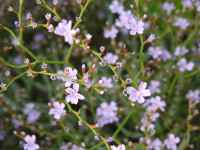
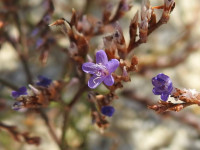
- Limonium: commonly known as statice, it is a genus with flowers often used in floral arrangements due to their long-lasting nature and bright colors. Several species of Limonium are present along the Italian and Mediterranean coasts.
- Plumbago: shrubby or lianose plants with tubular flowers, especially appreciated as ornamental plants in gardens.
In Italy, various species of the genus Limonium are present, often typical of brackish coastal environments. These species play an important role in coastal ecosystems, contributing to soil stabilization and providing resources to pollinators.
Etymology
The name of the family derives from the type genus Plumbago, whose name means “that carries lead” in Latin, probably referring to an ancient medicinal belief or to the color of the flowers of some species.
Curiosities and uses
Plumbaginaceae play a significant ecological role in arid and brackish environments, where they often represent a stable component of the vegetation, contributing to biodiversity and the balance of ecosystems. Many species are appreciated for their ornamental value and are cultivated in gardens and parks for the beauty of their flowers.
Sources
- Wikipedia
Species of the family
3 species catalogued
Explore
Other botanical families